


Short answer: Male loneliness is common and getting more common: in a 2021 national survey, 15% of American men said they had no close friends, about five times the share in 1990. That matters for more than mood. The US Surgeon General’s 2023 advisory links poor social connection to higher risks of heart disease, stroke, dementia and early death. The fix is practical: repeated, scheduled time with the same people, plus honest conversation once trust builds.
Key Takeaways
- About half of US adults report loneliness, and men’s close friendship circles have shrunk sharply since 1990.[1][2]
- A meta-analysis of 148 studies found that people with stronger social relationships had about 50% higher odds of survival over the follow-up period.[3]
- Friendships take time: one study estimated roughly 40 to 60 hours together to become casual friends and over 200 hours to become close friends.[4]
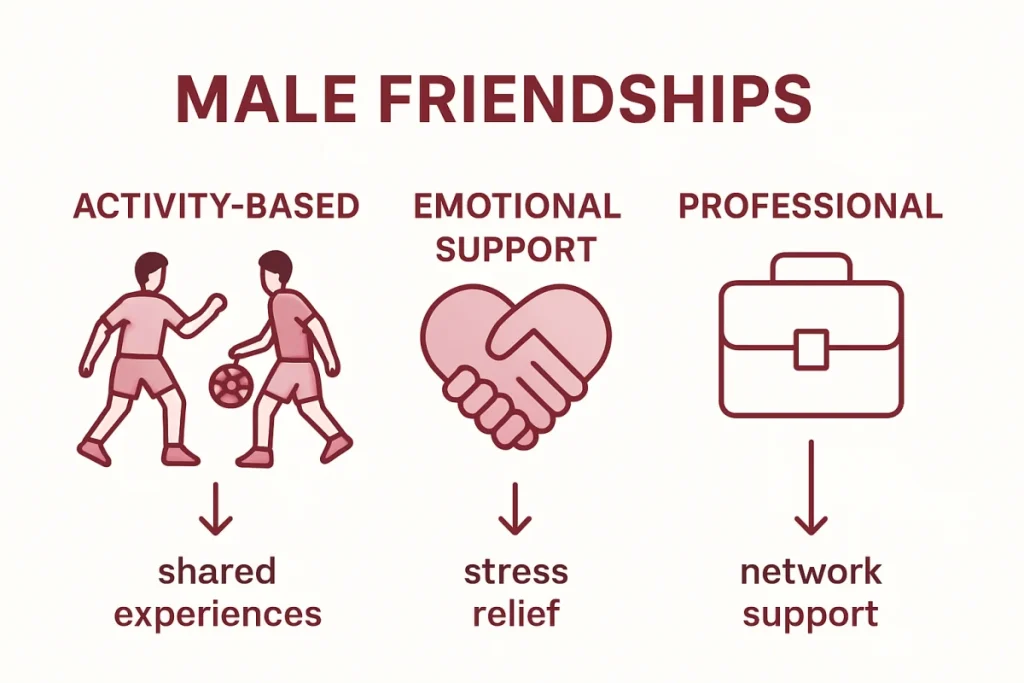
- Men tend to bond side by side through shared activities, which makes recurring activities (a league, a class, a weekly game) the most reliable way to build friendships.
- Loneliness and depression overlap. In men, depression often shows up as irritability, anger, overwork, risk taking or heavier drinking rather than obvious sadness.[6]
- If you are in crisis or thinking about suicide, call or text 988 in the US (free, confidential, 24/7).[7]
What Male Loneliness Is (and What It Is Not)
Loneliness is the gap between the relationships you want and the relationships you have. The CDC describes social connectedness as “the degree to which you have the number, quality, and variety of relationships that you want.”[5] That definition explains why a married man with a busy job and a full calendar can still feel deeply lonely: what is missing is not people around him but people who actually know him.
It also helps to separate two related ideas:
- Social isolation is objective: few contacts, few relationships, little time with others.
- Loneliness is subjective: the painful feeling that your connections are not enough.
Both matter for health, and the Surgeon General’s advisory reports figures for each. A man can have one without the other, which is why counting friends on social media says little about how connected he really is.
How common is it?
The 2023 Surgeon General’s advisory reports that approximately half of US adults experience loneliness, and that in-person time with friends fell from about 30 hours per month in 2003 to about 10 hours per month in 2020.[1] Over the same period, time spent alone rose by about 24 hours per month.
For men specifically, the Survey Center on American Life found what it called a shrinking social circle:[2]
| Measure (US men) | 1990 | 2021 |
|---|---|---|
| Men with no close friends | About 3% | 15% |
| Men with six or more close friends | 55% | 27% |
| Young men who would turn first to friends with a personal problem | 45% | 22% |
Source: Survey Center on American Life, 2021. The 1990 “no close friends” figure is implied by the report’s “fivefold increase.”
Why Loneliness Is a Health Issue, Not Just a Feeling
The strongest evidence comes from large observational studies in humans. They show associations, not proof that loneliness alone causes disease, but the pattern is consistent across many populations.
Longevity
The landmark 2010 meta-analysis by Holt-Lunstad, Smith and Layton pooled 148 studies with 308,849 participants followed for an average of 7.5 years. People with stronger social relationships had about 50% greater odds of survival, and the link was strongest for broad measures of social integration (being part of several groups and roles, not just having one person).[3]
Heart, brain and mood
The Surgeon General’s advisory summarizes the research this way:[1]
- Loneliness and social isolation are associated with a 26% and 29% higher risk of premature death, respectively.
- Poor social relationships are associated with a 29% higher risk of heart disease and a 32% higher risk of stroke.
- Chronic loneliness and isolation can raise dementia risk by about 50% in older adults.
- Lacking social connection can raise the risk of premature death about as much as smoking up to 15 cigarettes a day.
The CDC lists heart disease, stroke, dementia, depression and anxiety among the conditions whose risk social connection can help reduce.[5] Mayo Clinic adds that adults with strong social ties have lower rates of depression, high blood pressure and unhealthy weight, and that friends tend to nudge each other toward healthier habits such as drinking less and moving more.[8]
Why connection might matter physically
Researchers point to several pathways. Friends buffer stress, so the body spends less time in a prolonged stress response. Friends influence behavior: sleep, alcohol, exercise and whether you finally book that doctor’s appointment. And people with support tend to recover better from setbacks such as job loss, divorce or illness.[8] If chronic stress is already a problem for you, our guide to stress symptoms in men covers the warning signs.
Why Men Struggle to Make and Keep Friends
None of these reasons are character flaws. Most are structural, and that means they can be worked around.
- Life gets crowded. Work, children and caring for aging parents push friends down the list. Mayo Clinic names these as the main reasons adult friendships fade.[8]
- Built-in contact disappears. School, sports teams and early jobs supplied friends automatically. After that, nothing schedules friendship for you.
- Moving. A new city can mean starting from zero with no obvious way to meet people.[8]
- Shift in who men lean on. In the 2021 survey, young men were far more likely to turn first to parents or a partner than to friends, a reversal from 1990.[2] When one person carries all of a man’s emotional weight, losing that relationship can leave him with no one.
- Norms about vulnerability. Many men learned that self-control is strength and that talking about feelings is unmanly. Mayo Clinic notes that this same habit causes men to hide depression.[6]
- Friendship simply takes hours. Jeffrey Hall’s research estimated that moving from acquaintance to casual friend took about 40 to 60 hours together, and a close friendship more than 200 hours.[4] Without a recurring reason to be in the same place, few relationships ever reach those numbers.
Midlife can sharpen all of this as careers peak and kids leave home. Our piece on midlife changes in men looks at that stage in more detail.
How to Make Friends as an Adult Man: A Practical Plan
The research on time points to a clear strategy: choose settings where you will see the same people repeatedly, then gradually turn shared time into real conversation. Mayo Clinic’s list of ways to meet people lines up well with this.[8]
| Step | What to do | Why it works |
|---|---|---|
| 1. Reconnect first | Message two old coworkers, teammates or classmates this week and suggest a specific time to meet. | Shared history means you are not starting from zero hours. |
| 2. Join something recurring | Rec league, climbing gym, running club, martial arts class, chess night, trade association, men’s group. | Weekly contact with the same faces adds up to the hours friendships need. |
| 3. Volunteer | Coach youth sports, help at a food bank, join a faith community’s service team. | Shared purpose gives men an easy, side by side way to bond. |
| 4. Be the inviter | Accept invitations, then return them. Suggest coffee, lunch or a game after the activity. | Most people are waiting for someone else to make the first move. |
| 5. Put it on the calendar | A standing monthly poker night, breakfast or golf round. | A default plan removes the “we should hang out sometime” trap. |
| 6. Go one level deeper | Share something real about work, family or health once trust exists, and listen without jumping to advice. | Mayo Clinic notes that opening up and listening well deepen closeness.[8] |
| 7. Keep showing up | Keep commitments, arrive on time, check in between meetups. | Reliability is what turns acquaintances into people you can call. |
Small habits that keep friendships alive
The Surgeon General’s letter in the advisory suggests simple actions anyone can take: answer that phone call from a friend, make time to share a meal, listen without the distraction of your phone, do an act of service and express yourself authentically.[1] None of these require a big personality. They require consistency.
Your own health habits also make connection easier. Poor sleep makes people more irritable and less social, so a steady sleep routine helps more than it seems. Group exercise does double duty as fitness and friendship, and even home bodyweight workouts become social if you do them with a training partner.
When Loneliness Signals Depression
Loneliness and depression feed each other. Isolation can deepen low mood, and depression makes reaching out feel impossible. In men, depression often looks different from the stereotype. Mayo Clinic lists these signs:[6]
- Irritability or anger that gets out of control
- Escaping into work, sports or screens
- Reckless driving or other risky behavior
- Problems with alcohol or drugs
- Headaches, digestive problems or unexplained pain
- Fatigue, sleeping too little or too much, and losing interest in things you used to enjoy
- Conflict in relationships, or controlling behavior
If several of these have lasted two weeks or more, talk to your doctor or a licensed mental health professional. Depression is a medical condition, and effective treatments exist. Friendship helps, but it is not a substitute for care.
If you are thinking about harming yourself: in the US, call or text 988, or chat at chat.988lifeline.org. The 988 Suicide and Crisis Lifeline is free, confidential and available 24/7.[7] Veterans can call 988 and press 1. If you have firearms at home, Mayo Clinic advises unloading them and locking them up or using trigger locks.[6]
Where Supplements Fit (and Where They Do Not)
No supplement can replace friendship, and no capsule fixes loneliness. The habits above are the real work. Ultra Bann is a natural male vitality supplement by DL Bioproducts, taken as one capsule every 2 days, with seven botanicals listed at their exact amounts on the ingredients page. It is meant as one small part of a broader routine, alongside sleep, exercise and time with people who matter to you. You can see it in the Ultra Bann shop. If you are dealing with low mood or depression, see a clinician first.
Frequently Asked Questions
Why is male loneliness increasing?
Survey data point to several trends: less in-person time with friends overall, more time alone, and a shift in who men turn to for support. Between 2003 and 2020, Americans’ in-person time with friends fell from about 30 to about 10 hours per month.[1] Men in particular report fewer close friends than in 1990.[2]
Is it normal for a man to have no friends?
It is more common than many people think: 15% of US men reported having no close friends in 2021.[2] Common is not the same as healthy, though. Given the links between isolation and heart disease, stroke and early death, it is worth treating as something to fix, not something to accept.[1]
How long does it take to make a close friend as an adult?
One study estimated that moving to close friendship took more than 200 hours together, while a casual friendship took roughly 40 to 60 hours.[4] That is why recurring activities work better than one-off events.
Is loneliness as bad as smoking?
The Surgeon General’s advisory states that lacking social connection can increase the risk of premature death about as much as smoking up to 15 cigarettes a day.[1] That comparison is about mortality risk in population studies, not a claim that the two harm the body in the same way.
Where can men find support if they feel isolated?
Start with your doctor, who can screen for depression and refer you. Men’s groups, faith communities, veterans’ organizations and volunteer programs are good places to meet people. In a crisis, call or text 988 in the US.[7]
References
- Office of the US Surgeon General. Our Epidemic of Loneliness and Isolation: The U.S. Surgeon General’s Advisory on the Healing Effects of Social Connection and Community. US Department of Health and Human Services, 2023.
- Cox DA. Men’s Social Circles are Shrinking. The Survey Center on American Life, June 29, 2021.
- Holt-Lunstad J, Smith TB, Layton JB. Social Relationships and Mortality Risk: A Meta-analytic Review. PLOS Medicine, 2010;7(7):e1000316.
- Hall JA. How many hours does it take to make a friend? Journal of Social and Personal Relationships, 2019.
- Centers for Disease Control and Prevention. About Social Connectedness. CDC.
- Mayo Clinic Staff. Male depression: Understanding the issues. Mayo Clinic.
- 988 Suicide and Crisis Lifeline. 988lifeline.org.
- Mayo Clinic Staff. Friendships: Enrich your life and improve your health. Mayo Clinic.
These statements have not been evaluated by the Food and Drug Administration. This product is not intended to diagnose, treat, cure or prevent any disease. This article is for information only and is not medical advice.
Ultra Bann natural male vitality support
1 capsule every 2 days. Free US shipping and a 60-day money-back guarantee on your first order.
See Ultra BannThese statements have not been evaluated by the Food and Drug Administration. This product is not intended to diagnose, treat, cure, or prevent any disease.

