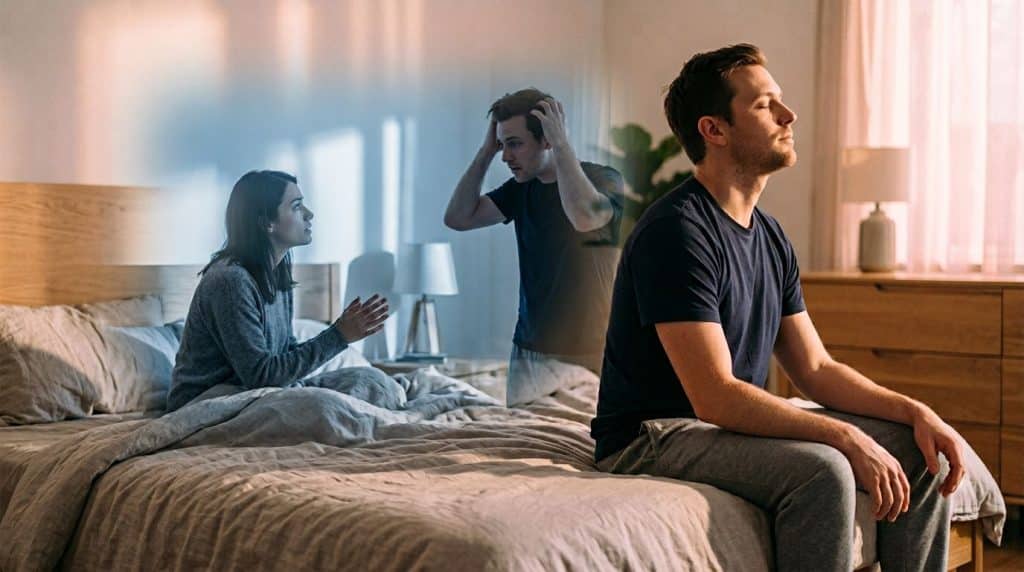
Short answer: If you can get and keep an erection alone (or you still wake up with erections) but lose it with a partner, the pattern often points toward psychological erectile dysfunction, also called psychogenic or situational ED. The erection “hardware” is usually working, and something in the partnered context, most often performance anxiety, stress or relationship strain, is interrupting it. It is still worth seeing a doctor, because physical and psychological causes frequently overlap and erection problems can be an early sign of heart or metabolic disease.
Key Takeaways
- Erections that work alone but fail with a partner are a classic clue that the cause is at least partly psychological, not purely physical.
- Clinicians consider “mixed” erectile dysfunction (physical plus psychological factors) the most common type seen in clinics, so a normal solo response does not rule out a medical cause.
- Performance anxiety is described in the medical literature as the “final common pathway” of psychogenic erectile problems: worry about failing makes failure more likely.
- Preserved night time and morning erections support a psychological cause; specialist testing exists when the picture is unclear.
- Talk therapy, certified sex therapy, couples work and structured exercises such as sensate focus are the core approaches, sometimes combined with medical treatment chosen by a doctor.
- Honest communication with your partner removes a large share of the pressure that keeps the cycle going.

What Psychological Erectile Dysfunction Is
Erectile dysfunction (ED) means having trouble getting or keeping an erection firm enough for sex. Doctors usually sort causes into two broad groups. Organic causes are physical: reduced blood flow, nerve problems, hormonal issues, medication side effects. Psychogenic (psychological) causes come from the brain and emotions: anxiety, stress, depression, relationship conflict, guilt or past experiences.
Mayo Clinic explains that the brain “plays a key role in getting sexually excited,” and lists depression, anxiety or other mental health conditions, stress, and issues with a partner as psychological causes of ED.[1] Arousal starts as a signal from the brain. If that signal is crowded out by worry or self monitoring, the body never fully gets the message, even when blood vessels and nerves are healthy.
Situational versus generalized
Researchers and clinicians often describe psychological ED as either situational or generalized. Situational ED shows up only in certain settings: with a partner but not alone, with a new partner but not a long term one, or during intercourse but not other forms of intimacy. Generalized ED happens across situations. The “fine alone, not with a partner” pattern is the textbook example of a situational problem, and it is one of the strongest hints that the issue is about context rather than plumbing.
Why the two categories overlap
The separation is not as clean as it sounds. A German clinical study of 751 patients argued that the traditional split between psychogenic and organic ED should be replaced by models that consider both dimensions at once, because many men have both.[2] Writing in the Cleveland Clinic Journal of Medicine, psychiatrist Stephen Levine noted that psychogenic cases are seen more often in younger men and organic cases far more often in older men, and that “mixed” ED is the most common type in clinics.[3] If you are younger and this sounds familiar, our guide to ED in young men covers that group specifically.
Why It Happens With a Partner but Not Alone
Solo arousal is private, familiar and free of evaluation. Partnered intimacy adds an audience, timing, expectations and the fear of disappointing someone you care about. That shift can flip the nervous system from a relaxed state that allows arousal into a stress state that works against it.
The performance anxiety loop
Levine describes performance anxiety as the “final common pathway” of psychogenic erectile problems: whatever the original trigger, it ends up as worry about whether the erection will work.[3] Cleveland Clinic sex therapist Theresa Callard-Moore calls it “a vicious cycle”: one disappointing experience becomes something you dread, and next time you are thinking about the last time instead of the moment.[4] Cleveland Clinic estimates that sexual performance anxiety affects up to 25% of men.[4] For a deeper look at this loop, see our article on sexual performance anxiety.
Common psychological triggers
- Relationship tension: Levine identifies anger as “a major cause of inadequate erections because it leads to alienation.”[3]
- Major life stress: job loss, money trouble, separation or divorce.
- Guilt: for example after an affair, or a new relationship after the death of a partner.[3]
- Depression and anxiety disorders: both are linked with erection problems; see depression and erectile dysfunction.
- A new partner: novelty can raise the stakes and the self monitoring.
When a small physical change starts the cycle
Mayo Clinic points out that a “minor physical condition that slows your sexual response might cause worry about keeping an erection,” and that worry then adds to the problem.[1] This is why a man in his 40s or 50s with early vascular changes may notice the problem first with a partner: the physical margin is thinner, and anxiety pushes him over the edge. It is also why a doctor visit matters even when the pattern looks purely psychological.

How Doctors Tell Psychological From Physical Causes
There is no single blood test for psychogenic ED. Clinicians build the picture from your history, an exam and, when needed, targeted tests.
| Clue | Leans psychological | Leans physical |
|---|---|---|
| Onset | Sudden, often tied to an event or new relationship | Gradual, worsening over months or years |
| Situations | Works alone or with some partners, fails in others | Weak in every situation, including alone |
| Night time and morning erections | Usually still present | Often reduced or absent |
| Age and health | More common in younger, otherwise healthy men | More common with age, diabetes, heart disease, smoking |
| Emotional context | Anxiety, stress, relationship conflict, low mood | May have none, though worry often develops later |
These are tendencies, not rules. Many men have features in both columns, which is exactly the “mixed” picture clinicians see most often.[3]
Night time erections as a clue
Healthy men have several erections during sleep, which is why waking up with one is common. Because sleep removes conscious worry, these erections act as a natural test of the physical system. You can read more in our guide to nocturnal penile tumescence. When the history is unclear, specialists can measure sleep erections with a home device. A 2019 review in Sexual Medicine Reviews concluded that this monitoring “is still considered a useful diagnostic tool” for psychogenic ED, and that a normal recording in a man with ED complaints “probably suggests” a psychological cause.[5] The same review warns that results can be affected by depression, smoking, aging, sleep disorders and even dream content, and that night time results do not always match erections during sexual stimulation.[5]
Older research supports a broad approach. A 1987 study in Behaviour Research and Therapy found that no single biological marker reliably separated physical from psychological cases, that men with psychogenic ED consistently underestimated their own erections, and that assessment should include psychological, social and relationship factors, not just physiology.[6]
What a typical visit includes
- A sexual and medical history, including when the problem started and in which situations it happens.
- A review of medications, alcohol, tobacco and other substances.
- Screening for diabetes, high blood pressure, heart disease and depression, which Levine lists as standard checks.[3]
- A physical exam and, depending on findings, blood tests such as glucose, lipids and hormones.
Levine also notes that it is “very helpful to speak with the sexual partner” during assessment, when the couple is comfortable with that.[3]
Therapy Options That Address the Cause
Because the trigger is in the mind and the relationship, the main treatments work there too. Levine argues that doctors should “recognize and try to address the psychological and interpersonal context in which ED exists,” and recommends that physicians “strongly consider a psychotherapist” when medication alone is not enough.[3]
Talk therapy and sex therapy
Cleveland Clinic recommends talk therapy for relationship concerns or past trauma, and a certified sex therapist for sexual concerns specifically.[4] Sex therapists are licensed mental health professionals with extra training in sexual problems. Sessions are conversations; nothing physical happens in the office. Cognitive behavioral approaches help you notice and challenge catastrophic thoughts (“if it fails tonight, the relationship is over”) and reduce the habit of watching yourself during intimacy.
Sensate focus
Sensate focus is a structured sex therapy technique developed by Masters and Johnson. Couples move through a series of non-demanding touching exercises, usually with intercourse taken off the table at first, so attention shifts from performance to sensation. A 2019 critical review in Current Sexual Health Reports concluded that sensate focus “continues to be an effective sex therapy technique.”[7] A therapist usually guides the stages.
Couples work
When anger, distance or trust issues are part of the picture, couples counseling can address the relationship directly. A German clinical study concluded that combined psychosomatic approaches are needed because patients are so varied.[2]
Medical treatment alongside therapy
A doctor may also discuss prescription options, which can help some men break the anxiety loop while therapy works on the cause. Levine stresses that patients should understand these medicines do not create sexual arousal on their own.[3] Which option, if any, is right for you is a decision for you and your clinician.
How to Talk to Your Partner
Silence tends to make things worse. A partner who is left guessing may assume they are no longer attractive or that something is wrong in the relationship, which raises the pressure for both of you. As Cleveland Clinic puts it, “your partner can’t read your mind.”[4]
- Pick a calm moment outside the bedroom, not right after a difficult night.
- Name what is happening plainly: it is about pressure and nerves, not about them.
- Agree to lower the stakes: focus on closeness and pleasure without a goal, and take intercourse off the table for a while if that helps.
- Plan the next step together: a doctor visit, a sex therapist, or both.
Callard-Moore notes that feeling connected and trusting a partner’s good intentions makes it easier to work through the problem together.[4]
Lifestyle Factors, Supplements and When to See a Doctor
Sleep, alcohol, tobacco, weight and fitness affect both mood and blood flow, so they matter in every type of ED. Mayo Clinic lists tobacco use, being overweight, certain medicines, and drug or alcohol use as risk factors, and states that erectile dysfunction “is not a typical part of aging.”[1]
No supplement addresses anxiety, relationship conflict or the thinking patterns behind psychological ED, and none replaces a medical evaluation or therapy. For readers who ask what is in our own product: Ultra Bann is a botanical supplement with seven herbs listed with their amounts, and the full label is on our ingredients page.
See a doctor if
- The problem lasts more than a few weeks or keeps coming back.
- You have diabetes, heart disease, high blood pressure or another condition Mayo Clinic links with ED.[1]
- Erections are weaker in every situation, including alone and in the morning.
- You also have chest pain, shortness of breath on exertion, low mood, or loss of interest in things you used to enjoy.
Mayo Clinic notes that erection problems “can be a sign of a health condition that needs treatment and a risk factor for heart disease.”[1] That alone is a good reason to get checked rather than assume it is all in your head.
Frequently Asked Questions
If I can get hard alone, does that mean my ED is psychological?
It makes a psychological cause more likely, but it does not prove it. Many men have a mix of physical and psychological factors, and a doctor should still check for things like diabetes, high blood pressure and medication effects.
Is situational erectile dysfunction permanent?
Situational ED is usually considered very treatable because the physical system is working. Addressing anxiety, stress and relationship factors, often with a therapist, is the typical path.
Can anxiety really stop an erection?
Yes. Arousal starts in the brain, and Mayo Clinic lists anxiety and stress among the psychological causes of ED. Worry about performance can become self fulfilling, which is why clinicians call performance anxiety the common pathway of psychogenic ED.
What kind of therapist treats psychological ED?
A certified sex therapist, a psychologist or counselor experienced in sexual concerns, or a couples therapist. Your doctor can refer you, and Cleveland Clinic suggests a certified sex therapist for sexual problems specifically.
Does it mean I am not attracted to my partner?
Usually not. The pressure of the situation, not a lack of desire, is the more common explanation. Telling your partner this directly can relieve a lot of tension for both of you.
References
- Mayo Clinic. Erectile dysfunction: Symptoms and causes. mayoclinic.org
- Psychological stress factors in erectile dysfunctions. Causal models and empirical results. Urologe A. 1998;37(5):487-94. PubMed
- Levine SB. Erectile dysfunction: Why drug therapy isn’t always enough. Cleveland Clinic Journal of Medicine. 2003;70(3):241-246. ccjm.org
- Cleveland Clinic Health Essentials. How To Overcome Sexual Performance Anxiety. 2024. health.clevelandclinic.org
- Zou Z, Lin H, Zhang Y, Wang R. The Role of Nocturnal Penile Tumescence and Rigidity (NPTR) Monitoring in the Diagnosis of Psychogenic Erectile Dysfunction: A Review. Sexual Medicine Reviews. 2019. UroToday abstract
- Sakheim DK, Barlow DH, Abrahamson DJ, Beck JG. Distinguishing between organogenic and psychogenic erectile dysfunction. Behaviour Research and Therapy. 1987;25(5):379-390. University of Memphis Digital Commons
- Avery-Clark C, Weiner L, Adams-Clark AA. Sensate Focus for Sexual Concerns: an Updated, Critical Literature Review. Current Sexual Health Reports. 2019;11:84-94. Springer
These statements have not been evaluated by the Food and Drug Administration. This product is not intended to diagnose, treat, cure or prevent any disease. This article is for information only and is not medical advice.
Ultra Bann natural male vitality support
1 capsule every 2 days. Free US shipping and a 60-day money-back guarantee on your first order.
See Ultra BannThese statements have not been evaluated by the Food and Drug Administration. This product is not intended to diagnose, treat, cure, or prevent any disease.