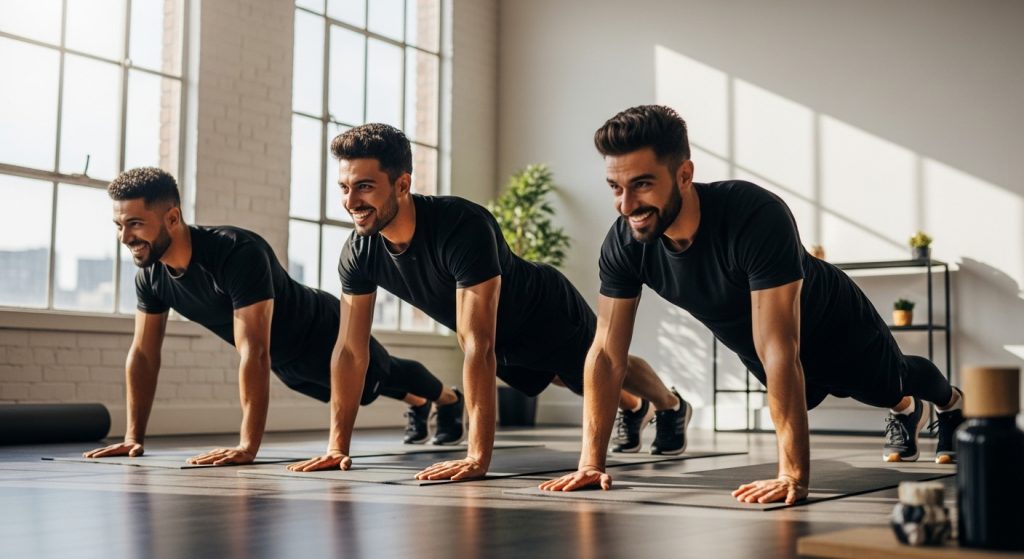
Short answer: A good bodyweight workout for men trains every major muscle group with a handful of moves (squat, push-up, lunge, hip hinge, row, bridge and plank) at least 2 days a week, which is the CDC minimum for muscle strengthening. Do 1 to 3 sets of 8 to 12 reps per exercise, push each set close to the point where another clean rep would be hard, and make the move harder once the top of that range gets easy. Add a few minutes of easy movement to warm up and leave a rest day between sessions that hit the same muscles.
Key Takeaways
- The CDC recommends at least 2 days a week of muscle-strengthening activity that works the legs, hips, back, abdomen, chest, shoulders and arms, plus 150 minutes of moderate aerobic activity.[1]
- Federal guidelines name body weight (push-ups, for example) as a valid form of resistance, so you do not need a gym to meet them.[2]
- One set of 8 to 12 reps per exercise is effective, and 2 or 3 sets may be more effective.[2]
- Progress by moving to a harder version of each exercise, not just by adding endless reps.
- Rest one full day before training the same muscle group again, and warm up first.[3]
- The 7 moves below, a 3-day weekly plan and an easier/harder option for each let you start at any fitness level.
What Counts as a Bodyweight Workout?
A bodyweight workout uses your own mass as the load. Gravity, leverage and tempo do the job a barbell does in a gym. The U.S. Physical Activity Guidelines for Americans state plainly that muscle-strengthening activity “can also be done by using elastic bands or body weight for resistance,” and they give push-ups as an example.[2] Mayo Clinic lists push-ups, pull-ups, planks, lunges and squats as exercises you can do with little or no equipment.[3]
What makes bodyweight training “count” is not the tool, it is the effort. The guidelines define intensity as how much force is used relative to how much you are able to lift, and they say strengthening exercises should be performed “to the point at which it would be difficult to do another repetition.”[2] Twenty easy squats while watching TV are movement. Ten slow, deep squats that leave your legs shaking are training.
Why it is worth doing
Mayo Clinic links regular strength training with stronger bones, easier weight management, better balance and physical function, and help managing some chronic conditions, including arthritis, heart disease, diabetes, depression and anxiety.[3] Harvard Health notes that strength training helps build and maintain muscle mass and strength and can slow bone loss, and that balance and power work improves stability.[5] Bodyweight training delivers those basics with zero cost and no commute, which removes the two most common excuses for skipping sessions.
The 7 Best Bodyweight Exercises for Men
These seven moves cover every muscle group the CDC lists.[1] Each one has an easier version so a beginner can start today and a harder version so a trained man still has room to progress. The rep range follows the federal guidance of 1 to 3 sets of 8 to 12 repetitions.[2]
| Exercise | Main muscles | Sets x reps | Easier version | Harder version |
|---|---|---|---|---|
| Bodyweight squat | Quads, glutes, hips | 2 to 3 x 8 to 12 | Squat to a chair (box squat) | Split squat, then rear-foot-elevated split squat |
| Push-up | Chest, shoulders, triceps, core | 2 to 3 x 8 to 12 | Hands on a counter or bench (incline push-up) | Feet elevated push-up, slow lowering |
| Reverse lunge | Quads, glutes, hamstrings, balance | 2 to 3 x 8 to 12 per leg | Shorter step, hand on a wall | Walking lunge, pause at the bottom |
| Single-leg hip hinge (Romanian deadlift) | Hamstrings, glutes, lower back | 2 to 3 x 8 to 12 per leg | Back toe lightly touching the floor | Slower tempo, no support |
| Inverted row or pull-up | Upper back, lats, biceps, grip | 2 to 3 x 8 to 12 | Row on a sturdy low bar with knees bent | Feet elevated row, then pull-ups or chin-ups |
| Glute bridge | Glutes, hamstrings | 2 to 3 x 8 to 12 | Shorter range, both feet | Single-leg bridge, shoulders on a couch (hip thrust) |
| Plank | Abdomen, deep core, shoulders | 2 to 3 holds | Plank on knees or hands on a bench | Side plank, plank with alternating arm reach |
Form cues that matter most
- Push-up: ACE coaches a rigid body line from head to heels, core braced, glutes and thighs squeezed, and head in line with the spine. The two classic faults are a sagging low back and hips hiking up. Keeping the elbows closer to your sides shifts more work to the triceps and may ease shoulder stress.[4]
- Squat: Sit the hips back and down, keep your whole foot on the floor and let the knees track in line with your toes. Go only as deep as you can while keeping your back neutral.
- Lunge: Step back far enough that both knees can bend comfortably. Lower straight down rather than lurching forward.
- Hip hinge: Push the hips back as the torso tips forward, with a long, flat back. You should feel the hamstrings stretch, not the lower back strain.
- Row: Use only a bar or table you are certain will hold your weight. Pull your chest to the bar and squeeze the shoulder blades together.
- Plank: End the hold the moment your hips sag. A short, perfect plank beats a long, collapsed one.
A Simple Weekly Bodyweight Workout Plan
The CDC minimum is 2 strength days a week.[1] Three full-body sessions on non-consecutive days give you extra practice while still respecting Mayo Clinic’s advice to rest one full day between sessions that work the same muscle group.[3] Fill the other days with aerobic activity so your weekly total reaches the 150 moderate minutes the CDC recommends.[1]
| Day | Session | What to do |
|---|---|---|
| Monday | Full body A | Squat, push-up, inverted row, plank |
| Tuesday | Aerobic | Brisk walk, cycling or swimming at a pace where you can talk but not sing |
| Wednesday | Full body B | Reverse lunge, single-leg hip hinge, push-up, glute bridge |
| Thursday | Aerobic or mobility | Walk plus light stretching or yoga |
| Friday | Full body A or B | Alternate A and B each week |
| Saturday | Aerobic | Longer walk, hike or bike ride |
| Sunday | Rest | Easy movement only |
Four exercises for 2 to 3 sets, plus a warm-up, fit easily into a lunch break. If you only have time for 2 days, keep Monday and Thursday (or any two non-consecutive days) and do all seven exercises in each.
If you want your conditioning to improve as well, see our guide on how to increase stamina, which covers aerobic endurance training in detail. For a flexibility day, yoga for men is a good fit on Thursday.
How to Progress Without Weights
The federal guidelines say improvements in strength and endurance are progressive over time, and that increasing the load or the number of training days makes muscles stronger.[2] Mayo Clinic adds that if you can easily do more reps than your target, it is time to increase the resistance.[3] With bodyweight training you raise resistance in these ways:
- Change leverage. An incline push-up is easier than a floor push-up, and a feet-elevated push-up is harder. Bending or straightening the knees does the same for rows.
- Go to one limb. Moving from a squat to a split squat, or from a bridge to a single-leg bridge, roughly shifts the work onto one leg.
- Slow the lowering phase. Taking several seconds to lower makes every rep harder without changing the exercise.
- Add a pause. Holding the bottom of a squat or lunge removes the bounce and increases effort.
- Add a set. Moving from 1 set to 2 or 3 sets is the next lever the guidelines point to.[2]
A practical rule: when you can do 12 clean reps on every set, move to the harder version and drop back to 8 reps. Keep a short log in your phone so you know what to beat next session.
Do not forget grip and the rest of the picture
Rows and pull-ups also train your hands and forearms. If grip is a weak point, our article on average grip strength explains how it is measured and trained. Recovery happens outside the workout: enough protein (see how much protein men need) and consistent sleep (see our sleep routines for men) make the training stick.
Safety: Warm-Up, Pain and When to Check With a Doctor
- Warm up. Mayo Clinic suggests a few minutes of brisk walking or other aerobic activity before strength work.[3] Follow with one easy set of the first exercise.
- Fatigue yes, pain no. Muscle burn and shaky final reps are expected. Sharp, joint-specific or radiating pain is a reason to stop and choose an easier variation.
- Breathe. Exhale on the effort and avoid holding your breath through long sets, especially if you have high blood pressure.
- Respect recovery. Leave one full day before training the same muscles again.[3]
- Use safe anchors. Never row from a wobbly table, a towel in a door, or anything not built to hold your full weight.
Talk to your doctor before starting if you have heart disease, chest pain or dizziness with effort, uncontrolled blood pressure, a recent surgery, or a joint injury. A physical therapist can adapt every move in this guide to a specific limitation. For older men, the federal guidelines recommend combining strength and aerobic work with balance training, such as standing on one leg.[2] Lunges and single-leg hinges already build some of that balance.
Where Supplements Fit (and Where They Do Not)
No capsule replaces the work in this plan. Training, protein, sleep and regular aerobic activity are the foundation. Some men who train also take a daily wellness supplement as part of their routine. Ultra Bann is a natural male vitality supplement by DL Bioproducts, taken as one capsule every 2 days. It contains seven botanicals with the amounts printed on the label and no proprietary blend: Thai Butea superba, Panax ginseng, Cynomorium songaricum, black ginger, tongkat ali, epimedium and reishi, 800 mg in total. You can read the full label on the ingredients page or see the product in the Ultra Bann shop. The first order includes free US shipping and a 60-day money-back guarantee. If you take any prescription medication, check with your doctor before adding a supplement.
Related reading: want a full weekly plan? Follow our calisthenics for beginners program.
Frequently Asked Questions
Can you build muscle with only bodyweight exercises?
Yes, as long as the exercises stay challenging. The federal guidelines treat body weight as a valid resistance and say each set should go to the point where another repetition would be difficult.[2] The key is progression: move to harder variations (feet-elevated push-ups, split squats, pull-ups) as you get stronger.
How many days a week should I do a bodyweight workout?
At least 2 days a week, covering all major muscle groups, is the CDC recommendation.[1] Three non-consecutive days works well for most men because it allows a full rest day between sessions for the same muscles.[3]
How many reps and sets should a beginner do?
Start with one set of 8 to 12 reps of each exercise, which the guidelines call effective, then build to 2 or 3 sets.[2] Mayo Clinic notes that a single set of 12 to 15 repetitions can build muscle efficiently in most people.[3] Choose the variation that lets you hit that range with good form.
Is a 20 to 30 minute bodyweight workout enough?
For general strength and health, yes. Seven exercises for 1 to 3 sets each fit comfortably in that window. The guidelines focus on effort, frequency and covering all major muscle groups, not on session length.[1][2]
Do I still need cardio if I do bodyweight training?
Yes. The CDC recommends 150 minutes a week of moderate aerobic activity in addition to the 2 strength days.[1] Strength circuits raise your heart rate, but they do not replace walking, cycling or swimming.
References
- Centers for Disease Control and Prevention. Adult Activity: An Overview. Physical Activity Basics. cdc.gov
- U.S. Department of Health and Human Services. Physical Activity Guidelines for Americans, 2nd edition. 2018. odphp.health.gov (PDF)
- Mayo Clinic Staff. Strength training: Get stronger, leaner, healthier. mayoclinic.org
- American Council on Exercise. Push-Ups. Exercise Library. acefitness.org
- Harvard Health Publishing. Strength training builds more than muscles. health.harvard.edu
These statements have not been evaluated by the Food and Drug Administration. This product is not intended to diagnose, treat, cure or prevent any disease. This article is for information only and is not medical advice.
Ultra Bann natural male vitality support
1 capsule every 2 days. Free US shipping and a 60-day money-back guarantee on your first order.
See Ultra BannThese statements have not been evaluated by the Food and Drug Administration. This product is not intended to diagnose, treat, cure, or prevent any disease.