
Short answer: ED in young men is more common than most people assume, and it is rarely a sign that something is permanently wrong. In men under 40, stress, anxiety, unrealistic expectations, alcohol, drugs and poor sleep are frequent contributors, but physical causes such as diabetes, high blood pressure, hormone problems and medication side effects still have to be ruled out. If erection problems keep happening, the right first step is a doctor’s visit, not a pill bought online.
Key Takeaways
- An occasional erection problem is normal. The NHS notes it is usually caused by stress, tiredness or too much alcohol and is “nothing to worry about.”[1]
- Repeated problems deserve a medical check, because ED can be the first sign of an underlying condition, including heart disease.[2]
- Young men are not immune: studies summarized in a 2016 review found that about one in four men seeking help for new ED in an Italian clinic were under 40.[4]
- Mind and body interact. Worry about performance can cause or worsen ED, and physical and psychological causes often overlap.[2][3]
- The link between pornography and ED is debated. Surveys show an association with problematic use, but they cannot prove cause and effect.[4][5]
- No supplement is a substitute for a diagnosis. Talk openly with a clinician and, when you are ready, with your partner.

What Counts as ED, and How Common Is It in Young Men?
Erectile dysfunction means trouble getting or keeping an erection firm enough for sex.[3] The key word is keeping happening. One bad night after a long week, a few drinks or a stressful argument is not a diagnosis. A pattern over weeks or months is different.
Most public health pages describe ED as a condition of older men. The Cleveland Clinic, for example, reports that it affects over 50% of males between 40 and 70, and notes that real numbers may be higher because many men stay silent out of embarrassment.[2] The Urology Care Foundation estimates that ED affects as many as 30 million men in the United States.[3]
Data on younger men are less tidy, but they are hard to ignore. A 2016 review in Behavioral Sciences gathered several studies: an Italian clinic study (2013) in which roughly one in four patients seeking help for new onset ED were under 40, and a Swiss study (2012) in which 30% of men aged 18 to 24 scored in the ED range on a screening questionnaire.[4] A 2021 international web survey of men aged 18 to 35 found that 21.48% of the 2,067 sexually active respondents had some degree of ED on the same type of questionnaire.[5]
Two cautions apply. Screening questionnaires capture mild and occasional problems, not only severe ones, and online surveys attract men who are already worried. These figures say “this is common,” not “one in three young men has a disease.”
Common Causes of ED in Young Men
Doctors usually think about three overlapping groups of causes: psychological, lifestyle and physical. In young men the first two are frequent, but the third is the one you cannot afford to miss.
Psychological and relationship factors
Depression, anxiety, relationship conflict, stress at work or at home, and social or cultural pressure can all cause or worsen ED.[3] Worry about performance is especially powerful: the Urology Care Foundation puts it simply, “worrying about your ability to get an erection can make it difficult to get one.”[3] If this sounds familiar, our guide to sexual performance anxiety covers that loop in more depth.
Lifestyle and substances
Alcohol, nicotine, marijuana, cocaine and opioids can damage blood vessels and nerves involved in erections; physical inactivity and a BMI over 25 are also listed risk factors.[2] The NHS suggests keeping alcohol under 14 units a week and cutting back on cycling if you ride more than 3 hours a week.[1] See how much alcohol is too much for practical limits.
Physical and medical causes
Blood vessel problems are the most common physical cause overall. Others include diabetes, high blood pressure, high cholesterol, kidney disease, hormone problems such as low testosterone or thyroid disease, nerve damage, Peyronie’s disease, and injuries or surgery involving the pelvis or spinal cord.[2] Many medications can contribute, including some antidepressants, anti-anxiety drugs, blood pressure drugs and antihistamines.[2] Never stop a prescribed medicine on your own; ask the prescriber about alternatives.[3]
| Cause group | Examples | Clues that point this way | Who to talk to |
|---|---|---|---|
| Psychological | Performance worry, anxiety, depression, stress, relationship conflict | Sudden start, problems only in certain situations, erections still possible at other times such as on waking | Doctor first, then a counsellor or sex therapist |
| Lifestyle | Heavy drinking, smoking or vaping nicotine, recreational drugs, inactivity, excess weight | Problems worse after drinking or drug use, low fitness, weight gain | Doctor, plus habit changes |
| Medication | Some antidepressants, anti-anxiety drugs, blood pressure drugs, antihistamines | Problems began after starting or changing a medicine | The prescribing clinician (do not stop on your own) |
| Vascular or metabolic | Diabetes, high blood pressure, high cholesterol | Gradual decline, family history, other risk factors | Primary care doctor; blood tests |
| Hormonal or neurological | Low testosterone, thyroid problems, nerve damage | Low desire, fatigue, other symptoms beyond erections | Primary care doctor or urologist |
Clues are only clues. The NHS points out that, depending on the cause, you may still get erections at other times, such as when you wake up,[1] but that does not replace a proper check.
Unrealistic Expectations and the Anxiety Loop
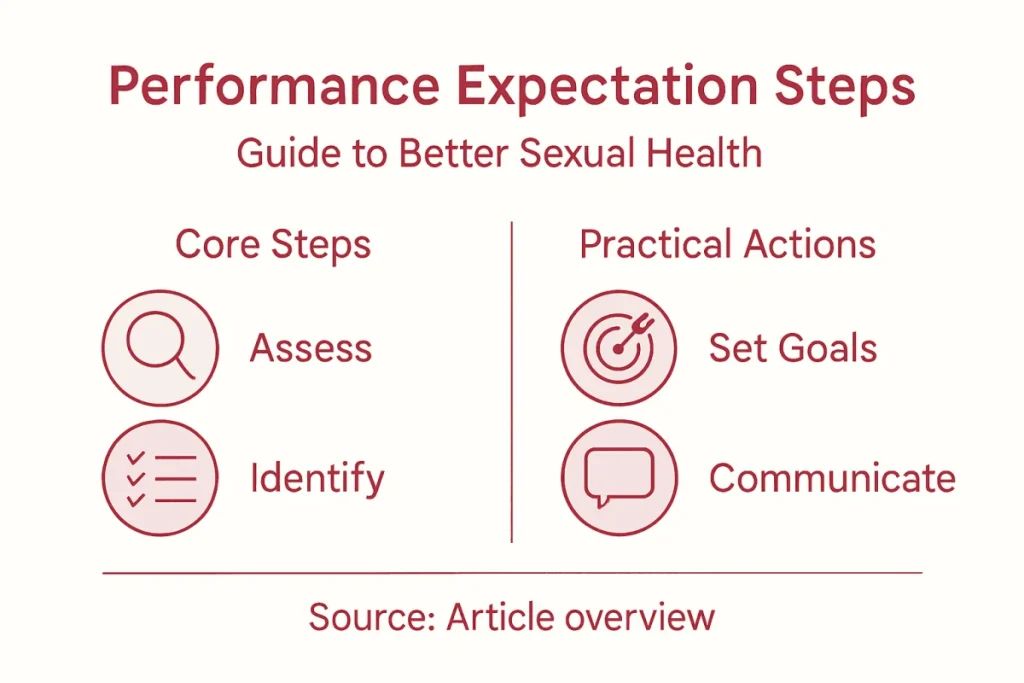
This post began as a guide to managing performance expectations, and that theme matters most for younger men. Expectations come from many places: what friends say, what movies show, what you assume a partner wants, and for many men, pornography. When the picture in your head does not match real life, a normal variation (a slower response, losing an erection briefly, needing more touch) can feel like failure.
That feeling has physical consequences. The Urology Care Foundation lists worry about sexual performance, social or cultural pressure and relationship conflict among the factors that can cause or worsen ED.[3] One tense night leads to worry about the next, and the worry makes the next one harder. Breaking the loop usually means three things:
- Reset the benchmark. Erections vary with sleep, mood, alcohol, time of day and how relaxed you feel. Variation is not dysfunction.
- Shift the goal. Treat intimacy as shared pleasure rather than a test. Pressure to “perform” is a known trigger.[3]
- Get a medical baseline. Knowing your blood pressure, blood sugar and, when indicated, hormone levels removes a lot of guesswork and fear.
Does porn cause erectile dysfunction?
This is one of the most searched questions on the topic, and the honest answer is that the evidence is mixed.
- A 2016 review with clinical case reports argued that heavy internet pornography use may condition arousal to cues a real partner cannot provide, and reported that stopping pornography sometimes reversed symptoms. The authors themselves called for intervention studies, and the case reports were small and descriptive.[4]
- A 2021 survey of men aged 18 to 35 found that higher scores on a scale of problematic online pornography use were linked to a higher probability of ED after adjusting for other factors, while masturbation frequency was not a significant factor. Because it was cross-sectional, the authors stated that a longitudinal study is needed before drawing conclusions.[5]
- The 2016 review also notes that at least one 2015 study concluded pornography use was not a significant risk factor for ED in young men, a conclusion the review’s authors disputed.[4]
A practical takeaway: if you suspect your habits are shaping your expectations or your arousal, it is reasonable to cut back and see whether things change, and to mention it to your doctor. It is not reasonable to assume pornography is the cause and skip a medical check.
When to See a Doctor, and What to Expect
The NHS advice is clear: see a GP or go to a sexual health clinic if erection problems keep happening, because frequent problems might be a sign of a health condition that can be treated.[1] The Cleveland Clinic recommends a primary care physician or a urologist.[2] Book sooner if you also have diabetes, heart disease, high blood pressure, or symptoms such as fatigue, low desire or changes in urination.
Your visit will likely include questions about your heart and vascular health, medicines, alcohol, smoking and drug use, stress, mood and relationship changes, followed by a physical exam.[3] Depending on the findings, tests may include blood work (blood count, lipid panel, liver and kidney function, thyroid and testosterone), a urine test and, less often, a penile Doppler ultrasound.[2] If low testosterone is a question, our pages on signs of low testosterone and signs of poor circulation explain what doctors look for.
Emergency warning: an erection that lasts longer than two to four hours, especially if painful, needs emergency care.[2][3]
Treatment options a clinician may discuss
Treatment depends on the cause. The NHS lists lifestyle changes (weight loss, stopping smoking, healthy eating, daily exercise, managing stress), vacuum pumps, prescription medicines, and counselling or therapy when erection problems are linked to emotional or mental health issues.[6] Urologists often start with heart and vascular health because, as the Urology Care Foundation puts it, what is good for your heart health is good for your sex health.[3] Prescription treatment is a decision to make with a clinician who knows your history.
How to Talk to Your Partner About It
ED can strain a relationship, and relationship problems can also contribute to ED.[3] Silence tends to make both worse, because a partner may fill the gap with the wrong explanation (“you are not attracted to me”). A few principles help:
- Pick a calm moment, not right after a difficult night in bed.
- Name it plainly: “I have been having trouble with erections and I am looking into why. It is not about you.”
- Share the plan: you are seeing a doctor, cutting back on alcohol, sleeping more. A plan reduces anxiety for both of you.
- Take pressure off sex: agree that intimacy does not have to follow one script while you sort things out.
- Consider joint support: doctors sometimes ask to speak with the partner, and sex or relationship therapists can work with couples.[3][6]
Where Supplements Fit (and Where They Do Not)
Many young men reach for “male enhancement” products before seeing a doctor. That order is backwards. No supplement can diagnose high blood pressure, diabetes, a medication side effect or depression, and products sold online are not always what their labels claim. If you do use an herbal product for general wellness, choose one with a fully disclosed label and tell your doctor about it. Ultra Bann, a botanical supplement by DL Bioproducts, lists its seven ingredients and their exact amounts on its ingredients page; like any supplement, it is not a substitute for a medical evaluation.
Frequently Asked Questions
Is it normal to have ED in your 20s?
Occasional erection problems at any age are normal and usually linked to stress, tiredness or alcohol.[1] Problems that keep happening in your 20s are not something to ignore. They are common enough that doctors see them regularly, and a checkup is the right step.
Can anxiety alone cause ED in young men?
Yes, anxiety, depression, stress and worry about performance can cause or worsen ED.[3] Physical causes still need to be ruled out, because the two often overlap.[2]
Does porn cause erectile dysfunction?
The evidence is mixed. Surveys link problematic pornography use to a higher chance of ED, but they cannot prove cause and effect, and researchers disagree about how strong the link is.[4][5] Cutting back is a reasonable experiment; skipping a medical check is not.
Can ED in young men be a sign of heart disease?
It can. The Cleveland Clinic notes that ED is sometimes the first symptom of an underlying problem, including heart disease.[2] That is one reason repeated problems deserve a medical evaluation, even in otherwise healthy young men.
Will ED in young men go away on its own?
Sometimes, especially when it is tied to a stressful period, heavy drinking or relationship strain that improves. When it persists, the NHS notes that frequent problems may reflect a treatable condition, so getting checked is the faster route.[1]
References
- NHS. Erection problems (erectile dysfunction). Reviewed 2023.
- Cleveland Clinic. Erectile Dysfunction (ED).
- Urology Care Foundation (American Urological Association). Erectile Dysfunction (ED).
- Park BY, Wilson G, Berger J, et al. Is Internet Pornography Causing Sexual Dysfunctions? A Review with Clinical Reports. Behavioral Sciences. 2016;6(3):17.
- Jacobs T, Geysemans B, Van Hal G, et al. Associations Between Online Pornography Consumption and Sexual Dysfunction in Young Men: Multivariate Analysis Based on an International Web-Based Survey. JMIR Public Health and Surveillance. 2021;7(10):e32542.
- NHS. Treatment for erection problems.
These statements have not been evaluated by the Food and Drug Administration. This product is not intended to diagnose, treat, cure or prevent any disease. This article is for information only and is not medical advice.
Ultra Bann natural male vitality support
1 capsule every 2 days. Free US shipping and a 60-day money-back guarantee on your first order.
See Ultra BannThese statements have not been evaluated by the Food and Drug Administration. This product is not intended to diagnose, treat, cure, or prevent any disease.