Short answer: Zinc can increase testosterone in men who are low in zinc, because the body needs enough of it to make and maintain normal testosterone levels. In men who already eat enough zinc, controlled studies have not shown that extra zinc pushes testosterone higher. For most men the goal is to reach the adult requirement of 11 mg per day, mostly from food, and to stay under the 40 mg daily upper limit.
Key Takeaways
- A 2023 systematic review of 38 papers (8 clinical, 30 animal) found that serum zinc tracks with total testosterone, and that zinc deficiency is linked with lower levels.[3]
- The benefit appears to depend on starting zinc status. In 14 exercising men who already ate enough zinc, a high-dose zinc product (ZMA) raised blood zinc but did not change total or free testosterone.[4]
- Adult men need 11 mg of zinc per day. The tolerable upper intake level for adults is 40 mg per day from all sources combined.[1]
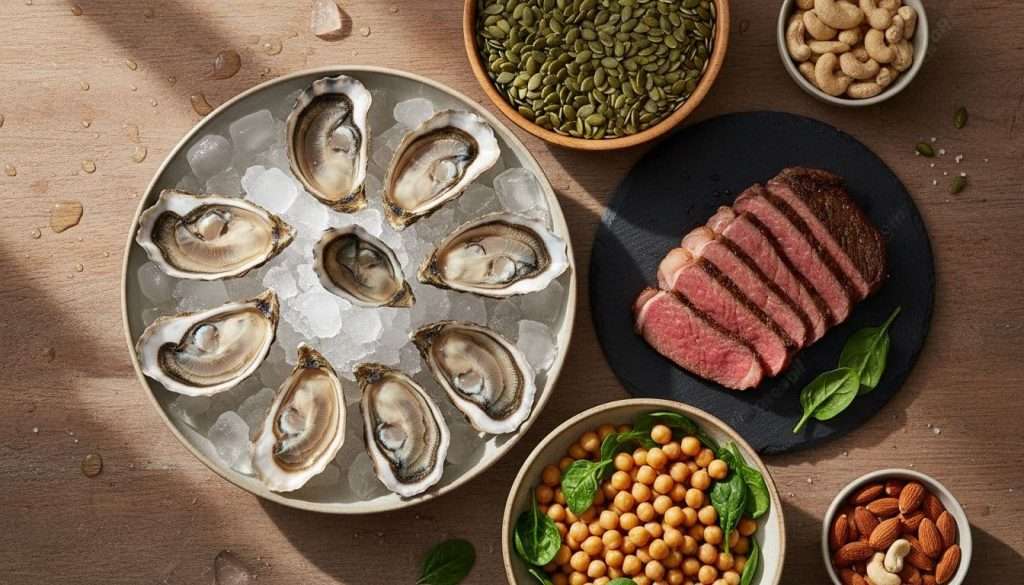
- Oysters are the richest food source by far. Beef, crab and pumpkin seeds also contribute meaningful amounts.[1]
- Taking 50 mg or more for weeks can lower copper absorption, weaken immune function and reduce HDL cholesterol.[1]
- In a large fertility trial published in JAMA in 2020, zinc plus folic acid did not improve semen quality or live birth rates compared with placebo.[5]
What Zinc Does in a Man’s Body
Zinc is an essential trace mineral. Your body cannot store large amounts of it, so you need a steady supply from food. It is involved in a very large number of enzyme reactions, in immune defense, in wound healing, and in taste and smell. Signs of inadequate intake listed by the NIH Office of Dietary Supplements include loss of appetite, impaired taste and smell, frequent infections and, in older adults, slower wound healing.[1][2]
For men, the reason zinc keeps coming up in testosterone conversations is that zinc is concentrated in reproductive tissue and appears to be needed for normal androgen production. A 2023 systematic review in the Journal of Trace Elements in Medicine and Biology describes zinc as one of the trace elements that helps keep male hormones such as testosterone in balance.[3] That makes zinc a requirement, not a booster.
Who is most likely to run low
The NIH lists several groups at higher risk of inadequate zinc status:[1]
- People with inflammatory bowel disease, celiac disease, or a history of gastrointestinal surgery, including bariatric surgery.
- People who follow vegetarian or vegan diets, because plant foods carry less zinc and more phytates, which reduce absorption.
- People with alcohol use disorder.
- People on long-term thiazide diuretics, which increase the amount of zinc lost in urine.
Does Zinc Increase Testosterone? What the Evidence Shows
Human studies
The systematic review (2023). Researchers pooled 38 papers on zinc and testosterone. Only 8 were clinical studies in people, and 30 were animal studies. They concluded that serum zinc was positively correlated with total testosterone, that zinc deficiency was associated with lower testosterone, and that moderate supplementation may help. They also noted that the size of any effect seemed to depend on baseline zinc and testosterone levels, the form of zinc, the elemental dose and the length of treatment.[3]
Zinc in men who already eat enough (2009). In a study in the European Journal of Clinical Nutrition, 14 healthy, regularly exercising men aged 22 to 33, with a baseline zinc intake of roughly 11.9 to 23.2 mg per day, took ZMA, a popular zinc, magnesium and vitamin B6 product. Serum zinc went up, but serum total and free testosterone did not change significantly, and urinary testosterone metabolites were also unchanged. The authors concluded that in men on a zinc-sufficient diet, the supplement had no significant effect on testosterone.[4]
Zinc and exercise in sedentary young men (2007). A small study in Neuroendocrinology Letters gave 10 sedentary male students zinc sulfate at 3 mg per kg of body weight per day for 4 weeks. Before supplementation, a fatiguing cycling test lowered their total and free testosterone. After 4 weeks of zinc, resting and post-exercise testosterone values were higher than before, and exercise no longer produced a significant drop.[6] This result is often quoted online, but keep its limits in mind: only 10 participants, no placebo group, a weight-based dose that is high compared with everyday intakes, and a short follow-up.
Animal studies
Animals made up 30 of the 38 papers in the 2023 review.[3] They help explain mechanisms but cannot predict how a healthy man’s lab results will respond.
Fertility and sperm
Zinc is also marketed for sperm health. The largest test of that idea, the Folic Acid and Zinc Supplementation Trial (FAZST) published in JAMA in 2020, enrolled couples seeking infertility treatment. Live birth rates were 34% and 35% in the two groups, with no meaningful difference, and semen quality did not improve compared with placebo. The supplement group also had a small increase in sperm DNA fragmentation and reported more stomach discomfort, nausea and vomiting.[5] Men with fertility concerns should work with a urologist or fertility specialist instead of relying on zinc.
| Study | Who was studied | What happened to testosterone | What it means |
|---|---|---|---|
| Systematic review, 2023[3] | 38 papers: 8 clinical, 30 animal | Serum zinc positively correlated with total testosterone; deficiency linked with lower levels | Adequate zinc matters, especially when starting low |
| Koehler et al., 2009[4] | 14 exercising men, already zinc sufficient | No significant change in total or free testosterone | Extra zinc does not raise normal levels |
| Kilic, 2007[6] | 10 sedentary young men, 4 weeks zinc sulfate | Higher resting and post-exercise levels after supplementation | Small, uncontrolled, high dose; weak evidence |
| FAZST, JAMA 2020[5] | Couples seeking infertility treatment | Not the main outcome; semen quality and live births did not improve | Zinc plus folic acid is not a fertility fix |
How Much Zinc Men Need, and the Best Food Sources
The Recommended Dietary Allowance (RDA) for men aged 19 and older is 11 mg per day. The Tolerable Upper Intake Level (UL) for adults is 40 mg per day, and it counts zinc from food, drinks, supplements and medicines together. The UL does not apply to people taking zinc for a medical reason under a doctor’s care.[1][2]
Food is the best place to start. These values come from the NIH zinc fact sheet:[1]
| Food (serving) | Zinc per serving | Percent of Daily Value |
|---|---|---|
| Oysters, Eastern, farmed, raw (3 oz) | 32 mg | 291% |
| Oysters, Pacific, cooked (3 oz) | 28.2 mg | 256% |
| Beef, bottom sirloin, roasted (3 oz) | 3.8 mg | 35% |
| Blue crab, cooked (3 oz) | 3.2 mg | 29% |
| Pumpkin seeds, roasted (1 oz) | 2.2 mg | 20% |
Other foods that add zinc include poultry, fish, lobster, fortified breakfast cereals, beans, nuts, whole grains, eggs and dairy.[2] Plant sources come with phytates, which bind zinc and lower how much you absorb. Soaking beans, grains and seeds before cooking can reduce this effect.[1] For more meal ideas, see our guide to foods that support healthy testosterone.
If you choose a supplement
- Read the elemental zinc amount. The Supplement Facts panel lists elemental zinc, which is the number that counts toward the 11 mg RDA and 40 mg UL.[1]
- Form matters a little. Common forms are zinc sulfate, acetate and gluconate. In young adults, absorption was about 61% for zinc citrate or gluconate and 50% for zinc oxide. The NIH consumer sheet says it is unclear whether any one form works better than the others.[1][2]
- Count every source. Multivitamins, cold lozenges and other products may also contain zinc. Add them up so your total stays under 40 mg.
- Space it from iron. Supplements with 25 mg or more of iron taken at the same time can reduce zinc absorption.[1]
Side Effects and Safety
Too much zinc at once can cause nausea, dizziness, headaches, stomach upset, vomiting and loss of appetite. Over the longer term, intakes of 50 mg or more per day for weeks can block copper absorption, reduce immune function and lower HDL (“good”) cholesterol. Very high doses can also reduce magnesium absorption. The NIH notes that it is unlikely anyone would get this much from food alone, so the risk comes from supplements.[1][2]
Low copper caused by excess zinc can lead to anemia and nerve problems such as poor coordination, numbness and weakness. These cases have been reported with years of heavy denture cream use, but the same copper problem is the reason high-dose zinc should not be taken for long periods without medical supervision.[1][2]
Medication interactions
- Quinolone and tetracycline antibiotics: zinc and the antibiotic can block each other’s absorption. Take the antibiotic at least 2 hours before or 4 to 6 hours after zinc.[1]
- Penicillamine: take it at least 1 hour apart from zinc.[1]
- Thiazide diuretics such as hydrochlorothiazide and chlorthalidone: they increase zinc loss in urine, so long-term users may need their zinc status checked.[1]
When to Talk to a Doctor
If you have symptoms such as persistent low energy, low sex drive, loss of morning erections or reduced muscle mass, zinc is not the first thing to try. These symptoms have many possible causes, and the right first step is a conversation with your doctor and, if appropriate, a morning blood test for testosterone. Our articles on signs of low testosterone and normal testosterone levels by age explain what clinicians look for.
Ask your doctor before starting zinc if you take antibiotics, penicillamine or diuretics, if you have a digestive condition that affects absorption, or if you plan to take more than 40 mg per day. Sleep, resistance training and a healthy weight matter more than any single mineral. Our guide to sleep routines for men is a good place to start.
Where Ultra Bann Fits
Ultra Bann is a different category of product: a natural male vitality supplement from DL Bioproducts built on seven botanicals. Each 800 mg serving lists every amount on the label with no proprietary blend: Thai Butea superba 345 mg, Panax ginseng 110 mg, Cynomorium songaricum 85 mg, black ginger (Kaempferia parviflora) 85 mg, tongkat ali 85 mg, epimedium (horny goat weed) 45 mg and reishi (Ganoderma lucidum) 45 mg. You take one capsule every 2 days.
It is herbal only, with no added minerals or vitamins. Those are still best covered by your diet. You can review the full Ultra Bann label or visit the Ultra Bann shop. First orders include free US shipping and a 60-day money-back guarantee.
Frequently Asked Questions
How much zinc should a man take per day for testosterone?
There is no special testosterone dose. Adult men need 11 mg per day, and the upper limit is 40 mg per day from all sources combined.[1] Research suggests zinc helps testosterone mainly when intake was low to begin with, so meeting the RDA is the practical target.
How long does it take for zinc to affect testosterone?
In the small 2007 study of sedentary young men, changes were measured after 4 weeks of zinc sulfate.[6] In men who already had adequate zinc, a high-dose product did not change testosterone at all.[4] If you are not deficient, waiting longer is unlikely to change that.
Is it safe to take 50 mg of zinc a day?
Not as a long-term habit without medical supervision. 50 mg is above the 40 mg upper limit, and taking 50 mg or more for weeks can lower copper absorption, weaken immune function and reduce HDL cholesterol.[1]
Does ZMA boost testosterone?
In 14 exercising men who already ate enough zinc, ZMA raised blood zinc but did not significantly change total or free testosterone.[4]
Does zinc help with sperm count or fertility?
A large randomized trial published in JAMA in 2020 found that zinc plus folic acid did not improve semen quality or live birth rates compared with placebo.[5] Men with fertility concerns should see a specialist.
References
- NIH Office of Dietary Supplements. Zinc: Fact Sheet for Health Professionals. ods.od.nih.gov
- NIH Office of Dietary Supplements. Zinc: Fact Sheet for Consumers. ods.od.nih.gov
- Correlation between serum zinc and testosterone: A systematic review. Journal of Trace Elements in Medicine and Biology, 2023, vol. 76. Abstract
- Koehler K, Parr MK, Geyer H, Mester J, Schänzer W. Serum testosterone and urinary excretion of steroid hormone metabolites after administration of a high-dose zinc supplement. European Journal of Clinical Nutrition. 2009;63:65 to 70. nature.com
- Folic Acid and Zinc Supplementation Trial (FAZST), JAMA, 2020. Summary: Folic acid and zinc supplementation in men not associated with increased fertility. 2 Minute Medicine. 2minutemedicine.com
- Kilic M. Effect of fatiguing bicycle exercise on thyroid hormone and testosterone levels in sedentary males supplemented with oral zinc. Neuroendocrinology Letters. 2007;28(5):681 to 685. nel.edu
These statements have not been evaluated by the Food and Drug Administration. This product is not intended to diagnose, treat, cure or prevent any disease. This article is for information only and is not medical advice.
Ultra Bann natural male vitality support
1 capsule every 2 days. Free US shipping and a 60-day money-back guarantee on your first order.
See Ultra BannThese statements have not been evaluated by the Food and Drug Administration. This product is not intended to diagnose, treat, cure, or prevent any disease.