
Short answer: The best documented CoQ10 benefits for men are in heart failure, where a two year trial using 300 mg a day (100 mg three times daily) reported fewer major cardiac events than placebo, and in male fertility, where a 2025 meta-analysis linked CoQ10 to better sperm motility and morphology. Evidence for statin muscle pain, blood pressure and exercise performance is mixed or weak. CoQ10 is generally well tolerated, but it can interact with warfarin and insulin, so men on those drugs should talk to a doctor first.
Key Takeaways
- CoQ10 is made by the body and is concentrated in the heart, liver, kidneys and pancreas. Mayo Clinic notes that levels decline with age and may be lower in people taking statins.[1][2]
- The strongest human result is Q-SYMBIO: 420 people with chronic heart failure took 100 mg three times daily or placebo for two years, and major adverse cardiac events occurred in 15% versus 26%.[3]
- For male fertility, a 2025 meta-analysis of 8 randomized trials (877 men) found improvements in sperm motility and normal morphology, but no significant change in sperm concentration.[4]
- NCCIH says overall evidence does not support CoQ10 for statin muscle pain, and it probably has no meaningful effect on blood pressure.[1]
- Side effects are usually mild (digestive upset, insomnia, headache). The German Federal Institute for Risk Assessment advises medical advice before taking more than 100 mg a day if you use blood pressure drugs or coumarin type blood thinners.[6]
What CoQ10 Is and Why Men Ask About It
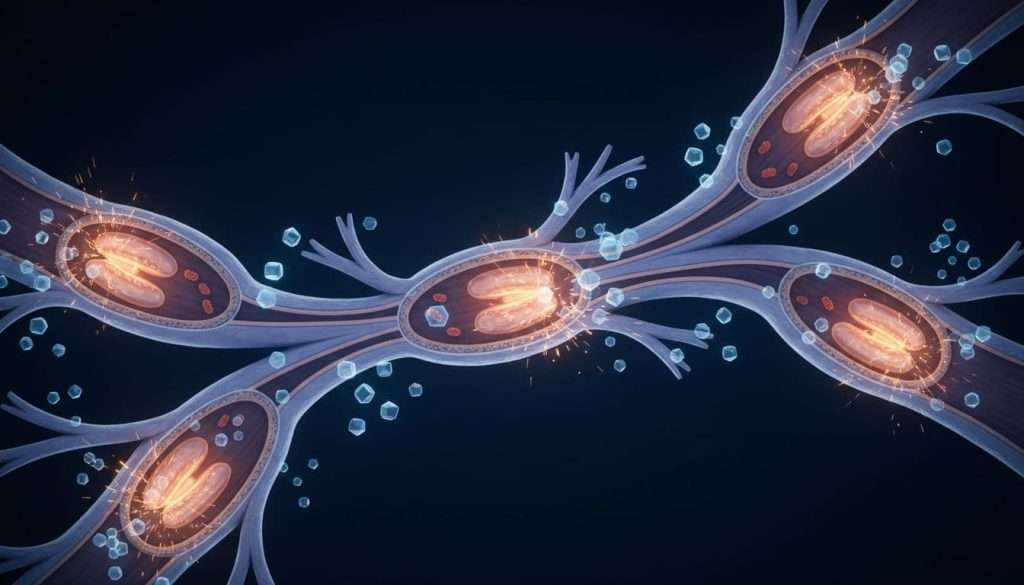
Coenzyme Q10 (CoQ10, also called ubiquinone; its reduced form is ubiquinol) is a compound your cells use for energy production and as an antioxidant. It is not a vitamin. The body builds it from the amino acids phenylalanine or tyrosine plus mevalonic acid, and no deficiency syndrome that needs treatment is known in otherwise healthy people.[6]
NCCIH reports that the highest concentrations are in the heart, liver, kidneys and pancreas, which are organs with very high energy demand.[1] Men usually ask about it for three reasons: heart health, statin side effects and fertility. The quality of research differs a lot between them.
Where CoQ10 comes from in the diet
Meat is the main dietary source, with fish, nuts and some oils also contributing. Fruit, vegetables, cereals and dairy contain only 0.01 to 0.3 mg per 100 g. The BfR estimates that a normal diet supplies about 3 to 6 mg per day, far below the amounts used in clinical trials.[6] Mayo Clinic adds that dietary amounts usually do not raise blood levels much, which is why studies use supplements.[2]
CoQ10 Benefits for Men: What the Human Evidence Shows
The table below separates areas with real human trial data from areas where results are mixed or negative. Animal and cell studies are not included, because they cannot tell you what a capsule will do for a man.
| Area | What human studies show | Evidence strength |
|---|---|---|
| Chronic heart failure | Q-SYMBIO: 100 mg three times daily for 2 years, fewer major adverse cardiac events (15% vs 26%); no significant change in short term measures at 16 weeks[3] | Moderate, one key trial; NCCIH still calls overall heart failure research inconclusive[1] |
| Recovery after heart surgery | May reduce some complications; Mayo notes benefit when combined with other nutrients[1][2] | Limited |
| Sperm quality | 8 RCTs, 877 men: better motility and normal morphology, no significant change in concentration[4] | Moderate, with high variation between trials |
| Statin muscle pain | Individual trials disagree; overall evidence does not support a benefit[1] | Weak or mixed |
| Blood pressure | Probably no meaningful effect[1] | Weak |
| Migraine | May reduce how often or how long migraines last, usually after about three months[2] | Limited |
| Exercise performance | 120 mg a day for 22 days in 18 young men led to smaller power gains than placebo after sprint training[5] | Weak, possibly unfavorable |
Heart health and heart failure
Q-SYMBIO is the trial most people refer to. It was a randomized, double blind, placebo controlled study in 420 patients with moderate to severe chronic heart failure, published in JACC: Heart Failure in 2014. CoQ10 was added to standard treatment. At 16 weeks, symptom class, walking distance and the heart strain marker NT-proBNP did not change significantly. Over two years, though, the CoQ10 group had fewer major adverse cardiovascular events (15% versus 26%).[3]
These were patients already under cardiology care, not healthy men looking for energy, and NCCIH still describes the overall heart failure evidence as inconclusive and notes that few studies have looked at preventing heart disease in the first place.[1] If you have a heart condition, CoQ10 is a question for your cardiologist, not a self experiment.
Sperm quality and male fertility
A systematic review and meta-analysis published in Frontiers in Pharmacology in January 2025 pooled 8 randomized controlled trials with 877 men (462 given CoQ10). The authors reported significant improvements in total and progressive sperm motility and in the share of normally formed sperm. Sperm concentration did not change significantly. They also reported higher circulating testosterone and inhibin B in the CoQ10 groups.[4]
The authors themselves called for larger, well designed trials, and the semen results showed significant heterogeneity, meaning the trials did not agree closely. NCCIH lists male infertility among areas where research is still too limited for firm conclusions.[1] If you and a partner are trying to conceive, a semen analysis and a visit to a urologist or fertility clinic come first.
Statin users and muscle aches
Statins block an early step of the mevalonate pathway, the same pathway the body uses to make CoQ10, which explains why Mayo Clinic notes that people taking statins may have lower CoQ10 levels.[2][6] The logical next step would be that CoQ10 eases statin muscle pain. In practice, results are inconsistent. Mayo Clinic says CoQ10 may ease statin related muscle weakness and pain but that evidence is insufficient, and NCCIH says the overall evidence does not support it.[1][2] Never stop or change a statin on your own because of muscle aches; tell your prescriber.
Energy, exercise and recovery
Because CoQ10 sits inside the cell’s energy machinery, many men assume it will improve workouts. Mayo Clinic calls the research on physical performance inconclusive.[2] The NIH Office of Dietary Supplements describes a trial in which 18 young men took 120 mg a day for 22 days; after a week of high intensity cycling sprints, the CoQ10 group gained less power than the placebo group, which the researchers read as poorer adaptation to training. ODS concludes that antioxidants like CoQ10 do not directly improve performance and may blunt some training adaptations.[5] For energy, sleep, training and diet will do far more. Our guide to sleep routines for men is a better starting point than any capsule.
How CoQ10 Works
CoQ10 has two jobs. Inside mitochondria, it shuttles electrons in the chain of reactions that produce ATP, the molecule cells spend as energy. In cell membranes, its reduced form acts as an antioxidant. Mayo Clinic summarizes this as cells using CoQ10 for growth and maintenance.[2]
The antioxidant role is the proposed link to sperm quality, since sperm cells are sensitive to oxidative damage. It is also the proposed reason for the disappointing exercise result: some oxidative stress during training appears to be a signal the body uses to adapt, and blocking it may not help.[5]
CoQ10 Dosage and Best Time to Take It
There is no official recommended daily intake, because CoQ10 is not an essential nutrient.[6] Doses in the studies above give a practical frame:
- 120 mg per day: used in the short exercise trial described by ODS.[5]
- 300 mg per day (100 mg three times daily): used for two years in Q-SYMBIO, under medical supervision.[3]
- Up to 100 mg per day: the amount German regulators allowed in food supplements under a 2014 ruling, with a warning for pregnant or breastfeeding women and people under 18.[6]
The BfR notes that studies have reported occasional side effects at doses up to 300 mg a day, and that it is unknown whether problems become more frequent above that level.[6] Staying at or below the label dose is the sensible approach.
Ubiquinone or ubiquinol?
Both forms are sold, and the body converts between them. The BfR points out that scientific uncertainty about high doses applies to both forms.[6] For most men the form matters less than consistency and a clean, tested product. Our page on third-party tested supplements explains what to look for on a label.
Best time to take CoQ10
CoQ10 is fat soluble, so most labels advise taking it with a meal that contains some fat. Because insomnia and sleep problems are listed side effects, taking it with breakfast or lunch rather than late at night is a reasonable choice.[1][2] Give any trial time: Mayo Clinic notes that people usually need about three months before seeing a migraine benefit, and short term heart measures in Q-SYMBIO did not change at 16 weeks.[2][3]
Side Effects, Interactions and Who Should Talk to a Doctor
NCCIH reports no serious side effects in research, with mild effects such as insomnia or digestive upset.[1] Mayo Clinic lists upper stomach pain, loss of appetite, nausea and diarrhea, plus dizziness, tiredness, headaches, rash and irritability.[2]
Important interactions
- Warfarin: CoQ10 may make it less effective, which could raise the risk of blood clots.[1][2]
- Insulin: NCCIH lists a possible interaction.[1]
- Blood pressure medicines and coumarin type anticoagulants: not well studied; the BfR advises medical advice before going above 100 mg a day.[6]
- Cancer treatment: CoQ10 may not be compatible with some types.[1]
Talk to a clinician first if you
- have heart failure or another heart condition, or are recovering from heart surgery;
- take a statin and have muscle pain (the pain itself needs to be evaluated);
- take blood thinners, insulin or blood pressure medication;
- are being treated for cancer;
- are trying to conceive and have not had a semen analysis yet.
Where Ultra Bann Fits
To be clear, Ultra Bann does not contain CoQ10. It is a botanical male vitality supplement from DL Bioproducts, taken as one capsule every 2 days, with seven herbs listed by amount and no proprietary blend: Thai Butea superba 345 mg, Panax ginseng 110 mg, Cynomorium songaricum 85 mg, black ginger (Kaempferia parviflora) 85 mg, tongkat ali 85 mg, epimedium (horny goat weed) 45 mg and reishi (Ganoderma lucidum) 45 mg, for a total of 800 mg. You can read the full label on our ingredients page and learn about one of its herbs in our Panax ginseng guide for men.
If you already use CoQ10 or any medication, show both labels to your doctor or pharmacist before combining products. First orders of Ultra Bann include free US shipping and a 60-day money-back guarantee.
Frequently Asked Questions
What does CoQ10 do for a man?
CoQ10 helps cells make energy and acts as an antioxidant. In men, human research is most developed for heart failure (fewer major cardiac events in the Q-SYMBIO trial) and for sperm quality (better motility and morphology in a 2025 meta-analysis). Benefits for energy, blood pressure and exercise are not well supported.[1][3][4][5]
How much CoQ10 should a man take per day?
There is no official requirement. Studies used 120 mg a day short term and 300 mg a day (three doses) for two years in heart failure patients. German regulators allowed up to 100 mg a day in food supplements, and the BfR advises medical advice above 100 mg if you take blood pressure drugs or blood thinners.[3][5][6]
Is it safe to take CoQ10 every day?
At label doses it appears well tolerated, with mild side effects such as stomach upset, headache or trouble sleeping. The main concerns are interactions with warfarin, insulin and some cancer treatments.[1][2]
Should I take CoQ10 if I am on a statin?
Statins can lower CoQ10 levels, but the overall evidence does not show that CoQ10 reliably relieves statin muscle pain. Talk with your prescriber about muscle symptoms rather than adding a supplement on your own.[1][2]
Does CoQ10 increase energy or stamina?
Not reliably. Mayo Clinic calls physical performance research inconclusive, and an exercise trial summarized by the NIH found smaller training gains with CoQ10 than with placebo.[2][5]
References
- National Center for Complementary and Integrative Health (NCCIH). Coenzyme Q10. Last updated January 2019.
- Mayo Clinic. Coenzyme Q10.
- The effect of coenzyme Q10 on morbidity and mortality in chronic heart failure: results from Q-SYMBIO: a randomized double-blind trial. JACC: Heart Failure. 2014;2(6):641-9. PubMed.
- Akhigbe TM, et al. Does coenzyme Q10 improve semen quality and circulating testosterone level? A systematic review and meta-analysis of randomized controlled trials. Frontiers in Pharmacology. 2025;15. PubMed.
- NIH Office of Dietary Supplements. Dietary Supplements for Exercise and Athletic Performance: Fact Sheet for Health Professionals.
- German Federal Institute for Risk Assessment (BfR). Coenzyme Q10: what is known about the health risks and what is not. FAQ, 10 November 2023.
These statements have not been evaluated by the Food and Drug Administration. This product is not intended to diagnose, treat, cure or prevent any disease. This article is for information only and is not medical advice.
Ultra Bann natural male vitality support
1 capsule every 2 days. Free US shipping and a 60-day money-back guarantee on your first order.
See Ultra BannThese statements have not been evaluated by the Food and Drug Administration. This product is not intended to diagnose, treat, cure, or prevent any disease.