Short answer: To read a supplement label, start with the Supplement Facts panel: check the serving size, then the exact amount of every dietary ingredient and its % Daily Value. Next, look for a “proprietary blend” that hides individual amounts, check that botanicals name the plant part and form (powder, extract, standardized extract), and scan the “Other ingredients” line. Finally, treat any claim to treat or cure a disease as a red flag, and look for independent testing, because the FDA does not approve supplements before they are sold.
Key Takeaways
- The Supplement Facts panel must list the serving size and the amount of each dietary ingredient; read amounts per serving, not per bottle.[1]
- A % Daily Value only exists for nutrients with an established recommendation. Herbs and most botanicals show an asterisk and the footnote “Daily Value not established.”[1]
- A proprietary blend only has to disclose its total weight, so you cannot tell how much of each ingredient you are getting.[1]
- “Standardized” has no legal definition in the United States and is not required by law, so it is not proof of quality on its own.[2]
- The FDA does not approve supplements for safety or effectiveness before sale; the company is responsible for that.[3]
- Quality seals (USP, NSF, ConsumerLab) check manufacturing and label accuracy, but they do not guarantee a product is safe or effective.[4]
The Anatomy of a Supplement Label
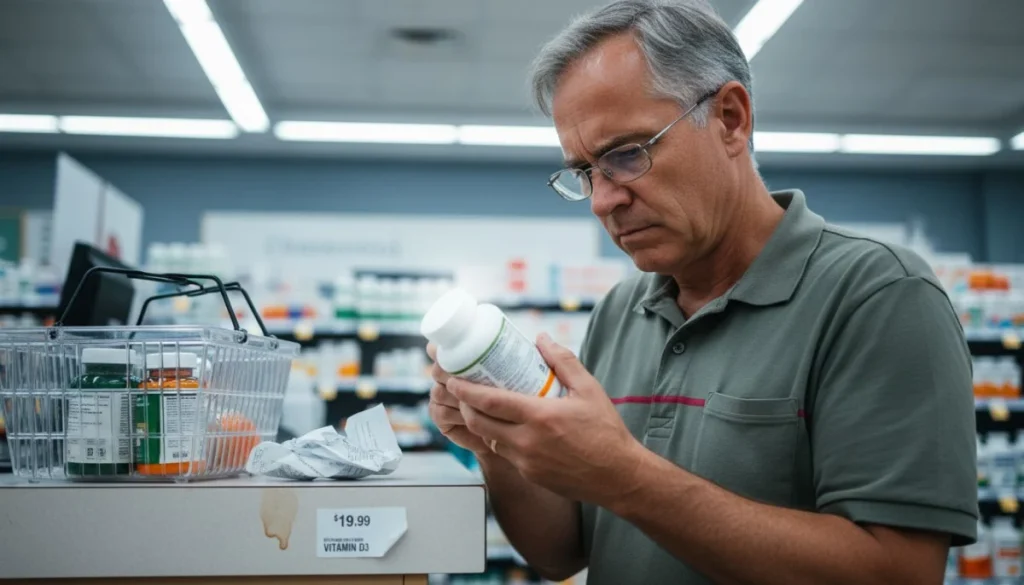
Every dietary supplement sold in the United States carries the same basic building blocks. Once you know where each one sits, a label takes about a minute to read.
Statement of identity
The front of the package must identify the product as a “dietary supplement” or use a similar term, often with the type of ingredient (for example, “vitamin C supplement” or “herbal supplement”).[1][3] If a product looks like a supplement but never says so, be careful about what you are actually buying.
The Supplement Facts panel
This boxed panel is the core of the label. FDA rules require the title “Supplement Facts,” the serving size, servings per container, and the name and amount of each dietary ingredient.[1][3] Ingredients that have recommended daily amounts (vitamins and minerals) are listed first, followed by ingredients with no established recommendation, such as herbs.[1]
Other ingredients
Below the panel you will find the non-active components: capsule shell, fillers, flow agents, colors and flavorings.[5] This is where you check for gelatin (if you avoid animal products), allergens, or added sugars and artificial colors.
Company name and contact details
A real label tells you who made, packed or distributed the product. You need this information to ask the company questions, and the NIH Office of Dietary Supplements advises reporting any bad reaction to the manufacturer using the contact information on the label.[5]
How to Read the Supplement Facts Panel, Line by Line
1. Serving size comes first
Every amount on the panel is per serving, and a serving is the amount the company recommends for one occasion.[1] If the serving is three capsules, a 500 mg ingredient means about 167 mg per capsule. When you compare two products, convert both to the same basis (per capsule or per day) before deciding which is stronger or cheaper. The suggested serving is the manufacturer’s suggestion; your health care provider may recommend a different amount.[5]
2. Amount per serving
Look for an actual number with a unit (mg, mcg, g or IU) next to each ingredient. A product that lists ingredients without amounts tells you almost nothing about what you are taking.
3. % Daily Value (%DV)
The %DV shows how much one serving contributes toward the reference amount for a nutrient. FDA uses the example that 60 mg of vitamin C equals 100% DV under the reference values in its guide, and %DVs are written for adults and children 4 years and older unless the label says otherwise.[1]
Two practical rules help here:
- An asterisk is normal for herbs. When no daily recommendation exists, the label shows an asterisk in the %DV column that points to “Daily Value not established.”[1] That is not a warning; it simply means no reference amount has been set.
- Very high percentages deserve a second look. Colorado State University Extension notes that products providing no more than 100% DV are usually considered safe and that high potency products above 100% DV should be reviewed with a health professional. It also points out that some manufacturers use very high numbers such as 250% DV as a marketing strategy.[6]
4. Botanical names and plant parts
For herbs, FDA rules call for the standard common name and, if that name is not in the reference used by the agency (Herbs of Commerce), the Latin name. The label must also identify the part of the plant used.[1] This matters: root, leaf, seed and fruit of the same plant can contain very different compounds. A label that says only “ginseng” with no species, plant part or form gives you much less to go on than “Panax ginseng (root) extract.”
Proprietary Blends: What They Hide
A proprietary blend groups several ingredients under one name, often a fanciful one. Under FDA rules, when individual amounts are not given, the company must state only the total weight of the blend and list its ingredients in descending order by weight.[1]
That rule creates a real blind spot. A “Vitality Matrix 1,000 mg” listing eight herbs could contain 900 mg of the first, cheapest ingredient and only a few milligrams of the rest. You cannot compare it to clinical studies, you cannot compare it to another product, and you cannot tell whether the amount of a given herb is meaningful.
Blends are legal, and some companies use them to protect a formula. But as a buyer, a fully disclosed label (every ingredient with its own amount) lets you check each dose against the research, which is why it is the better choice when everything else is equal.
Standardization and Extract Ratios
Botanicals are sold as dried whole plant powders, tinctures (soaked in alcohol and water), or extracts, which can be liquid or dried for capsules.[2] Different preparations of the same herb can deliver very different amounts of its constituents.[2]
“Standardized” means the manufacturer measured certain marker compounds and adjusted the extract so each batch contains a consistent amount.[2] That can be useful for consistency, but keep three facts in mind from the NIH Office of Dietary Supplements:
- U.S. law does not require supplements to be standardized.[2]
- There is no legal or regulatory definition of “standardized” in the United States.[2]
- For most botanicals, the compounds responsible for their effects are not known, so the chosen marker may not be the one that matters, and the word “standardized” does not necessarily mean the product is high quality.[2]
In practice, a standardized extract tells you more when the label names the marker compound and its percentage, and when that matches the preparation used in human studies of the herb.
Quick Reference: What to Look For
| Label element | What a good label shows | Red flag |
|---|---|---|
| Statement of identity | “Dietary supplement” or a similar term on the front | Product never identifies itself as a supplement |
| Serving size | Clear number of capsules or scoops per serving | Large serving that makes per capsule amounts look bigger than they are |
| Amount per serving | Each ingredient with mg, mcg, g or IU | Ingredients listed with no amounts |
| % Daily Value | %DV for nutrients; asterisk for herbs | Many nutrients far above 100% DV without a clear reason |
| Botanicals | Species, plant part and form (powder or extract) | Vague names such as “ginseng complex” |
| Blends | Every ingredient disclosed individually | “Proprietary blend” with only a total weight |
| Claims | General structure or function language with the FDA disclaimer | Promises to treat, cure or prevent a disease |
| Quality signals | Third-party seal from a recognized tester, company contact details | Unknown seals, no company address or phone |
Claims, Seals and FDA Rules
What the FDA does and does not do
The FDA does not have the authority to approve dietary supplements for safety and effectiveness before they reach shelves. Companies are responsible for making sure their products meet safety standards, and the FDA’s role mainly begins once a product is on the market: inspecting facilities, reviewing labels and websites, and monitoring adverse event reports.[3] Companies are required to report serious adverse events to the FDA within 15 days.[3]
The FDA also allows some leeway on amounts: under its labeling guide, a naturally occurring ingredient is not considered misbranded if testing finds at least 80% of the declared amount.[1] Harvard Health adds that the agency rarely penalizes manufacturers for not having the right amount of ingredients, and cites research that found melatonin gummies containing up to 347% more melatonin than listed.[4]
Disease claims are a red flag
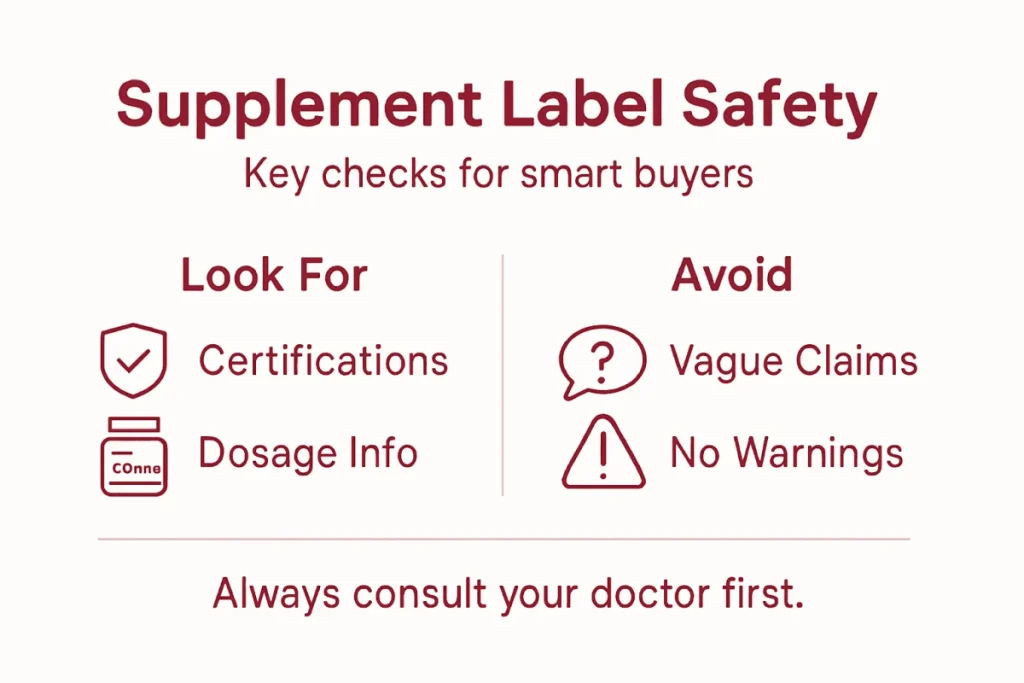
A product intended to treat, prevent, cure or relieve the symptoms of a disease is legally a drug, not a supplement.[3] Supplements may describe how an ingredient supports normal body structure or function, and those statements carry the familiar line “These statements have not been evaluated by the Food and Drug Administration.” If a label or website promises to cure a condition, or uses words like “miracle,” walk away. In the FDA’s words, if something sounds too good to be true, it probably is.[3]
Third-party seals
Independent groups such as U.S. Pharmacopeia, NSF International and ConsumerLab.com test products and may award a seal for proper manufacturing and label accuracy, but those seals do not guarantee a product is safe or effective.[5] Harvard Health warns that most seals of approval are meaningless and recommends seals from recognized certifiers instead.[4] Colorado State University Extension suggests also looking for a cGMP (current Good Manufacturing Practice) statement.[6] For a deeper look at how testing works, see our guide to third-party tested supplements.
“Natural” is not the same as safe
The NIH Office of Dietary Supplements notes that some natural botanicals, such as comfrey and kava, can harm the liver, and that supplements can interact with medicines: St. John’s wort can speed the breakdown of many drugs, and vitamin K can reduce the effect of the blood thinner warfarin.[5] If you take any prescription medicine, show the label to your doctor or pharmacist before you start a new product.
A Fully Disclosed Label in Practice: Ultra Bann
As an example of a label with no proprietary blend, Ultra Bann by DL Bioproducts lists every botanical with its own amount. The serving is one capsule, taken every 2 days, and it contains seven botanicals totaling 800 mg:
- Thai Butea superba: 345 mg
- Panax ginseng: 110 mg
- Cynomorium songaricum: 85 mg
- Black ginger (Kaempferia parviflora): 85 mg
- Tongkat ali: 85 mg
- Epimedium (horny goat weed): 45 mg
- Reishi (Ganoderma lucidum): 45 mg
Because each amount is on the label, you can compare any single herb with what studies used, which is the whole point of reading labels carefully. The full Ultra Bann ingredient label is published online. If you decide to try it, the first order includes free US shipping and a 60-day money-back guarantee through the Ultra Bann shop. As with any supplement, check with your doctor first if you take medication or have a health condition.
If you are also deciding whether you need basic vitamins and minerals, our article on whether men should take a multivitamin walks through the %DV side of the label in more detail.
Frequently Asked Questions
What does “Daily Value not established” mean on a supplement label?
It means no official daily reference amount exists for that ingredient, which is the case for most herbs. The label shows an asterisk in the %DV column that links to this footnote.[1] It is not a safety warning, but it does mean you need to compare the amount with research on that ingredient rather than with a %DV.
Are proprietary blends bad?
They are legal, but they limit what you can know. Only the total blend weight and the order of ingredients by weight are required,[1] so you cannot tell whether any single ingredient is present in a meaningful amount. When you can choose, a fully disclosed label is easier to evaluate.
Does “standardized extract” mean a supplement is better?
Not automatically. Standardization adjusts marker compounds for batch consistency, but U.S. law does not require it, there is no legal definition of the term, and for most botanicals the active compounds are not known.[2] It is more meaningful when the label names the marker and its percentage.
Does the FDA approve supplements?
No. The FDA does not approve dietary supplements for safety and effectiveness before they are sold. The company is responsible for safety and truthful labeling, and the FDA acts mostly after products reach the market.[3]
How do I report a bad reaction to a supplement?
Stop taking it, get medical advice, and report the problem to the FDA (the NIH lists 800-FDA-1088 and the online Safety Reporting Portal) as well as to the manufacturer using the contact details on the label.[3][5]
References
- U.S. Food and Drug Administration. Small Entity Compliance Guide: Statement of Identity, Nutrition Labeling and Ingredient Labeling of Dietary Supplements.
- NIH Office of Dietary Supplements. Botanical Dietary Supplements: Background Information. Updated 2020.
- U.S. Food and Drug Administration. FDA 101: Dietary Supplements. Consumer Update.
- Harvard Health Publishing. Start vetting your supplements. 2023.
- NIH Office of Dietary Supplements. Dietary Supplements: What You Need to Know. Updated 2023.
- Colorado State University Extension. Dietary Supplements: Vitamins and Minerals.
These statements have not been evaluated by the Food and Drug Administration. This product is not intended to diagnose, treat, cure or prevent any disease. This article is for information only and is not medical advice.
Ultra Bann natural male vitality support
1 capsule every 2 days. Free US shipping and a 60-day money-back guarantee on your first order.
See Ultra BannThese statements have not been evaluated by the Food and Drug Administration. This product is not intended to diagnose, treat, cure, or prevent any disease.