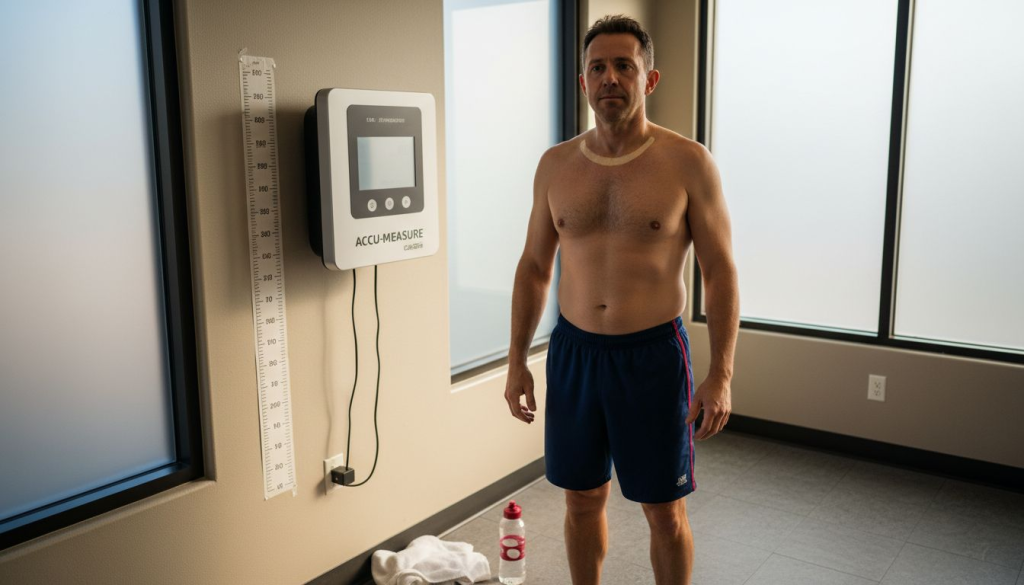
Short answer: A healthy body fat percentage for men usually falls between about 14% and 25%, with 6% to 13% typical of athletes and anything above 25% classed as obese on the chart used by Cleveland Clinic fitness centers.[6] Harvard Health notes that 14% is generally considered excellent for a healthy man, but there is no single “normal” number.[2] Where the fat sits matters as much as how much there is, so pair any body fat reading with a waist measurement and a check on how much muscle you are keeping.
Key Takeaways
- Body composition is the split between fat mass and lean mass (muscle, bone, organs and water). Two men with the same weight can have very different health profiles.
- On a common body fat chart for men, 6% to 13% is “athletes,” 14% to 17% is “fitness,” 18% to 25% is “acceptable” and above 25% is “obese.”[6]
- BMI is a screening tool, not a body fat test: the CDC states it cannot tell fat from muscle and bone, or show where fat is stored.[1]
- Visceral (belly) fat is the more harmful type. A waist of 40 inches or more signals excess visceral fat in men.[3]
- Muscle declines by roughly 3% to 5% per decade starting around age 30, so protecting lean mass is half of the composition story.[4]
- Strength training at least twice a week, regular aerobic exercise and adequate protein are the evidence-backed levers for improving composition.[3][4]
What Body Composition Means for Men
Your bathroom scale reports one number: total weight. Body composition breaks that number into parts. The simplest model has two compartments, fat mass and fat-free mass. Fat-free mass includes skeletal muscle, bone, organs and body water. Lab methods such as DEXA go one step further and also estimate bone mineral density.[5]
This matters because weight alone hides the trade-offs that happen with age and lifestyle. A man can stay at the same weight for ten years while slowly losing muscle and gaining fat, which is exactly the pattern that raises metabolic risk. Another man can be classed as “overweight” by BMI simply because he carries a lot of muscle.[1]
Subcutaneous fat vs visceral fat
Not all fat behaves the same way. Subcutaneous fat sits under the skin, the kind you can pinch, and Harvard Health describes it as causing few health issues. Visceral fat is stored inside the abdominal cavity, around organs such as the liver and pancreas. It makes up only about 10% of total body fat, yet high amounts are linked to higher blood pressure, blood sugar and total cholesterol.[3]
This is why a man with a “normal” overall body fat reading but a large belly may still carry more risk than his number suggests, and why waist size is worth tracking alongside body fat percentage. Our guide on how to measure your waist correctly walks through the tape technique step by step.
Healthy Body Fat Percentage for Men: The Ranges
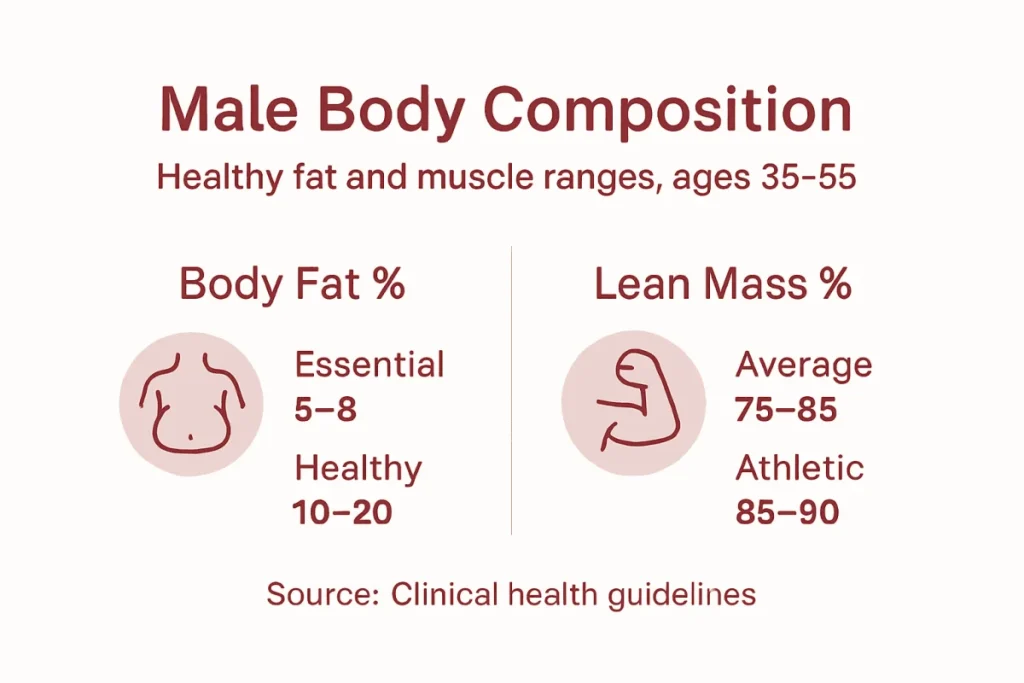
There is no universally agreed medical cutoff for body fat percentage. Researchers publishing in the American Journal of Clinical Nutrition noted that accepted ranges did not exist, and proposed building them by linking body fat measured with reference methods (a four-compartment model and DXA) in 1,626 adults to the existing BMI cutoffs.[7] In practice, gyms and fitness centers use category charts like the one below.
| Category (men) | Body fat % | What it usually means |
|---|---|---|
| Essential fat | 2 to 4% | Minimum needed for normal body function; not a sustainable everyday target |
| Athletes | 6 to 13% | Typical of trained, competitive athletes |
| Fitness | 14 to 17% | Lean and active; Harvard Health calls about 14% excellent for a healthy man[2] |
| Acceptable | 18 to 25% | Within a generally healthy range for most adult men |
| Obese | Above 25% | Higher fat level associated with increased health risk |
Source: Cleveland Clinic Fitness Centers skinfold worksheet (body fat chart for men).[6]
Two points keep this chart honest. First, the right number depends on overall health, fat distribution, metabolism and activity level, which is why Harvard Health avoids naming a single “normal” value.[2] Second, the reading you get depends heavily on how it was measured. The Cleveland Clinic worksheet itself notes an industry-standard 3% to 5% margin of error for skinfold results,[6] so a reading of 18% could plausibly be anywhere from the low teens to the low twenties.
How to Measure Body Fat: Methods Compared
The Harvard T.H. Chan School of Public Health lists the main methods and their trade-offs.[5] The practical rule: pick one method you can repeat under the same conditions and watch the trend, rather than comparing numbers from different devices.
| Method | How it works | Strengths | Limitations |
|---|---|---|---|
| BMI | Weight relative to height (lb / in / in x 703) | Free, easy, good for population screening | Cannot separate fat from muscle and bone or show fat location[1] |
| Waist circumference | Tape laid flat across the navel, standing, breathing normally | Good predictor of disease risk; tracks belly fat | Does not give a body fat percentage |
| Waist-to-hip ratio | Waist divided by hips at widest point of the buttocks | Cheap and predictive | Harder to interpret; cutoffs vary by ethnicity |
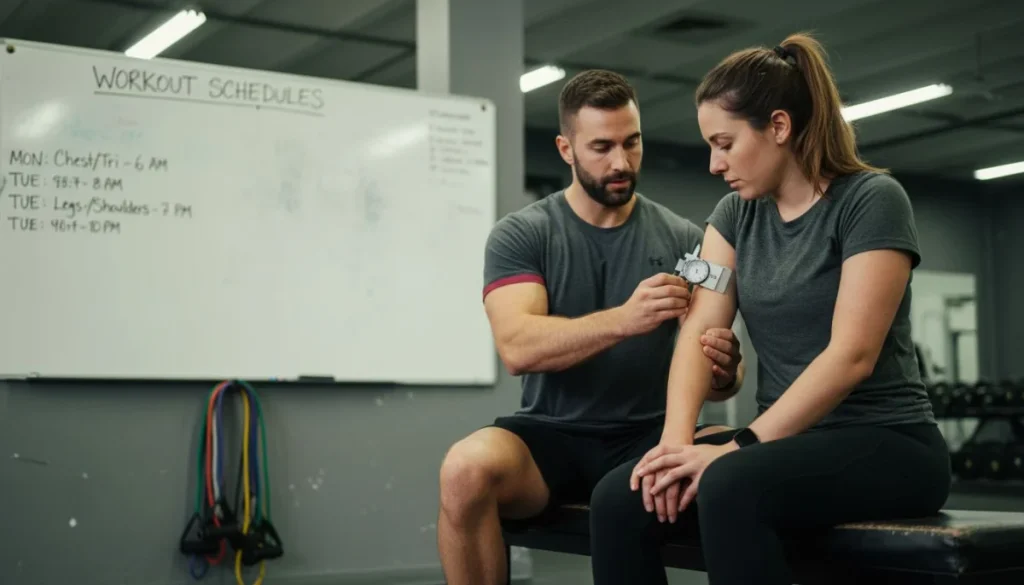
| Skinfold calipers | Pinch thickness at several sites, run through an equation | Inexpensive and convenient | Depends on tester skill; needs at least three measurements; less accurate with obesity |
| Bioelectrical impedance (smart scales, handhelds) | Small, safe current; fat resists it more than lean tissue and water | Convenient, portable, relatively cheap | Shifts with hydration, illness and weight loss; less accurate at BMI 35 or higher |
| Underwater weighing | Body density from weight on land vs fully submerged | Accurate | Costly, uncomfortable, mostly research settings |
| Air displacement (Bod Pod) | Body volume from air pressure changes in a chamber | Accurate, quick, comfortable | Expensive |
| DEXA | Two low-level X-ray beams | Accurate; also measures bone mineral density | Expensive; cannot separate visceral from subcutaneous fat; limited at BMI 35 or higher |
| CT and MRI | Imaging of fat compartments | Most accurate; can measure abdominal fat directly | Very expensive; research settings |
Source: Harvard T.H. Chan School of Public Health, The Nutrition Source.[5]
BMI vs body fat percentage
BMI is still useful. The CDC says it is moderately to strongly associated with measures that do capture fat amount and distribution, and the WHO cutoffs (18.5 to 24.9 normal, 25.0 to 29.9 overweight, 30 or higher obesity) remain the standard screen.[1][5] But the CDC is explicit that BMI is not a direct measure of body fat and that a muscular person may land in the overweight or obesity range.[1] Harvard Health adds that BMI is most meaningful at the extremes, at 30 or above or below 18.5.[2] If your BMI and your waist tell different stories, trust the waist more.
The best at-home routine
- Tape measure first. For men, a waist of 40 inches or more signals excess visceral fat;[3] Harvard Health suggests aiming for 35 inches or less and a waist-to-hip ratio of about 0.9.[2]
- Smart scale second. Weigh at the same time of day, under the same hydration conditions, and look at the four-week trend, not the daily figure.
- A DEXA scan occasionally, if you want a precise baseline that also covers bone density.
Muscle, Aging and Sarcopenia
Body composition can worsen even when weight is stable, because muscle quietly declines. Harvard Health describes a gradual loss of about 3% to 5% of muscle mass per decade starting at age 30, and says people who skip strength training can expect to lose four to six pounds of muscle per decade.[4] When the loss becomes significant it is called sarcopenia, which affects about 5% to 13% of people aged 60 to 70 and up to 50% of people 80 or older. It is closely linked with falls and fractures.[4]
Scales and BMI miss this entirely. A simple functional check is grip strength, a quick proxy for overall muscle health; see our guide to average grip strength by age to see where you stand.
How to Improve Your Body Composition
The goal is two-sided: reduce fat, especially visceral fat, while keeping or building muscle. The evidence points to the same few habits.
1. Strength train at least twice a week
Harvard Health recommends two strength sessions per week as part of a plan to cut visceral fat,[3] and its sarcopenia guide suggests sets of 8 to 12 repetitions for standard moves.[4] Resistance training is the main signal that tells your body to keep muscle while you lose fat.
2. Add aerobic work, including some intensity
For visceral fat, Harvard Health cites 30 minutes to an hour of moderate-intensity aerobic exercise two or three days a week, intense enough that conversation becomes difficult, with some sessions built as high-intensity interval training (HIIT).[3] Expect patience: visceral fat can be slow to come off.[3]
3. Eat enough protein
The RDA is 0.8 grams of protein per kilogram of body weight (about 58 grams a day for a 160-pound man).[3] For men doing regular strength and power training, Harvard Health notes that 1 to 1.2 grams per kilogram per day may help repair muscle.[4] For a full breakdown by body weight and goal, read how much protein men need per day.
4. Manage the calorie side sensibly
Fat loss still requires an energy deficit, but a slow one protects muscle better than a crash diet. Our guide to weight management for men covers practical ways to set that up, and good sleep supports the whole process (sleep routines for men).
When to Talk to a Doctor
Body fat charts are a fitness tool, not a diagnosis. See a clinician if your waist is at or above 40 inches, your BMI is 30 or higher, you are losing weight or muscle without trying, or you notice fatigue and weakness that do not improve with training. A doctor can combine your measurements with blood pressure, blood sugar and cholesterol results, which the CDC says should be weighed alongside BMI.[1]
Where Ultra Bann Fits
Ultra Bann is a natural male vitality supplement by DL Bioproducts, taken as one capsule every 2 days. It contains seven botanicals with every amount listed on the label (Thai Butea superba, Panax ginseng, Cynomorium songaricum, black ginger, tongkat ali, epimedium and reishi, 800 mg in total). It is not a fat-loss product, a protein source or a substitute for training, and nothing here suggests it changes body composition. If you are already handling the fundamentals above and want to try it, you can review the full label or visit the Ultra Bann shop; first orders ship free in the US and include a 60-day money-back guarantee.
Frequently Asked Questions
What is a healthy body fat percentage for a man?
On the chart used by Cleveland Clinic fitness centers, 14% to 17% is “fitness” and 18% to 25% is “acceptable,” with over 25% classed as obese.[6] Harvard Health considers about 14% excellent for a healthy man but stresses there is no single normal number.[2]
How accurate are body fat scales?
Smart scales use bioelectrical impedance, which is convenient but sensitive to hydration, illness and recent weight loss, and less accurate at a BMI of 35 or higher.[5] Use them for trends under consistent conditions, not as an exact figure.
Is BMI or body fat percentage better?
Body fat percentage describes composition directly; BMI does not. The CDC notes BMI cannot separate fat from muscle and bone or show where fat is stored.[1] BMI is still a useful quick screen, and waist size adds the fat-location information both of them miss.
What is the most accurate way to measure body fat?
CT and MRI are considered the most accurate, followed by DEXA, underwater weighing and air displacement, but these are expensive and often limited to clinical or research settings.[5] For most men, a DEXA baseline plus regular waist and scale checks is a practical combination.
Can you lose fat and gain muscle at the same time?
Many men improve both when they combine regular strength training, aerobic exercise and adequate protein, which is the approach Harvard Health recommends for cutting visceral fat and limiting age-related muscle loss.[3][4]
References
- Centers for Disease Control and Prevention. Frequently Asked Questions about BMI.
- LeWine HE. What is a healthy body fat percentage? Harvard Health Publishing, 2026.
- Harvard Health Publishing. An inside look at body fat.
- Harvard Health Publishing. A guide to combatting sarcopenia and preserving muscle mass as you get older.
- Harvard T.H. Chan School of Public Health. Body Fat (measuring fat). The Nutrition Source.
- Cleveland Clinic Employee Health Plan. Skinfold Pinch Test Worksheet (body fat chart). Updated 2025.
- Healthy percentage body fat ranges: an approach for developing guidelines based on body mass index. American Journal of Clinical Nutrition, 2000;72(3):694-701.
These statements have not been evaluated by the Food and Drug Administration. This product is not intended to diagnose, treat, cure or prevent any disease. This article is for information only and is not medical advice.
Ultra Bann natural male vitality support
1 capsule every 2 days. Free US shipping and a 60-day money-back guarantee on your first order.
See Ultra BannThese statements have not been evaluated by the Food and Drug Administration. This product is not intended to diagnose, treat, cure, or prevent any disease.