Short answer: In large British data pooled from twelve studies, average (median) grip strength for men peaks at about 51 kg (112 lb) in the 30s, is still about 48 kg at 50 and falls to about 39 kg at 70; for women the peak median is about 31 kg (68 lb). Grip matters because it tracks whole body strength: in the PURE study of nearly 140,000 adults, every 5 kg drop in grip was linked to a 16% higher risk of death from any cause. You can test it at home in two minutes with a hand dynamometer, and it responds to simple, regular training.
Key Takeaways
- Median grip strength in men peaks at about 51 kg between ages 29 and 39, then declines slowly through midlife and faster after 60 [1].
- Below about 27 kg for men or 16 kg for women is considered weak by population standards [1].
- In PURE, lower grip predicted all cause and cardiovascular death more strongly than systolic blood pressure did [2].
- Grip is a marker, not a proven cause: there is no evidence yet that training grip alone extends life [4].
- A cheap hand dynamometer, used seated with the elbow bent at 90 degrees, gives you a number you can compare to age norms [3].
- Compare yourself mainly with your own results over time, and with both hands: a large gap between hands is worth noticing [3].
What Grip Strength Is and Why Doctors Pay Attention to It
Grip strength is the maximum force your hand and forearm muscles can produce when you squeeze. Clinicians and researchers measure it with a handheld dynamometer, a device that reads out force in kilograms or pounds. A review in The Open Orthopaedics Journal describes the Jamar hydraulic dynamometer as the gold standard tool and calls grip strength a herald of overall health [3].
Why would a hand squeeze say anything about the rest of your body? Because people who are strong in the hand tend to be strong elsewhere, and muscle strength is a reflection of activity level, nutrition and general physical reserve. Harvard Health notes that weak grip is associated with lower overall strength, lower bone mineral density, falls and fractures, sleep problems, memory problems, depression, malnutrition and death from any cause [4]. That is a long list for a test that takes under a minute.
Grip also matters in a practical way. Opening jars, carrying groceries, holding a railing on the stairs and turning a stiff door handle all depend on it. Losing grip is one of the early, visible signs of the slow muscle loss that comes with age, which doctors call sarcopenia when it becomes significant.
Average Grip Strength by Age: The Norms
The most useful reference values come from a 2014 PLoS ONE paper by Dodds and colleagues, which pooled grip measurements from twelve British studies covering the whole life course [1]. The table below shows their centiles. The 50th centile is the median: half of people are stronger, half are weaker. Pound values are converted from the kilogram figures in the paper and rounded.
| Age | Men, 10th centile | Men, median (50th) | Men, 90th centile | Women, median (50th) |
|---|---|---|---|---|
| 30 | 38 kg (84 lb) | 51 kg (112 lb) | 64 kg (141 lb) | 31 kg (68 lb) |
| 40 | 38 kg (84 lb) | 50 kg (110 lb) | 63 kg (139 lb) | 31 kg (68 lb) |
| 50 | 35 kg (77 lb) | 48 kg (106 lb) | 60 kg (132 lb) | 29 kg (64 lb) |
| 60 | 33 kg (73 lb) | 45 kg (99 lb) | 56 kg (123 lb) | 27 kg (60 lb) |
| 70 | 29 kg (64 lb) | 39 kg (86 lb) | 49 kg (108 lb) | 24 kg (53 lb) |
| 80 | 23 kg (51 lb) | 32 kg (71 lb) | 42 kg (93 lb) | 19 kg (42 lb) |
| 90 | 16 kg (35 lb) | 25 kg (55 lb) | 33 kg (73 lb) | 14 kg (31 lb) |
Source: Dodds et al., PLoS ONE 2014, Table 2 [1].
How to read the table
- Peak: men reach a peak median of 51 kg between ages 29 and 39; women reach 31 kg between ages 26 and 42 [1].
- Midlife: the decline from 40 to 60 is gradual, about 5 kg at the median for men. The drop speeds up after 60.
- Weak grip thresholds: the same paper places a “weak” cut point (2.5 standard deviations below the young adult mean) at about 27 kg for men and 16 kg for women [1]. A large US analysis of adults over 50, summarized in the orthopaedics review, used similar cut points: under 26 kg for men and under 16 kg for women [3].
- Population matters: these are British values. Dodds and colleagues also found lower grip strength in people from developing regions, so the authors of the review suggest cut points may need to differ by region [3].
US data tell a similar story. In a set of American norms cited in the review, the median dominant hand grip for men aged 18 to 24 was 105.4 lb, compared with 65.0 lb for men aged 80 to 85 [3]. A separate UK Biobank analysis of more than 224,000 adults produced percentile norms for each hand by sex, age and body height, and also found that men were stronger than women and that grip declined with age [5]. If you are very tall or very short, height adjusted norms like these are a fairer comparison.
What the Evidence Links Grip Strength To
The PURE study (The Lancet, 2015)
The strongest single piece of evidence comes from the Prospective Urban Rural Epidemiology (PURE) study, led by Darryl Leong and published in The Lancet [2]. Researchers measured grip in 139,691 adults aged 35 to 70 in 17 countries and followed them for a median of 4 years. After adjusting for other factors, every 5 kg lower grip strength was associated with:
- 16% higher risk of death from any cause
- 17% higher risk of cardiovascular death
- 17% higher risk of non cardiovascular death
- 7% higher risk of heart attack
- 9% higher risk of stroke
The authors reported that grip strength was a stronger predictor of all cause and cardiovascular death than systolic blood pressure [2]. Just as important are the outcomes where grip did not help: PURE found no significant link with new diabetes, injury from falls or fractures [2].
Other human studies
The orthopaedics review collects many cohort studies that point the same way [3]:
- In more than 6,000 Japanese American men aged 45 to 68 in Hawaii, followed for 25 years, midlife grip strength predicted disability in old age.
- In more than 19,000 Americans over 50, the “weak” group had a 40% higher risk of early death than the not weak group, and 54% higher than the strong group.
- A difference of more than 10% between hands was linked to having multiple chronic conditions.
Marker, not magic
All of this is observational. It shows that weaker people tend to have worse outcomes, not that a stronger handshake protects you. Harvard Health states plainly that there is no evidence yet that building forearm muscle or grip strength improves longevity or overall health [4]. The useful reading is this: a low or falling grip score is a signal to look at your whole routine, including strength training, protein intake, sleep and any untreated health problems.
The 2 Minute Grip Strength Test at Home
Option 1: hand dynamometer (best)
Digital and hydraulic hand dynamometers are widely sold for home use and give you a number you can compare with the table above. The standard clinical protocol, described in the review [3], is simple:
- Sit in a straight backed chair with your feet flat on the floor.
- Keep your upper arm against your side, elbow bent to 90 degrees, forearm and wrist in a neutral position.
- Set the handle to the second position if your device is adjustable (this was the strongest setting for most hands in testing).
- Squeeze as hard as you can for a few seconds, then relax.
- Do three trials per hand with a short rest between them and record the average (some protocols use the best single trial; just be consistent).
Test both hands. If one hand is consistently more than about 10% weaker than the other, mention it at your next checkup [3].
Option 2: no equipment
Without a dynamometer you cannot compare yourself to published norms, but you can still track progress. Pick one or two of these and repeat them the same way every 6 to 8 weeks:
- Dead hang: hang from a sturdy pull up bar with straight arms and time how long you hold on.
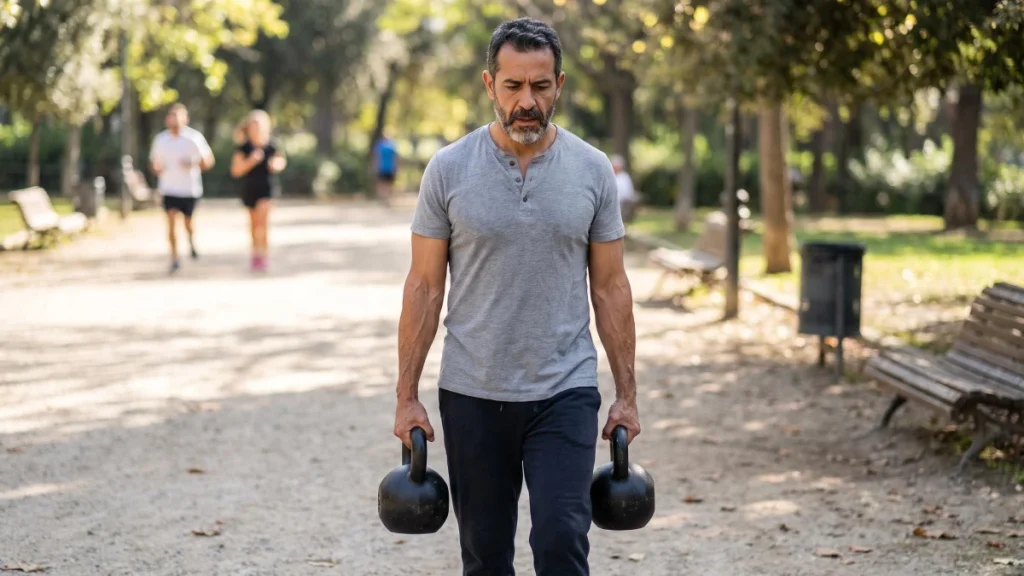
- Farmer’s hold: stand tall holding a heavy bag or water jug in each hand and time the hold. Use the same load every time.
- Bathroom scale squeeze: some people squeeze the edges of a mechanical scale to get a rough reading. It is not a validated test, so use it only to compare yourself with yourself.
Skip hanging and heavy holds if you have shoulder, elbow or wrist problems, or a heart condition, until your doctor clears you. Stop any test that causes sharp pain.
How to Improve Grip Strength
Grip responds to training like any other muscle group. Two approaches work well together: light, controlled hand and wrist work, and heavier full body lifts that load the grip naturally.
| Exercise | How to do it | Starting dose |
|---|---|---|
| Wrist flexion and extension | Light dumbbells (1 to 3 lb), elbows bent, palms down; lift and lower at the wrist, holding each end for a count of five | 1 set of 10, building to 2 to 3 sets [4] |
| Supination and pronation | Same position; rotate the forearm palm up, hold five, then palm down, hold five | 1 set of 10, building to 2 to 3 sets [4] |
| Putty or ball squeeze | Squeeze therapy putty in your palm, then release | 10 per hand, every other day [4] |
| Putty three point pinch | Pinch putty between thumb and the pads of index and middle fingers | 10 per hand, every other day [4] |
| Hand gripper | Close a spring gripper with control, then release slowly | A few minutes a day [4] |
| Farmer’s carry and dead hang | Walk holding heavy weights in each hand; hang from a bar with straight arms | Add 2 to 3 sets to regular strength sessions, progress gradually |
Tips that make the difference
- Train the whole body. Rows, deadlifts and carries build grip and the larger muscles that grip strength reflects. That is where the health signal really comes from.
- Progress slowly. Tendons in the forearm adapt more slowly than muscle. Add load or time in small steps.
- Support recovery. Adequate daily protein and good sleep support any strength program. Some men also use creatine with resistance training.
- Retest on a schedule. Every 6 to 8 weeks, same device, same time of day, same protocol.
When to Talk to a Doctor
A grip score is a screening signal, not a diagnosis. See a clinician if:
- Your grip falls below the weak thresholds above (about 27 kg for men, 16 kg for women) or drops noticeably within a few months.
- One hand is suddenly much weaker than the other, or you have numbness, tingling or hand pain. These can point to nerve, joint or neurological problems that need a proper exam.
- Weakness comes with unexplained weight loss, fatigue, falls or shortness of breath.
- You have heart disease, high blood pressure or recent surgery and want to start heavy carries or hangs.
Where Ultra Bann Fits
No supplement replaces strength training, and Ultra Bann makes no strength or grip claims. Ultra Bann is a natural male vitality supplement by DL Bioproducts, taken as one capsule every 2 days. Each 800 mg serving lists seven botanicals with their amounts on the label and no proprietary blend: Thai Butea superba 345 mg, Panax ginseng 110 mg, Cynomorium songaricum 85 mg, black ginger (Kaempferia parviflora) 85 mg, tongkat ali 85 mg, epimedium (horny goat weed) 45 mg and reishi 45 mg. You can review the full label or see it in the Ultra Bann shop, where first orders include free US shipping and a 60 day money back guarantee.
Frequently Asked Questions
What is a good grip strength for a man?
For a man in his 30s or 40s, about 50 to 51 kg (110 to 112 lb) is the median in British norms, and about 63 to 64 kg puts you in the top 10% [1]. At 60 the median is about 45 kg. Anything under about 27 kg is considered weak at any age [1].
What is the average grip strength for a 50 year old?
In the pooled British data, the median at age 50 is about 48 kg (106 lb) for men and 29 kg (64 lb) for women [1].
Can you improve grip strength after 50?
Yes. Grip responds to regular hand, wrist and full body strength work at any age. Start light, as in the Harvard Health routine of one set of 10 repetitions building to two or three sets, and progress gradually [4].
Does improving grip strength help you live longer?
Not proven. Studies like PURE show that lower grip is linked with higher mortality, but there is no evidence yet that training grip itself extends life [2] [4]. Grip is best used as a marker that tells you whether your overall strength routine is working.
Is grip strength measured with the dominant hand?
Most norms report the dominant or the stronger hand, but it is worth testing both. A difference of more than 10% between hands has been linked with multiple chronic conditions in research [3].
References
- Dodds RM, Syddall HE, Cooper R, et al. Grip strength across the life course: normative data from twelve British studies. PLoS ONE. 2014;9. doi:10.1371/journal.pone.0113637. Publication record
- Leong DP, Teo KK, Rangarajan S, et al. Prognostic value of grip strength: findings from the Prospective Urban Rural Epidemiology (PURE) study. The Lancet. 2015;386(9990):266 to 273. Abstract; see also NEJM CardioExchange summary
- Minasian R, Kuschner S, Lane C. A Review of Handgrip Strength and its Role as a Herald of Health. The Open Orthopaedics Journal. 2022;16. Full text
- Klein S. Forearm workouts: Strengthening grip for everyday function. Harvard Health Publishing. 2024. health.harvard.edu
- Spruit MA, et al. New Normative Values for Handgrip Strength: Results From the UK Biobank. Journal of the American Medical Directors Association. 2013. UK Biobank record
These statements have not been evaluated by the Food and Drug Administration. This product is not intended to diagnose, treat, cure or prevent any disease. This article is for information only and is not medical advice.
Ultra Bann natural male vitality support
1 capsule every 2 days. Free US shipping and a 60-day money-back guarantee on your first order.
See Ultra BannThese statements have not been evaluated by the Food and Drug Administration. This product is not intended to diagnose, treat, cure, or prevent any disease.