

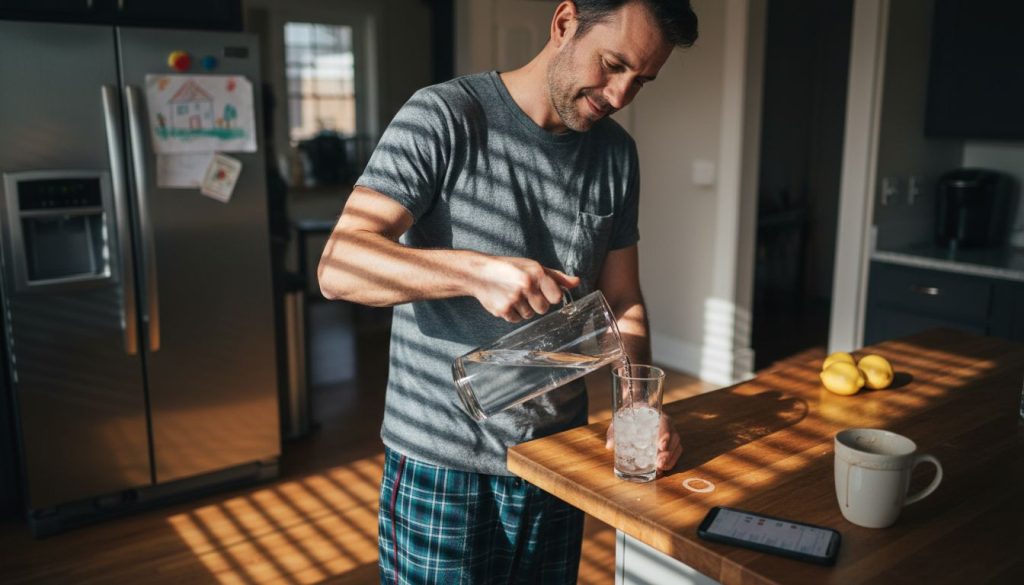
Short answer: A healthy adult man needs about 3.7 liters (roughly 15.5 cups, or about 125 fluid ounces) of total water a day from all sources, according to the National Academies reference values summarized by Harvard Health. About 3 liters (around 13 cups) of that typically comes from water and other drinks, and the rest from food. Heat, sweat, illness and some medical conditions move that number up or down, so use thirst and urine color as your daily check.[1][2][3]
Key Takeaways
- The reference figure for adult men is about 3.7 liters of total water per day, of which about 3.0 liters usually comes from beverages.[1][3]
- Food supplies about 20% of daily water, so you do not need to drink the full 3.7 liters as plain water.[2]
- Coffee, tea and milk count toward your fluid total. Sugary drinks count too, but add calories with little nutrition.[2][4]
- Colorless or light yellow urine is a simple sign you are drinking enough; dark urine suggests you are not.[2]
- In the heat, CDC workplace guidance is 1 cup of water every 15 to 20 minutes, and generally no more than 6 cups per hour.[5]
- More is not always better: drinking far more than your kidneys can clear can dilute blood sodium (hyponatremia), which can be life threatening.[1][2]
How Much Water Should a Man Drink a Day? The Real Numbers
The most cited figure comes from the Dietary Reference Intakes for water published by the Institute of Medicine (now the National Academies). It set an Adequate Intake of 3.7 liters of total water per day for adult men (the report lists this for men 19 to 30, and Harvard Health presents the same 15.5 cups as the general figure for men).[1][3] “Total water” means everything: plain water, coffee, tea, milk, juice, soup and the water inside food.
Of that total, the report notes that drinking water and other beverages supply about 3.0 liters a day for men, which works out to roughly 13 cups or 101 fluid ounces.[1] Mayo Clinic adds that food provides about 20% of the water you need each day.[2]
Two important details often get lost:
- It is an Adequate Intake, not a hard target. The National Academies report states that fluid intake driven by thirst and drinking with meals allows healthy people to maintain normal hydration.[1] The number describes what well hydrated men typically take in, not a quota you must hit by force.
- Plain water is only part of it. Harvard Health notes that most people need about four to six cups of plain water a day, because the rest of the total comes from other drinks and foods.[3]
What about the “8 glasses a day” rule?
Mayo Clinic describes eight glasses a day as an easy to remember goal, while noting that some people need less and some need more.[2] For most men, eight 8 ounce glasses (about 1.9 liters) of plain water plus the fluid from coffee, tea, milk and food lands in a reasonable range on an ordinary day. On hot or active days, it is usually not enough.
Daily Water Intake for Men by Activity, Heat and Health
Your real need depends on how much water you lose. The National Academies report states that higher intakes are required for people who are physically active or exposed to hot environments.[1] The CDC lists hot climates, more activity, fever, diarrhea and vomiting as situations where you need more water.[4] The table below pulls the sourced guidance together.
| Situation | What the sources say | Practical approach |
|---|---|---|
| Ordinary day, mild weather, desk job | About 3.7 L total water for men, about 3.0 L of it from drinks[1] | Drink with every meal and between meals; aim for light yellow urine |
| Workout or sports | Drink extra water before, during and after activity that makes you sweat[2] | Start the session hydrated and sip during it; drink again afterward |
| Moderate work in the heat, under 2 hours | 1 cup (8 oz) every 15 to 20 minutes[5] | Do not wait for thirst; keep a bottle within reach |
| Sweating for several hours | Use sports drinks with balanced electrolytes; fluid generally should not exceed 6 cups per hour[5] | Replace salt as well as water on long, sweaty days |
| Hot or humid weather, high altitude | Needs go up[2] | Add water above your usual routine |
| Fever, vomiting or diarrhea | Fluid losses increase[2][4] | Drink small amounts often; see a clinician if you cannot keep fluids down |
| Heart, kidney, liver or thyroid disease; water retaining medicines | You may need less water[3] | Follow your doctor’s fluid target, not a general rule |
How to Tell If You Are Drinking Enough
You do not need a lab test to check hydration on a normal day. Mayo Clinic gives two simple signs: you rarely feel thirsty, and your urine is colorless or light yellow.[2] Harvard Health lists dark yellow urine, weakness, low blood pressure, dizziness and confusion as warning signs of dehydration.[3] The CDC adds that dehydration can cause unclear thinking, mood changes, overheating, constipation and kidney stones.[4]
Thirst gets less reliable with age
Harvard Health points out that older adults may not feel thirst as strongly, which is a particular concern for men taking diuretics (water pills), since those medicines increase fluid loss.[3] If that applies to you, it is worth agreeing on a daily fluid plan with your doctor instead of relying on thirst alone.
Detailed signs and common myths about dehydration are a topic of their own; this page focuses on how much to drink.
What Counts Toward Your Daily Water Intake
Many men undercount their intake because they only count glasses of plain water. According to Mayo Clinic, tea, coffee and milk count toward how much you should drink each day.[2] Harvard Health agrees that caffeinated and even alcoholic drinks still add to total fluid intake overall, though it also reminds men to stay within one to two alcoholic drinks per day.[3]
Drinks that count but come with a cost
Soda, sports drinks and fruit or vegetable juices also add fluid, but Mayo Clinic warns about their sugar, salt and calories.[2] The CDC notes that regular sodas, fruit drinks, sports drinks, energy drinks, sweetened waters and sweetened coffee and tea contain calories but little nutritional value, and that energy drinks can carry large amounts of added sugar, caffeine and other stimulants.[4] Because water has no calories, swapping sugary drinks for plain water is one of the easiest ways to cut calories without changing what you eat.[4]
Food counts too
Fruits and vegetables with a high water content add meaningfully to your total, according to the CDC.[4] Harvard Health suggests salads, fruit and applesauce as easy options.[3] A diet built around produce, soups and whole foods quietly covers a share of your daily water without a single extra glass. If you are building meals around training, our guide to what to eat before a workout pairs well with a hydration plan.
How to Drink More Water: Practical Habits That Work
Knowing the number is easy. Hitting it on a busy day is the hard part. These habits come straight from CDC and Harvard Health recommendations:[3][4]
- Carry a reusable bottle. If you know your bottle holds 750 ml or 1 liter, you can count refills instead of glasses.
- Drink with every meal. Serving water at meals and ordering water when eating out are two of the CDC’s top tips.
- Spread it out. Harvard Health recommends drinking fluids gradually through the day rather than all at once.
- Attach it to routines. Have a drink when you take medicine, after coffee, or at social occasions.
- Make it taste better. A wedge of lime or lemon makes plain water easier to drink.
- Keep it cold. Freezing water in freezer safe bottles gives you cold water through the day.
- Swap one sugary drink. Replacing one soda or sweetened coffee with water improves both hydration and calorie intake.
A glass of water is also an easy anchor for a healthy morning routine, and steady hydration is one of the simple basics covered in our guide on how to get more energy.
Can a Man Drink Too Much Water?
Yes, although it is rare in healthy adults. Mayo Clinic explains that drinking too much water can lower blood sodium, a condition called hyponatremia that can be life threatening.[2] The National Academies report describes how excess intake of low sodium fluids combined with low sodium intake can lead to excess body water, hyponatremia and swelling of cells, and notes that acute water toxicity has occurred after rapid intake of large volumes that exceed the kidneys’ maximum excretion rate of about 0.7 to 1.0 liter per hour.[1]
That is why the CDC heat guidance caps intake at about 6 cups per hour and recommends electrolyte drinks when sweating lasts for several hours.[5] MedlinePlus lists symptoms of low blood sodium that include confusion, irritability, headache, fatigue, nausea and vomiting, muscle weakness or cramps, and in severe cases convulsions, and its prevention advice is to use fluids containing electrolytes during sports or vigorous activity.[6] MedlinePlus also lists diuretic medicines, heart failure, kidney disease, cirrhosis, heavy sweating, vomiting and diarrhea among the causes of low sodium.[6]
Who should get a personal target from a doctor
- Men with heart failure or other heart problems, kidney disease, liver disease or thyroid disease.[3]
- Men taking medicines that cause water retention, such as NSAIDs, opiate pain medicines or some antidepressants, or taking diuretics.[3]
- Anyone with confusion, severe headache, vomiting or muscle cramps after drinking large amounts of water or after a long, sweaty event. Seek medical care promptly.
Hydration and Supplements
Water does not replace food, sleep or medical care, and no supplement replaces water. If you take any capsule supplement, swallowing it with a full glass of water is a simple habit that also adds to your daily fluid total. Ultra Bann, a natural male vitality supplement from DL Bioproducts, is taken as one capsule every 2 days and lists its seven botanicals and their amounts on the label, with no proprietary blend. You can review the full label on the ingredients page or see the product in the Ultra Bann shop. First orders include free US shipping and a 60 day money back guarantee.
Frequently Asked Questions
How many bottles of water should a man drink a day?
Using a standard 500 ml (about 16.9 oz) bottle, the roughly 3.0 liters men typically get from beverages equals about 6 bottles, but coffee, tea, milk and other drinks count toward that. If you drink a few cups of coffee or tea, 4 to 5 bottles of plain water is often enough on an ordinary day. Hot or active days need more.[1][2]
Is 1 gallon of water a day too much for a man?
A US gallon is about 3.8 liters, slightly more than the total water reference for men from all sources. For a healthy man spreading it over the day, especially when active or in heat, it is generally manageable. It is unnecessary on a quiet day, and men with heart, kidney or liver disease should follow their doctor’s limit.[1][3]
Does coffee dehydrate you?
Not in the amounts most people drink. Mayo Clinic says coffee and tea count toward your daily fluid, and Harvard Health says caffeinated drinks still add to total fluid intake overall.[2][3]
How much water should I drink when working out?
Drink extra before, during and after exercise that makes you sweat.[2] For moderate activity in the heat under 2 hours, CDC guidance is 1 cup every 15 to 20 minutes, and for several hours of sweating it recommends sports drinks with electrolytes, generally staying at or below 6 cups per hour.[5]
Do men need more water than women?
Yes, on average. Harvard Health lists about 15.5 cups of total water a day for men and about 11.5 cups for women.[3] Individual needs vary with activity, climate and health.
References
- Institute of Medicine (National Academies). Dietary Reference Intakes for Water, Potassium, Sodium, Chloride, and Sulfate, Chapter 4: Water. National Academies Press, 2005.
- Mayo Clinic Staff. Water: How much should you drink every day? Mayo Clinic, updated 2026.
- Harvard Health Publishing. How much water should you drink? Harvard Medical School, updated 2023.
- Centers for Disease Control and Prevention. About Water and Healthier Drinks. CDC, 2026.
- Centers for Disease Control and Prevention, NIOSH. Heat Stress: Workplace Recommendations. CDC, 2026.
- MedlinePlus Medical Encyclopedia. Low blood sodium. US National Library of Medicine.
These statements have not been evaluated by the Food and Drug Administration. This product is not intended to diagnose, treat, cure or prevent any disease. This article is for information only and is not medical advice.
Ultra Bann natural male vitality support
1 capsule every 2 days. Free US shipping and a 60-day money-back guarantee on your first order.
See Ultra BannThese statements have not been evaluated by the Food and Drug Administration. This product is not intended to diagnose, treat, cure, or prevent any disease.

