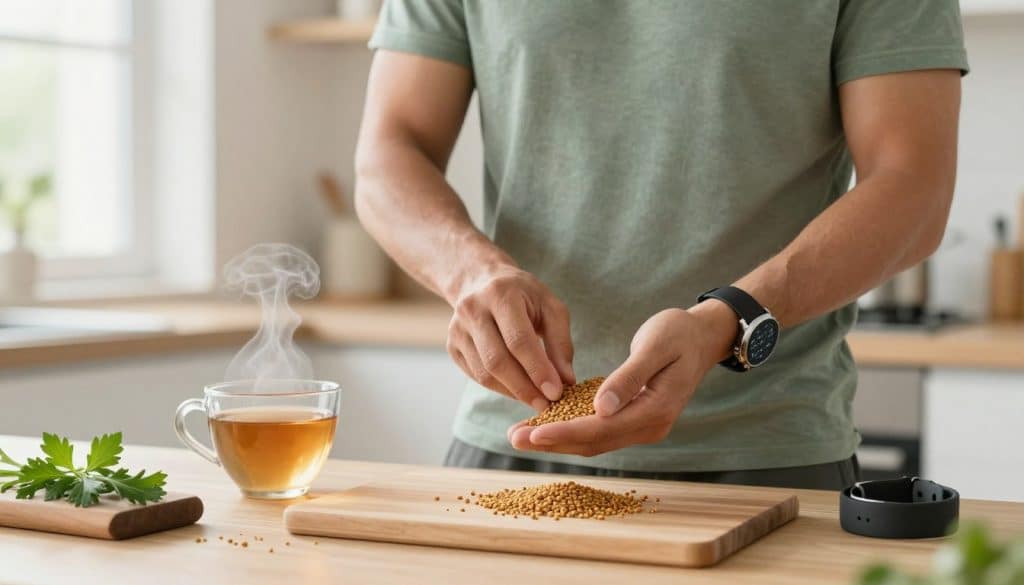
Short answer: The best studied fenugreek benefits for men are modest. A 2026 meta-analysis of placebo-controlled trials found a small, very uncertain rise in total testosterone, no reliable change in free testosterone, and some signals for lower body fat and better strength when men were also lifting weights. Fenugreek may also help lower blood sugar, but the quality of that research is low. It is generally safe in food amounts, yet it can upset the stomach, trigger allergies (especially in people allergic to peanuts or other legumes) and interact with blood thinners and diabetes drugs.
Key Takeaways
- Fenugreek (Trigonella foenum-graecum) is a seed spice from the Mediterranean, southern Europe and western Asia, sold as a supplement mainly for blood sugar, appetite and male vitality.
- Across 6 trials with 385 men, fenugreek extract produced a small increase in total testosterone, but the authors rated the certainty as very low and said the data do not support testosterone boosting claims.[1]
- Free testosterone, the fraction your tissues can actually use, showed no stable benefit.[1]
- Most male trials used 500 to 600 mg per day of a standardized seed extract for 8 to 12 weeks.[1]
- Common side effects are digestive: gas, bloating, nausea and diarrhea. Men on warfarin, antiplatelet drugs, SSRIs or glucose lowering medication should talk to a doctor first.[3][4][5]

What Fenugreek Is and Why Men Take It
Fenugreek is a clover-like herb whose small, golden seeds have a maple-like flavor. Cooks use them in curries and spice blends, and traditional medicine has used them for centuries as a tonic and digestive aid.[3] In Europe, the regulator’s herbal committee recognizes fenugreek seed only for traditional uses: temporary loss of appetite and, applied to the skin, minor skin inflammation.[6]
Men’s supplements took a different route. Standardized seed extracts have since been tested in randomized trials looking at testosterone, libido, strength and body composition. That research is the reason “fenugreek for men” became a popular search. It is also why the evidence needs a careful read: the trials are small and short, and reviewers judged most of them to carry some risk of bias.[1]
What the Research Shows in Men
Testosterone
The most complete look at the question is a 2026 systematic review and meta-analysis in Frontiers in Nutrition. The authors gathered 13 randomized placebo-controlled trials; eight of them reported testosterone data from 637 randomized men.[1]
- Total testosterone: pooling 6 studies (385 participants) gave a small favorable effect (standardized mean difference 0.25). Results were consistent between studies, but the effect is small.
- Free testosterone: pooling 5 studies (334 participants) showed no meaningful effect, with wide disagreement between trials.
- Quality: none of the trials was rated low risk of bias overall, and the certainty of evidence for both outcomes was rated very low.
The authors concluded that fenugreek “may” be linked to a small total testosterone effect, but that the evidence does not support clinical or commercial testosterone boosting claims.[1] An earlier meta-analysis of 4 randomized trials, published in Phytotherapy Research in 2020, also reported a significant effect on total serum testosterone, but it was based on far fewer studies.[2]
In plain terms: if your testosterone is genuinely low, fenugreek is not a substitute for a medical workup. If you want to understand the warning signs first, read our guide to the signs of low testosterone.
Libido and sexual well-being
Sexual function was a secondary outcome in several trials, measured with questionnaires. In the 2026 review, one scale (the Derogatis Interview for Sexual Functioning total score) favored fenugreek, while the sexual domain of the Aging Males’ Symptoms scale showed no clear difference.[1] The review did not produce a pooled libido estimate, and the authors noted these outcomes cannot prove that any effect works through testosterone. Mixed questionnaire results from small trials are a reason for curiosity, not confidence.
Strength and body composition
Trials that paired fenugreek with resistance training are where the more interesting signals appear. Pooled data showed body fat percentage fell by about 1.4 percentage points more than placebo, and bench press one rep max rose by roughly 4.9 kg more.[1] Fat-free mass results were not stable. These numbers come from men already training, so the extract looks like a possible small add-on to a lifting program, not a replacement for one.
Blood sugar
Fenugreek seeds are rich in fiber, and some studies suggest they may lower blood sugar in people with type 2 diabetes. The National Center for Complementary and Integrative Health (NCCIH) notes that many of those studies were of low quality and that there is not enough high-quality evidence to say fenugreek is useful for diabetes.[3] Memorial Sloan Kettering’s integrative medicine service reaches a similar view: it may help lower blood sugar and cholesterol, but data are limited.[4]
Human versus lab evidence
Many websites list dozens of fenugreek benefits, from heart health to anti-inflammatory effects. Most of those claims rest on cell or animal studies. Keep them separate in your mind: the human evidence for men is limited to the outcomes above, and even there certainty is low.
| Outcome in men | What human trials show | Strength of evidence |
|---|---|---|
| Total testosterone | Small increase vs placebo (6 trials, 385 men) | Very low certainty |
| Free testosterone | No stable effect (5 trials, 334 men) | Very low certainty |
| Libido and sexual function | Mixed questionnaire results; no pooled libido estimate | Weak |
| Body fat (with training) | About 1.4 percentage points lower vs placebo | Limited |
| Bench press strength (with training) | About 4.9 kg more vs placebo | Limited |
| Blood sugar | May lower it in type 2 diabetes; many low-quality studies | Low |
Sources for the table: Frontiers in Nutrition 2026 meta-analysis[1] and NCCIH[3].
How Fenugreek Might Work
Researchers have proposed a few mechanisms, none of them proven in men:
- Standardized extracts: the trials in men used concentrated seed extracts rather than kitchen amounts of the spice, so any hormonal effect is thought to come from compounds concentrated in those extracts. Which compound matters most is still unsettled.
- Estrogen receptor activity: Memorial Sloan Kettering describes fenugreek as an estrogen receptor modulator that stimulated breast cancer cells in a lab study.[4] That is one reason hormone-sensitive conditions call for caution.
- Fiber: the seeds’ soluble fiber slows digestion, which helps explain the blood sugar findings and the digestive side effects.[5]
How Much Fenugreek Men Take
Dose depends heavily on the form. A standardized extract is concentrated, while whole seed powder is mostly fiber.
- Standardized seed extract: most male trials used 500 to 600 mg per day for 8 to 12 weeks. One 12-week trial compared 600, 1,200 and 1,800 mg per day.[1]
- Whole seed or powder: LiverTox reports doses used in studies ranging from 2 to 100 grams daily, often split into two or three doses.[5] The European Medicines Agency notes that more than 25 g per day of seed powder has been linked to minor stomach symptoms.[6]
Practical tips: take it with a meal, start at the low end, and give any extract at least 8 weeks before judging it, since that is how long most trials ran. Check the label for the extract’s standardization, and favor brands that publish third-party testing.
Side Effects and Safety
Fenugreek is considered safe for adults in food amounts and possibly safe in larger supplement amounts.[3] LiverTox gives it a likelihood score of E, meaning it is an unlikely cause of clinically apparent liver injury.[5] Still, it has real downsides:
- Digestive upset: gas, bloating, nausea and diarrhea are the most common complaints.[3][5]
- Low blood sugar: large doses may cause a harmful drop in blood sugar.[3]
- Allergy: allergic reactions, sometimes serious, have been reported. People allergic to peanuts, soy or other legumes should avoid it.[3][6]
- Bleeding risk: case reports suggest fenugreek may strengthen the effect of warfarin, and LiverTox flags a higher risk with antiplatelet drugs.[4][5]
- Serotonin syndrome: one case report involved fenugreek taken with the antidepressant sertraline.[4]
Short trials in men did not report serious side effects attributed to fenugreek, but follow-up was brief and reporting was inconsistent.[1]
Who should avoid fenugreek or talk to a doctor first
- Men taking warfarin, antiplatelet drugs, SSRIs or diabetes medication.
- Anyone with a hormone-sensitive cancer or a history of one.[4]
- People allergic to peanuts, soy or other legumes.[6]
- Pregnant women: amounts above food levels are not considered safe and have been linked to birth defects.[3] This matters if your partner shares your supplements.
- Anyone under 18.[6]
- Men with symptoms such as low sex drive, erection problems or fatigue that has lasted for weeks. These deserve a proper medical evaluation, not a supplement trial.
Fenugreek vs Other Herbs Men Use
Fenugreek is one of several botanicals marketed for male vitality, and none of them is a shortcut. Sleep, resistance training, a healthy waistline and a solid diet still do most of the work; see our list of foods linked to healthy testosterone for the nutrition side. If you are comparing herbs, read about Panax ginseng for men and tongkat ali side effects, which cover two other widely studied options.
Where Ultra Bann Fits In
A quick note on our own product, so there is no confusion. Fenugreek is not one of its ingredients.
Ultra Bann is a natural male vitality supplement by DL Bioproducts, taken as one capsule every 2 days. Each serving lists seven botanicals with their exact amounts, and there is no proprietary blend: Thai Butea superba 345 mg, Panax ginseng 110 mg, Cynomorium songaricum 85 mg, black ginger (Kaempferia parviflora) 85 mg, tongkat ali 85 mg, epimedium (horny goat weed) 45 mg and reishi (Ganoderma lucidum) 45 mg, for 800 mg total. You can review the full label before you buy. First orders ship free in the US and come with a 60-day money-back guarantee. If that formula suits you better than a single herb, you can see Ultra Bann here.
Frequently Asked Questions
Does fenugreek increase testosterone in men?
Possibly a little. Pooled trials show a small rise in total testosterone, but no reliable change in free testosterone, and the certainty of the evidence is very low.[1] It should not be relied on to correct low testosterone.
How long does fenugreek take to work?
Most trials in men lasted 8 to 12 weeks, with one lasting 6 weeks.[1] If you try it, give it about two months before deciding whether you notice anything.
Is it safe to take fenugreek every day?
For most healthy adults, daily use in typical extract doses appears well tolerated in short trials. Digestive upset is the most common problem. Daily use is not a good idea if you take blood thinners, SSRIs or diabetes drugs without medical advice.[3][4][5]
Does fenugreek help with libido?
Results are mixed. One sexual function questionnaire favored fenugreek in the 2026 review, while another showed no clear difference.[1] Ongoing low libido can have medical causes and is worth discussing with a clinician.
When is the best time to take fenugreek?
Taking it with a meal is a sensible choice, since small studies suggest it lowers blood sugar when taken with meals.[4] Splitting larger seed powder doses across meals can also reduce stomach upset.[5]
References
- Yang P, Niu Z, Guo J, Huang T, Chang D, Huang X. Effects of oral fenugreek-derived preparations on testosterone-related outcomes in adult men: a systematic review and meta-analysis of randomized placebo-controlled trials. Frontiers in Nutrition. 2026;13. frontiersin.org
- Mansoori A, Hosseini S, Zilaee M, Hormoznejad R, Fathi M. Effect of fenugreek extract supplement on testosterone levels in male: a meta-analysis of clinical trials. Phytotherapy Research. 2020;34(7). PMID 32048383. Abstract record
- National Center for Complementary and Integrative Health. Fenugreek: Usefulness and Safety. Updated February 2025. nccih.nih.gov
- Memorial Sloan Kettering Cancer Center. Fenugreek (About Herbs). mskcc.org
- LiverTox: Clinical and Research Information on Drug-Induced Liver Injury. Fenugreek. National Institute of Diabetes and Digestive and Kidney Diseases. Updated January 29, 2018. ncbi.nlm.nih.gov
- European Medicines Agency, Committee on Herbal Medicinal Products. Fenugreek seed: Assessment Report Summary for the Public. 2025. ema.europa.eu
These statements have not been evaluated by the Food and Drug Administration. This product is not intended to diagnose, treat, cure or prevent any disease. This article is for information only and is not medical advice.
Ultra Bann natural male vitality support
1 capsule every 2 days. Free US shipping and a 60-day money-back guarantee on your first order.
See Ultra BannThese statements have not been evaluated by the Food and Drug Administration. This product is not intended to diagnose, treat, cure, or prevent any disease.