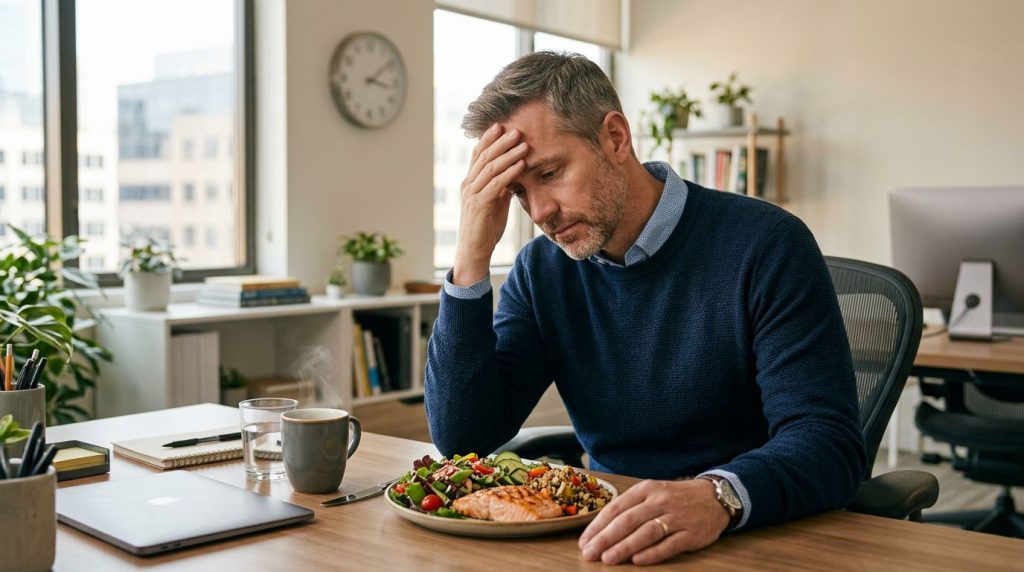
Short answer: Feeling tired after eating, especially after lunch, is mostly normal. Your body clock has a built-in early afternoon dip in alertness, and a large meal heavy in refined carbs or fat makes that dip deeper; short or poor sleep the night before amplifies both.[1][2] The fix is usually simple: eat a smaller lunch built on protein, fiber and slower carbs, skip lunchtime alcohol, walk for 10 minutes after eating, and time caffeine so it does not wreck tonight’s sleep. If the crash is frequent, severe or comes with other symptoms, see a doctor.
Key Takeaways
- Post-meal sleepiness (doctors call it postprandial somnolence) often starts 30 minutes to 2 hours after eating and can last up to 3 to 4 hours, and it is stronger after bigger, higher-energy meals.[1]
- The old idea that “all your blood goes to your stomach” has been disproven; gut signals, blood sugar and amino acid changes, brain arousal pathways and the circadian afternoon dip are the real drivers.[1][2]
- People who eat a big lunch tend to have a more pronounced afternoon slump, so the size of the plate matters as much as what is on it.[4]
- A 10 to 30 minute walk after eating, daylight, water and a short nap when possible are the best-supported quick fixes.[1][2][3]
- Frequent or severe sleepiness, loud snoring, dizziness after meals, or shakiness and sweating a few hours after eating are reasons to get checked, including blood sugar tests.[1]
Why You Get Tired After Eating Lunch
The afternoon slump is not one thing. It is a stack of four or five factors that pile up around the same hour, which is why it can feel so predictable at 2 or 3 p.m.
1. The circadian “post-lunch dip”
Your internal clock lowers its wake-promoting signals in the early afternoon. Sleep researchers call this the post-lunch dip, and it happens even when you skip lunch, although food makes it more noticeable.[2] On top of that, sleep drive builds the longer you are awake, so an afternoon meal is more likely to make you drowsy than breakfast.[2] Morning types (“larks”) are more likely than night owls to feel this dip after lunch.[2]
2. Meal size
Cleveland Clinic notes that post-meal sleepiness is stronger after larger, higher-energy meals.[1] Harvard Health reports the same pattern in real life: people who eat a big lunch tend to have a sharper afternoon slump.[4] A registered dietitian at Cleveland Clinic suggests a practical test: eat about half your usual lunch portion and add a small snack before and after instead.[3]
3. Meal composition and blood sugar
High-carbohydrate meals are more likely to cause sleepiness than lower-carb meals because they raise blood sugar quickly, and high-fat meals can also bring on fatigue.[2] Harvard Health explains that simple sugars give a quick boost that fades fast, leaving you depleted and wanting to eat more, while whole grains and unsaturated fats provide steadier reserves.[4] This is not a reason to cut carbs entirely. It is a reason to choose slower ones and pair them with protein and fiber.
4. Sleep debt
Poor or short sleep makes post-meal drowsiness more intense.[2] Adults generally need 7 to 9 hours a night, and even one bad night can throw off your rhythm.[3] If your slump is worst on days after late nights, sleep is your first lever, not lunch. Our guide on why you wake up tired covers the morning side of that problem.
5. Alcohol, caffeine timing and medicines
A beer or glass of wine at lunch adds its own sedation, and the effect is stronger when you are short on sleep.[2] Coffee late in the day can backfire: it may get you through 3 p.m. but disrupt the night, which sets up a worse dip tomorrow.[2][3] Some medicines also worsen post-meal sleepiness, including sedating antihistamines, sedating antidepressants, gabapentinoids, opioids and some blood pressure drugs in the beta and alpha blocker families.[1] Never stop a prescribed drug on your own; ask your prescriber whether timing or an alternative could help.
The Lunch Swap Table: Same Food Habits, Less Crash
Cleveland Clinic’s dietitian recommends a simple plate rule: fill half with non-starchy vegetables and split the other half between protein and carbohydrates, choosing carbs such as beans, sweet potatoes, squash or peas.[3] Cleveland Clinic’s food coma page adds a preference for lower glycemic index carbohydrates and smaller, balanced meals.[1] Here is how that looks with common lunches.
| Typical slump lunch | Easy swap | Why it helps |
|---|---|---|
| Large bowl of white pasta with cream sauce | Half portion of pasta with chicken or beans, tomato sauce and a big side salad | Smaller, less fatty meal; protein and fiber slow the blood sugar rise |
| Footlong white-bread sub, chips and soda | Half sub or wrap with lean protein, extra vegetables, fruit, and water or sparkling water | Cuts refined starch and sugar that give a quick boost and fast fade |
| Burger, fries and a shake | Burger (or grilled chicken) with a side salad or vegetables, no shake | Lower total energy and fat, which are linked to stronger post-meal sleepiness |
| Big plate of white rice with a small amount of meat | Smaller rice portion plus beans or lentils and a half plate of vegetables | Follows the half-vegetables, quarter-protein, quarter-carb plate |
| Pastry or muffin eaten at the desk | Greek yogurt with fruit and a few nuts, or eggs with whole-grain toast | Protein and fiber instead of a simple-sugar spike |
| Lunch with beer or wine | Same meal with water, unsweetened tea or coffee (before your cutoff) | Alcohol adds its own sleepiness, worse after a short night |
For a broader list of everyday foods that support steady energy, see foods that give you energy. This article stays focused on the after-lunch window.
What about mid-afternoon snacks?
Harvard Health suggests small meals and snacks every few hours to keep a steady stream of fuel to the brain, and notes that a piece of fruit or a few nuts is enough.[4] A planned snack around 3 p.m. is better than arriving at dinner starving, or reaching for candy when the dip hits.
The 10-Minute After-Lunch Reset
When the slump arrives anyway, this routine stacks the habits with the best support. It takes about 10 minutes and needs no equipment.
- Walk outside (minutes 0 to 8). Cleveland Clinic suggests a 10 to 30 minute walk after eating, and its dietitian notes that movement after a meal can help steady blood sugar.[1][3] Going outdoors adds daylight, which the Sleep Foundation lists as a way to push back post-meal sleepiness.[2]
- Drink a glass of water (minute 8). Staying hydrated is on the Sleep Foundation’s list of practical fixes.[2]
- Decide on caffeine (minute 9). If you want coffee or tea, have it now and only if bedtime is at least 8 hours away.[2] Black tea (about 71 mg per 12 oz) or green tea (about 37 mg) is gentler than brewed coffee (113 to 247 mg per 12 oz).[5]
- Start the next task standing or in bright light (minute 10). A bright-light lamp at the desk after lunch is one of the ideas Cleveland Clinic’s dietitian mentions.[3]
If you work somewhere a nap is possible, a 20-minute nap is another option Cleveland Clinic lists.[1] Keep it short so it does not interfere with night sleep.
Caffeine: how much and when
The FDA cites 400 mg a day, roughly two to three 12-ounce cups of coffee, as an amount not generally linked with negative effects in most healthy adults, but sensitivity varies a lot.[5] Too much can bring a racing heart, jitters, anxiety, upset stomach and poor sleep.[5] A useful rule: caffeine should solve today’s dip without creating tomorrow’s. Our article on how much caffeine is too much goes deeper.
A Simple One-Week Food Fix Plan
Change one variable at a time so you learn what actually drives your slump.
- Days 1 and 2: Keep your usual lunch but cut the portion roughly in half and add a fruit or nut snack mid-morning and mid-afternoon.[3][4]
- Days 3 and 4: Rebuild the plate: half vegetables, a quarter protein, a quarter slower carbs.[3] Drop lunchtime alcohol.
- Days 5 and 6: Add the 10-minute reset after every lunch.
- Day 7: Review. Was the dip smaller? Was it worse after short-sleep nights? That answer tells you whether to focus on food or on sleep.
If food changes help but energy is still low most of the day, not just after lunch, the problem is probably bigger than the post-lunch dip. Our pieces on how to get more energy and causes of low energy in men cover the wider picture.
When Being Tired After Eating Is a Medical Clue
Occasional sleepiness after a meal is common and is not, by itself, a sign of diabetes.[1] But Cleveland Clinic lists type 2 diabetes, overweight and obesity, metabolic syndrome, sleep disorders and depression as factors that raise the risk of strong post-meal sleepiness.[1] The Sleep Foundation adds sleep apnea, hypothyroidism, anemia and some digestive disorders, and Cleveland Clinic’s dietitian mentions celiac disease and food intolerances.[2][3]
Talk to a doctor if you notice any of the following:[1]
- Frequent or severe daytime sleepiness, not just a mild dip
- Loud snoring or pauses in breathing at night
- Dizziness or fainting after meals
- Shakiness, sweating or confusion a few hours after eating
- Thirst, frequent urination or blurred vision
Your doctor may check an A1c and sometimes an oral glucose tolerance test.[1] If you want to understand how insulin resistance is measured, see our explainer on the HOMA-IR test. One safety point: do not drive or run machinery when you are sleepy after a meal. Pull over, nap or delay the task.[1]
Where Ultra Bann Fits
Ultra Bann is a natural male vitality supplement by DL Bioproducts, taken as one capsule every 2 days. It contains seven botanicals with every amount on the label and no proprietary blend: Thai Butea superba, Panax ginseng, Cynomorium songaricum, black ginger (Kaempferia parviflora), tongkat ali, epimedium (horny goat weed) and reishi. It is not an energy product and it is not a fix for an afternoon slump; the lunch, sleep and movement changes above do that work. If you are curious about the formula, you can see it on the Ultra Bann shop page. First orders get free US shipping and a 60-day money-back guarantee.
Frequently Asked Questions
Why am I so tired after lunch but not after breakfast?
Two reasons. Your circadian rhythm dips in the early afternoon, and sleep pressure has been building since you woke up, so the same meal hits harder at 1 p.m. than at 8 a.m.[2] Lunch is also often the bigger, more carb-heavy meal of the workday.
Is being tired after eating a sign of diabetes?
Not by itself. Occasional post-meal sleepiness is common.[1] It is worth asking about screening if it is frequent, or if you also have thirst, frequent urination, blurred vision, or shakiness and sweating a few hours after meals.[1]
How long does a food coma last?
Sleepiness usually starts 30 minutes to 2 hours after eating, tends to peak within 1 to 2 hours, and can last up to 3 to 4 hours.[1]
What should I eat for lunch to avoid the afternoon slump?
A moderate portion with half the plate as non-starchy vegetables, a quarter protein and a quarter slower carbohydrates such as beans, lentils or sweet potato.[1][3] Limit refined sugar and white starches, and skip alcohol at lunch.[1][4]
Does a walk after lunch really help?
Yes, it is one of the most consistently recommended fixes. Cleveland Clinic suggests a 10 to 30 minute walk after eating, and doing it outside adds daylight, which also helps alertness.[1][2]
References
- Cleveland Clinic. Food Coma (Postprandial Somnolence). my.clevelandclinic.org
- Bryan L. Why You Get Sleepy After Eating. Sleep Foundation. Medically reviewed by Lulu Guo, MD. Updated October 28, 2025. sleepfoundation.org
- Cleveland Clinic Health Essentials. Why you feel tired after eating (with Julia Zumpano, RD, LD). 2022. health.clevelandclinic.org
- Harvard Health Publishing. Foods that fight fatigue. 2012. health.harvard.edu
- U.S. Food and Drug Administration. Spilling the Beans: How Much Caffeine Is Too Much? fda.gov
These statements have not been evaluated by the Food and Drug Administration. This product is not intended to diagnose, treat, cure or prevent any disease. This article is for information only and is not medical advice.
Ultra Bann natural male vitality support
1 capsule every 2 days. Free US shipping and a 60-day money-back guarantee on your first order.
See Ultra BannThese statements have not been evaluated by the Food and Drug Administration. This product is not intended to diagnose, treat, cure, or prevent any disease.