


Short answer: Healthy masculinity means keeping the strengths many men value (responsibility, courage, loyalty, protecting others) while dropping the rules that hurt health, such as hiding every emotion, never asking for help and treating risk as proof of manhood. The American Psychological Association links rigid “traditional masculinity ideology” to poorer mental and physical health and to men using health services less often.[1] In practice, healthy masculinity looks like a man who handles stress, talks to people he trusts, sees a doctor, and shows up for his family and community.
Key Takeaways
- Healthy masculinity (also called positive masculinity) is not about being softer or harder. It is about strength that also protects your own health and your relationships.
- The APA describes four core standards of traditional masculinity ideology: anti-femininity, achievement, avoiding any appearance of weakness, and adventure, risk and violence. Rigid adherence is linked to worse health.[1]
- Men are less likely than women to have received mental health treatment in the past year, yet the CDC reports men make up nearly 80% of US suicides.[2][3]
- Depression in men often shows up as anger, irritability, risk-taking, heavy drinking or unexplained aches rather than obvious sadness.[2][4]
- The most practical signs of healthy masculinity are habits: regular checkups, honest conversations, controlled anger, good sleep, limited alcohol and engaged fathering.
- If you or someone you know is in crisis in the US, call or text 988 (Suicide and Crisis Lifeline), 24 hours a day.

What Is Healthy Masculinity?
Healthy masculinity is a way of being a man that keeps the traits most people admire and lets go of the expectations that quietly damage health. It is not a political label, and it does not ask men to stop being competitive, protective or ambitious. It asks a simpler question: does this way of acting help you, and the people who depend on you, live longer and better?
Researchers often contrast it with “traditional masculinity ideology.” In its 2018 Guidelines for Psychological Practice with Boys and Men, the APA defines that ideology as a set of beliefs about how boys and men should and should not think and act, built around anti-femininity, achievement, avoiding any appearance of weakness, and adventure, risk and violence.[1] The guidelines are careful to note that these norms are not the same for every man and that men from different backgrounds may experience them differently.
The problem is not achievement or courage. The problem is rigidity. When “never look weak” becomes “never see a doctor” or “never admit you are struggling,” the cost shows up in the body and in relationships. The APA links this kind of gender role strain to poorer mental and physical health and to strained relationships.[1]
How Americans see masculinity today
Views are mixed rather than hostile. In a Pew Research Center survey of 6,204 US adults in September 2024, 43% said people in the US mostly view “manly or masculine” men positively, 25% said mostly negatively, and 31% said neither.[5] About 6 in 10 Americans said society does not place enough value on men who are caring or open about their emotions.[5] In other words, most people do not see masculinity itself as the problem, and many would welcome men being more open.
10 Signs of Healthy Masculinity
These are traits of a good man that you can actually observe in daily life, not abstract ideals.
1. He asks for help before things fall apart
The APA describes a “double jeopardy” pattern: the men who most need help are often the least likely to seek it, partly because of socialization toward self-reliance.[1] A man with healthy habits calls a doctor, a counselor or a friend early.
2. He can name what he feels
Saying “I am stressed,” “I am worried about money” or “I am angry and need ten minutes” is a skill. It lowers the chance that feelings come out sideways as drinking, shouting or shutting down.
3. He controls anger instead of being controlled by it
Anger is a normal emotion. Using it to intimidate or hurt people is not. Mayo Clinic lists hard to control anger and controlling or abusive behavior among possible signs of depression in men, so frequent rage is worth taking seriously.[4]
4. He takes his physical health seriously
The APA notes that men are less likely than women to use preventive care such as colorectal cancer screening.[1] Getting blood pressure, cholesterol, blood sugar and age-appropriate cancer screening done is a quiet sign of responsibility. See our guide to health screenings for men.
5. He manages risk instead of chasing it
According to the APA guidelines, risk-taking is a major driver of men’s higher death rates, and accidents are the leading killer of males aged 1 to 44.[1] Wearing a seatbelt, not driving after drinking and respecting safety gear at work are masculine choices, not timid ones.
6. He keeps real friendships
Mayo Clinic lists building social connections and seeking emotional support as core coping strategies.[4] A healthy man has at least one or two people he can talk to honestly, not just people he watches games with.
7. He respects boundaries
He hears “no” without taking it as an attack, whether from a partner, a coworker or his kids, and he sets his own boundaries clearly.
8. He is an engaged father or mentor
The APA estimates there are about 70 million fathers in the US and that more than 80% report being involved in their children’s lives.[1] Showing up, being patient and modeling honesty may be the most direct way men shape the next generation’s idea of manhood.
9. He takes accountability
He apologizes when he is wrong, repairs damage and does not blame others for every setback. That is strength in its most useful form.
10. He protects his sleep, body and mind
Regular movement, decent food, enough sleep and limited alcohol are the boring foundation of everything else. Our article on sleep routines for men covers the basics.
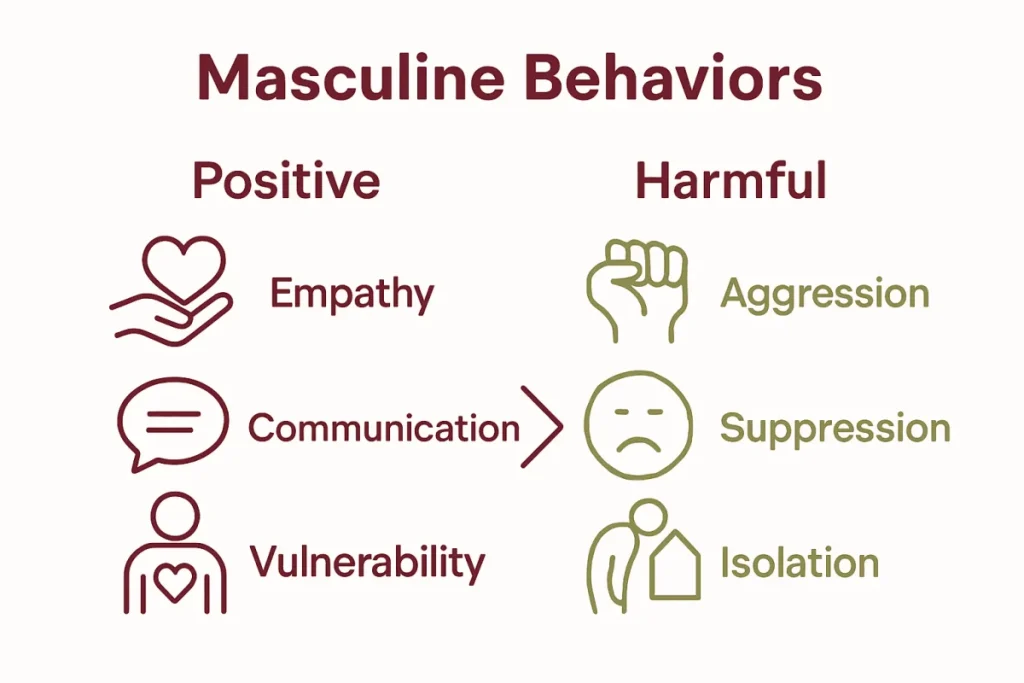
Habits That Help vs Habits That Harm Men’s Health
The table below turns the ideas above into everyday choices. The “harm” column reflects patterns the APA, NIMH and Mayo Clinic connect with worse outcomes in men.[1][2][4]
| Area | Habit that helps | Habit that harms |
|---|---|---|
| Stress | Talking it through, exercise, problem-solving, mindfulness | Bottling it up, heavy drinking, escaping into work |
| Help-seeking | Seeing a doctor or counselor early | Waiting until a crisis, “toughing it out” |
| Anger | Naming it, stepping away, returning to talk calmly | Shouting, intimidation, violence |
| Physical health | Annual checkup, screenings, knowing your numbers | Avoiding doctors, ignoring warning signs |
| Risk | Calculated challenges, safety gear, sober driving | Reckless driving, risk-taking to prove something |
| Relationships | Honest conversation, respect for boundaries | Control, withdrawal, silent treatment |
| Fatherhood | Presence, patience, modeling emotional honesty | Absence, harshness, “boys don’t cry” messages |
| Substances | Limited alcohol, no tobacco | Using alcohol or drugs to numb feelings |
Why It Matters: What the Data Shows About Men’s Health
Mental health and suicide
NIMH notes that several mental disorders are less common in men than women, but men are more likely to die by suicide and less likely to have received mental health treatment in the past year.[2] CDC data show the 2023 suicide rate among males was about four times higher than among females, and that males make up 50% of the population but nearly 80% of suicides.[3] The APA guidelines add that men report more stigma about seeking help than women do.[1]
That gap between need and help-seeking is exactly what healthy masculinity aims to close. Reaching out is not a failure of strength; it is how strong people stay functional.
Depression often looks different in men
Many men do not recognize depression because they expect sadness to be the main symptom. NIMH and Mayo Clinic both list signs that are more common in men, including anger, irritability or aggressiveness, misuse of alcohol or drugs, high-risk activities, escaping into work, and aches, headaches or digestive problems without a clear cause.[2][4] Mayo Clinic also notes that men may downplay symptoms or fear that stigma will hurt their career or family respect.[4] Long-term stress plays a role too; see our overview of stress symptoms in men.
Physical health and life expectancy
The APA guidelines report that men have higher death rates than women for most leading causes of death, that men’s age-adjusted death rates for heart disease and cancer are 50% and 80% higher respectively, and that men are more likely to smoke and drink heavily.[1] Many of these gaps are shaped by habits men can change, which is why healthy masculinity is a health topic and not only a social one. If you smoke, read about the benefits of quitting smoking.
Fathers can struggle too
According to the APA guidelines, postpartum depression affects roughly 10% of fathers in the 3 to 6 months after a birth.[1] New dads who feel flat, irritable or overwhelmed deserve the same support new mothers get.
How to Practice Healthy Masculinity Day to Day
- Book one appointment. A routine physical with blood pressure, cholesterol and blood sugar checks is a concrete start.
- Use a simple feelings check. Once a day, ask yourself: what am I feeling, and what do I need? Write one line if that helps.
- Have one honest conversation a week. With a partner, brother, friend or mentor. It does not have to be heavy.
- Build an anger plan. Notice the early signs (tight jaw, raised voice), step away, then come back to talk.
- Audit your drinking. If alcohol is how you unwind every night, that is a signal worth exploring with a professional.
- Move your body most days. Mayo Clinic includes exercise, a regular routine and healthy eating among practical coping steps.[4]
- Delay big decisions when you feel low. Mayo Clinic advises postponing major decisions, such as changing jobs, until you feel better.[4]
When to Talk to a Doctor or Counselor
See a healthcare professional if low mood, irritability, poor sleep, heavy drinking or loss of interest lasts more than a couple of weeks or starts affecting work, relationships or safety. A primary care doctor is a good first stop and can refer you to a therapist or psychiatrist.
If you are in crisis: in the US, call or text 988 to reach the 988 Suicide and Crisis Lifeline, available 24 hours a day, 7 days a week, or chat at 988lifeline.org. Veterans and service members can call 988 and press 1, or text 838255. If there is immediate danger, call 911.[2][4]
Mayo Clinic also recommends that anyone with suicidal thoughts who owns firearms unload them and store them locked away.[4]
Where Supplements Fit (and Where They Do Not)
No supplement is a substitute for sleep, exercise, relationships or professional mental health care. Ultra Bann is a herbal male vitality supplement made by DL Bioproducts, taken as one capsule every 2 days, with seven botanicals listed by amount on the label (no proprietary blend). Some men include it as one small part of a broader wellness routine. It is not a mental health product and should not replace talking to a doctor or counselor. You can review the full ingredient label or visit the Ultra Bann shop; first orders include free US shipping and a 60-day money-back guarantee.
Frequently Asked Questions
What is the difference between healthy masculinity and toxic masculinity?
Healthy masculinity keeps traits like responsibility, courage and protectiveness while allowing men to express emotions, seek help and respect others. “Toxic masculinity” is a popular term for the harmful extremes, such as using aggression to dominate, avoiding all vulnerability and taking dangerous risks to prove manhood. The APA uses the more neutral phrase “traditional masculinity ideology” and focuses on how rigid adherence affects health.[1]
What are the traits of a good man?
Common traits include honesty, accountability, reliability, respect for boundaries, emotional self-control, willingness to ask for help and active involvement with family and community. These are visible in behavior, not just in what someone says about himself.
Is positive masculinity the same as healthy masculinity?
Mostly, yes. Both terms describe a strengths-based view of manhood that emphasizes traits like courage, loyalty and care for others while supporting mental and physical health. “Positive masculinity” is often used in psychology, and “healthy masculinity” is more common in everyday conversation.
Why don’t men seek help for mental health?
Reasons include not recognizing that anger, irritability or physical symptoms can be signs of depression, seeing talk about feelings as unmanly, and fearing stigma at work or in the family.[1][4] Starting with a primary care doctor can feel less intimidating than going straight to therapy.
How can I support a man who is struggling?
Ask directly and listen without fixing everything at once. Do things side by side (a walk, a drive, a workout) if face-to-face talk feels awkward. Encourage a doctor visit, and if you are worried about his safety, call or text 988 together.[2]
References
- American Psychological Association. APA Guidelines for Psychological Practice with Boys and Men (2018).
- National Institute of Mental Health. Men and Mental Health.
- Centers for Disease Control and Prevention. Suicide Data and Statistics.
- Mayo Clinic. Male depression: Understanding the issues.
- Pew Research Center. How Americans See Men and Masculinity (October 17, 2024).
These statements have not been evaluated by the Food and Drug Administration. This product is not intended to diagnose, treat, cure or prevent any disease. This article is for information only and is not medical advice.
Ultra Bann natural male vitality support
1 capsule every 2 days. Free US shipping and a 60-day money-back guarantee on your first order.
See Ultra BannThese statements have not been evaluated by the Food and Drug Administration. This product is not intended to diagnose, treat, cure, or prevent any disease.

