


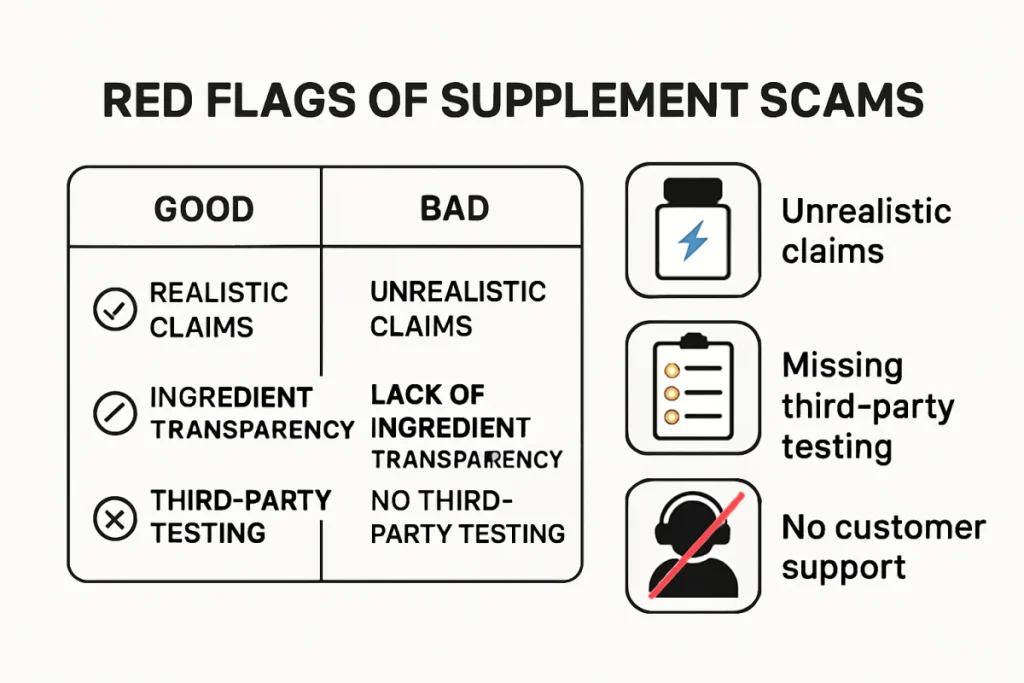
Short answer: Most supplement scams give themselves away with the same signals: one product that “does it all,” promises of fast or guaranteed results, “miracle” or “secret ingredient” language, testimonials instead of studies, hidden doses, and a “free” offer that turns into recurring charges. The most dangerous scams are products marketed for sexual performance, weight loss and bodybuilding, because the FDA keeps finding hidden prescription drug ingredients in them. Before you buy, check the label, the company, the price terms and the FDA’s public warning lists, and ask your doctor or pharmacist if you take any medication.
Key Takeaways
- Dietary supplements do not need FDA approval before they are sold, so “FDA approved” on a supplement is a red flag, not a credential.[1]
- The FDA lists six classic tip-offs of health fraud: one product does it all, personal testimonials, quick fixes, “all natural” cures, “miracle cure” language and conspiracy theories.[2]
- Products sold for sexual enhancement, weight loss and bodybuilding are the highest risk category for hidden prescription drugs.[3][4]
- “Natural” does not mean safe, and a quality seal shows the product contains what the label says, not that it works.[1]
- Under FTC guidance, health claims need competent and reliable scientific evidence, generally human clinical trials. Customer stories alone are never enough.[5]
- If something goes wrong, stop the product, call your doctor and report it to the FDA (and deceptive marketing to the FTC).
What Counts as a Supplement Scam?
The FDA describes health fraud as products that claim to prevent, treat or cure diseases or other health conditions but are not proven safe and effective for those uses. It also covers “articles of unproven effectiveness that are promoted to improve health, well being or appearance.”[6] The harm goes beyond a wasted purchase: the FDA warns that these products can delay proper diagnosis and treatment and can cause serious or even fatal injuries.[6]
Supplement scams fall into three groups:
- Marketing scams: a real but ordinary product sold with exaggerated or illegal claims, fake reviews or invented “doctor” endorsements.
- Billing scams: a cheap or “free” bottle used to collect your card number, followed by charges you never clearly agreed to.
- Tainted products: pills sold as supplements that actually contain undeclared drug ingredients. These are the most dangerous because the risk is to your health, not just your wallet.
Why scammers love the supplement category
Supplements are regulated more loosely than medicines. Drug makers must prove safety and effectiveness before a drug is sold. Supplement companies are responsible for having evidence that their products are safe, but the FDA is not authorized to review supplements for safety and effectiveness before they reach the market.[1][4] The agency can act against adulterated or misbranded products only after they are on sale, and it cannot test every product marketed as a supplement.[4]
7 Red Flags of a Supplement Scam
1. One product “does it all”
A pill that claims to fix energy, weight, blood sugar, joints and performance at the same time is the first warning sign on the FDA’s list. In the agency’s words, “miracle cures don’t exist,” and those companies are selling false hope.[2]
2. Quick fixes and guaranteed results
Claims like “works in 20 minutes” or “lose 30 pounds in 30 days” should stop you. The FDA notes that few conditions can be treated quickly, even with legitimate products.[2] Phrases such as “new discovery,” “guaranteed results” and “secret ingredient” are listed as alarm bells as well.[2]
3. Testimonials instead of evidence
Stories like “it changed my life” are easy to invent and are not a substitute for science.[2] The FTC goes further: consumer experiences “are never sufficient to substantiate claims about the effects of a health product,” and testimonials showing results beyond what buyers can typically expect are likely deceptive even with a “results not typical” note.[5] Paid influencers and bloggers must clearly disclose that they were paid.[5]
4. “All natural” used as proof of safety
“Natural” is not a safety guarantee. Herbs such as comfrey and kava can harm the liver.[1] Worse, the FDA has found “all natural” products that contained hidden, dangerously high doses of prescription drug ingredients.[2]
5. Hidden doses and secret formulas
A label that lists a “proprietary blend” without the amount of each ingredient tells you very little. You cannot compare it with research doses, and you cannot tell your doctor what you are taking. Our guide on how to read supplement labels walks through the Supplement Facts panel line by line.
6. Disease claims or “FDA approved”
Supplement labels are not allowed to claim to diagnose, treat, cure, mitigate or prevent disease. Legitimate structure and function claims must carry the statement “This statement has not been evaluated by the Food and Drug Administration.”[4] A supplement that says it cures a condition, or that calls itself “FDA approved,” is either breaking the rules or misleading you.
7. Conspiracy talk and pressure tactics
“Big Pharma doesn’t want you to know about this” is the sixth FDA tip-off. It is designed to distract you from the basic question of whether the product works.[2] Countdown timers and “only 3 bottles left” banners work the same way: they rush you past the fine print.
Red Flags vs. Legitimate Products at a Glance
| What you check | Scam warning sign | What a legitimate product does |
|---|---|---|
| Claims | Cures, treats, “instant,” “guaranteed,” “miracle” | Careful wording plus the FDA disclaimer |
| Ingredients | Proprietary blend or “secret formula” with no amounts | Every ingredient listed with its amount per serving |
| Evidence | Testimonials, before and after photos, “doctor recommended” with no name | Points to published research and describes it accurately |
| Price terms | “Free” bottle, small shipping fee, hidden auto-ship | Full price shown before checkout, no forced subscription |
| Company | No address, no phone, only a social media page | Real business name, contact details and a written refund policy |
| Where sold | Single-dose “performance” pills at the gas station counter | Brand’s official store or a verified marketplace listing |
The Highest Risk Scam: Hidden Drugs in Men’s Performance Products
The FDA keeps a public list of sexual enhancement and energy products that were found to contain hidden drug ingredients. The notifications cover male enhancement supplements, male energy pills and stamina pills, and run from 2014 to 2026.[3] The agency’s description of these products is blunt: they “pose a serious health risk and are not guaranteed to work” and “can lead to severe health issues and hospitalization.”[3]
According to the FDA, these products are sold online and in stores, are often labeled as dietary supplements or all natural treatments, and often come with many positive reviews or social media buzz.[3] The FDA also stresses that its list “covers only a small fraction of the contaminated products on the market,” so a product missing from the list is not proof that it is safe.[3]
The same pattern shows up in other categories. FDA laboratories found hundreds of weight loss products illegally marketed as supplements that contained sibutramine, a drug withdrawn from the US market after it was linked to a higher risk of heart attack and stroke.[2] The FDA has also found prescription blood thinners and anticonvulsants in products sold as supplements.[4] You cannot warn your doctor about a drug you do not know you are taking, and undeclared drugs can interact with medicines you already use.
The NCCIH puts the scale of supplement problems in perspective: a 2015 study estimated about 23,000 emergency room visits every year in the US linked to dietary supplements.[4] If you want to see how a common stimulant herb can cause trouble on its own, read our page on yohimbe side effects.
Your Pre-Purchase Checklist
Run through these steps before you pay for any supplement, especially one sold for energy, performance, weight or muscle:
- Read the Supplement Facts panel. Every ingredient should have an amount. Compare it with the NIH Dietary Supplement Label Database if you want a second view.[4]
- Check FDA warnings. Search the brand on the FDA Health Fraud Product Database and the sexual enhancement notification list.[3][4]
- Vet the company. Search its name with “complaints,” “recall” or “warning letter,” and confirm a physical address, a working phone number and a written return policy.
- Read the price terms before entering your card. Look for words like “trial,” “membership,” “auto-ship” or “subscription,” and know exactly how to cancel.
- Look for independent quality testing. Seals from groups such as USP, NSF International or ConsumerLab.com indicate the product was properly made and contains the listed ingredients without harmful levels of contaminants. They do not guarantee that it is safe or effective for you.[1] See our guide to third-party tested supplements.
- Ask four questions the NIH suggests for any supplement: what are the potential benefits for me, does it have safety risks, what is the proper dose, and how, when and for how long should I take it?[1]
- Talk to your doctor or pharmacist if you take any medication, have a heart, liver or blood pressure condition, or have surgery coming up. Some herbs interact with prescription and over the counter medicines.[1][7]
How to spot fake reviews
Be wary of dozens of short five-star reviews posted within days of each other, the same phrases repeated under different names, before and after photos that look like stock images, and a total absence of mixed opinions. Remember that, under FTC rules, even an honest testimonial does not prove a product will work for other people.[5]
What to Do If You Were Scammed
| Problem | What to do |
|---|---|
| You feel unwell after taking a product | Stop taking it and contact your health care provider.[4] Keep the bottle and lot number. |
| Side effect or bad reaction | Report it to the FDA through MedWatch online or by calling 1-800-FDA-1088. You can also report it to the manufacturer.[1][2] |
| Product seems tainted or illegally sold online | Use the FDA “Report a Problem” form or call 1-888-INFO-FDA.[6] |
| Unwanted recurring charges | Cancel in writing, keep the confirmation, and ask your bank or card issuer to dispute the charges. |
| Deceptive ads or a fake “free trial” | Report the seller to the Federal Trade Commission at ReportFraud.ftc.gov. |
In Canada, Health Canada accepts reports of side effects from natural health products, and you can also contact your card issuer to reverse unauthorized charges.
How Ultra Bann Handles These Checks
Apply this checklist to any brand, including ours. Ultra Bann is a natural male vitality supplement made by DL Bioproducts. The label lists every ingredient with its amount and there is no proprietary blend: seven botanicals totaling 800 mg per serving (Thai Butea superba 345 mg, Panax ginseng 110 mg, Cynomorium songaricum 85 mg, black ginger 85 mg, tongkat ali 85 mg, epimedium 45 mg and reishi 45 mg). The dose is one capsule every 2 days. You can read the full Ultra Bann label before buying, and the first order comes with free US shipping and a 60-day money-back guarantee. It is a supplement, not a medicine, and it is not a substitute for medical care. If you take prescription medication, check with your doctor or pharmacist first. You can see the product on our shop page.
Frequently Asked Questions
Are dietary supplements approved by the FDA?
No. Medicines need FDA approval before sale, but supplements do not. The company is responsible for having evidence that its product is safe and that its label claims are truthful.[1] A supplement advertised as “FDA approved” is making a misleading claim.
Is a “free trial” supplement offer a scam?
Not always, but it is one of the most common traps. Many “free” bottles only charge shipping up front and then enroll you in a recurring shipment. Before you enter a card number, read the terms for words like trial period, membership or auto-ship, note the cancellation deadline, and take a screenshot of the offer page.
Are supplements sold at gas stations safe?
Be very cautious with single-dose “performance,” energy or weight loss pills sold at counters and corner stores. The FDA says tainted sexual enhancement products are sold both online and in stores, and its warning list includes many male enhancement and stamina pills.[3]
Does a USP or NSF seal mean a supplement works?
No. These seals indicate the product was properly manufactured, contains the listed ingredients and does not contain harmful levels of contaminants. The NIH notes that they do not guarantee that a product is safe or effective.[1]
Can natural herbal supplements interact with my medication?
Yes. Some herbs interact with prescription and over the counter medicines, and some supplements can affect bleeding or your response to anesthesia before surgery.[1][7] St. John’s wort, for example, can make many medicines less effective.[4] Tell your health care provider about every supplement you take.
References
- NIH Office of Dietary Supplements. Dietary Supplements: What You Need to Know. Updated 2023.
- U.S. Food and Drug Administration. 6 Tip-offs to Rip-offs: Don’t Fall for Health Fraud Scams. Consumer Update.
- U.S. Food and Drug Administration. Sexual Enhancement and Energy Product Notifications. 2026.
- National Center for Complementary and Integrative Health. Using Dietary Supplements Wisely.
- Federal Trade Commission. Health Products Compliance Guidance. 2022.
- U.S. Food and Drug Administration. Health Fraud Scams. 2026.
- MedlinePlus, National Library of Medicine. Herbal Medicine. 2025.
These statements have not been evaluated by the Food and Drug Administration. This product is not intended to diagnose, treat, cure or prevent any disease. This article is for information only and is not medical advice.
Ultra Bann natural male vitality support
1 capsule every 2 days. Free US shipping and a 60-day money-back guarantee on your first order.
See Ultra BannThese statements have not been evaluated by the Food and Drug Administration. This product is not intended to diagnose, treat, cure, or prevent any disease.

