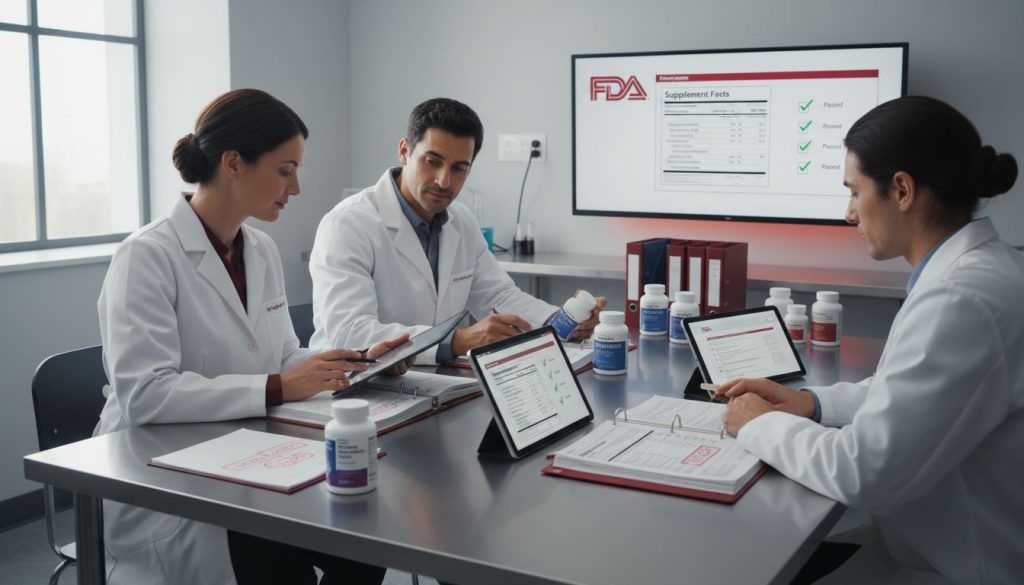
Short answer: No. Dietary supplements are not FDA approved. By law, the FDA does not approve supplements for safety or effectiveness before they are sold, and it does not approve their labels either.[1] The company that makes or sells a supplement is responsible for making sure it is safe and truthfully labeled, and the FDA steps in mainly after a product is on the market.[2]
Key Takeaways
- Supplements are regulated by the FDA, but they are not approved by it. Regulation and approval are two different things.
- The core law is the Dietary Supplement Health and Education Act of 1994 (DSHEA), which treats supplements differently from both conventional foods and drugs.[3]
- Manufacturers must follow current good manufacturing practice rules (21 CFR Part 111), which require specifications for identity, purity, strength, composition and contaminant limits.[5]
- Labels may carry structure/function claims, but only with a disclaimer saying the FDA has not evaluated the claim. Claims to treat, cure or prevent a disease make a product a drug.[4]
- Companies must report serious adverse events to the FDA within 15 days, and consumers can report problems directly.[2]
- Any supplement that advertises itself as “FDA approved” is making a misleading claim.
Are Supplements FDA Approved? What the Law Actually Says
The confusion comes from two words that sound similar: regulated and approved. The FDA does regulate dietary supplements. It regulates both finished products and the dietary ingredients that go into them, under the Federal Food, Drug, and Cosmetic Act as amended by DSHEA.[3] What it does not do is review a supplement and grant it permission to be sold.
The FDA states this plainly in its consumer update on the topic: “By statute, the FDA does not approve dietary supplements for safety and effectiveness.” The same article notes that many supplements can be marketed without even notifying the agency.[1] The NIH Office of Dietary Supplements gives the same answer to consumers: medicines must be approved by the FDA before they can be sold, and supplements do not require this approval.[6]
So the honest answer to “are supplements regulated by the FDA?” is yes, and the honest answer to “are supplements FDA approved?” is no. Both are true at the same time.
What the FDA does approve
For contrast, the FDA lists products that do need approval before they reach the market. With rare exceptions, new drugs and biological products for people must be FDA approved. Generic drugs and biosimilars are approved, as are high risk (Class III) medical devices such as mechanical heart valves. Food additives and most color additives also need approval before market entry.[1]
Supplements sit on the other side of that line, alongside most cosmetics, food labels and compounded drugs, none of which are FDA approved.[1]
Supplements vs Drugs: How FDA Oversight Differs
The table below summarizes the practical difference between a prescription or over the counter drug and a dietary supplement, based on FDA and NIH guidance.
| Question | New drugs | Dietary supplements |
|---|---|---|
| Needs FDA approval before sale? | Yes, with rare exceptions | No |
| Who proves safety before launch? | Company, reviewed and approved by FDA | Company is responsible; FDA does not pre-approve |
| Must prove it works? | Yes, for its approved use | No proof of effectiveness reviewed by FDA |
| Label reviewed by FDA before sale? | Yes | No |
| Can claim to treat or prevent a disease? | Yes, for approved uses | No; that would make it a drug |
| Manufacturing rules | Drug GMP rules | Dietary supplement cGMP (21 CFR Part 111) |
| Main FDA role | Premarket review plus monitoring | Mostly after the product is on the market |
The key line from the FDA: “a product intended to treat, prevent, cure, or alleviate the symptoms of a disease is a drug,” even if it is labeled as a supplement.[2] That single rule shapes everything supplement companies are allowed to say.
How the FDA Regulates Supplements
Even without premarket approval, supplement makers face real legal duties. Here is how the system works in practice.
1. DSHEA and the company’s responsibility
Under DSHEA, firms may not market supplements or dietary ingredients that are adulterated (unsafe or contaminated) or misbranded (falsely or incompletely labeled). They are responsible for evaluating the safety and labeling of their products before marketing.[3] The NIH adds that companies must have evidence that their products are safe and that their label claims are truthful and not misleading.[6]
2. New dietary ingredient notifications
There is one important exception to “no notification needed.” Ingredients that were not marketed in the US before October 15, 1994 are treated as new dietary ingredients.[6] A company that wants to use one must notify the FDA before marketing, and the notification must explain why the supplement “will reasonably be expected to be safe under the conditions of use recommended or suggested in the labeling.”[7] The FDA calls these 75-day premarket notifications. This is a notification, not an approval.
3. Current good manufacturing practice (21 CFR Part 111)
Supplement manufacturing is covered by its own federal rule: Part 111, “Current Good Manufacturing Practice in Manufacturing, Packaging, Labeling, or Holding Operations for Dietary Supplements.”[5] Among its requirements:
- Specifications for each finished batch covering identity, purity, strength, composition and limits on contaminants.
- At least one identity test on each dietary ingredient before use, unless the FDA grants an exemption.
- Quality control personnel who approve or reject processes and tests, and who decide whether a batch can be released.
- Review and investigation of product complaints, and retention of reserve samples.
The FDA periodically inspects manufacturing facilities to check compliance.[2] Note that a facility being registered with the FDA is not the same as approval. The FDA says registration “does not denote approval of the establishment” and does not mean a product may be legally marketed.[1]
4. Labeling requirements
Every supplement must carry a Supplement Facts panel that lists the serving size, servings per container, and each dietary ingredient with its amount per serving. The front of the package must identify the product as a “dietary supplement” or a similar term such as “herbal supplement.”[2] For a step by step walkthrough, see our guide on how to read supplement labels.
5. Structure/function claims and the disclaimer
Supplements may describe how a nutrient or ingredient affects the normal structure or function of the body. The FDA gives examples such as “calcium builds strong bones” and “fiber maintains bowel regularity.”[4] Three conditions apply:
- The company must have substantiation that the claim is truthful and not misleading.
- The label must state that the FDA has not evaluated the claim and that the product is not intended to “diagnose, treat, cure or prevent any disease.”
- The company must notify the FDA of the claim text no later than 30 days after marketing the product with it.[4]
That familiar disclaimer at the bottom of supplement labels and websites is not a formality. It exists because the FDA has not reviewed the claim.
6. Advertising and the FTC
The FDA handles labels, while the Federal Trade Commission requires supplement advertising to be truthful and not misleading.[6] Ads, influencer posts and website copy all fall under truth in advertising rules.
Safety Monitoring and Adverse Event Reporting
Because supplements are not reviewed before sale, the FDA relies heavily on what happens after they are sold. It reviews product labels and websites, monitors adverse event reports, and can work with a company, request a voluntary recall, or remove an unsafe or noncompliant product from the market.[2]
Supplement firms must report serious adverse events to the FDA within 15 days.[2] Consumers can report problems too:
- Tell your health care provider first if you think you had a bad reaction.[6]
- Report to the FDA by calling 800-FDA-1088 or using the FDA’s online reporting form.[6]
- Contact the manufacturer using the information on the label.[6]
If you have a reaction, the FDA advises stopping the supplement and seeking medical care before reporting it.[2]
How to Choose Supplements When Nothing Is “FDA Approved”
Since FDA approval is not an available quality signal, smart buyers look at other evidence.
Read the full label
Look for a complete Supplement Facts panel with the amount of each ingredient per serving. Vague “proprietary blends” make it harder to compare a product to the doses used in research.
Look for independent testing
Organizations such as U.S. Pharmacopeia, NSF International and ConsumerLab.com test products and may award quality seals. A seal is a useful quality signal, but the NIH notes that these seals “do not guarantee that a product is safe or effective.”[6] Our article on third-party tested supplements explains what each seal covers.
Treat red flags seriously
- Any product labeled or advertised as “FDA approved.”
- Claims that a supplement treats, cures or prevents a disease.
- Promises that sound like a prescription drug, or “works instantly” language.
- No company name, address or contact information on the label.
Check for interactions
The NIH points out that some supplements interact with medicines. Vitamin K can interfere with the blood thinner warfarin, St. John’s wort can reduce the effectiveness of many medicines, and antioxidant vitamins C and E may reduce the effectiveness of some chemotherapy.[6] The risk of problems is higher with high doses, when supplements are used in place of prescribed medicines, or when many supplements are combined.[6]
Who Should Talk to a Doctor First
The FDA recommends talking with a health care professional before taking any supplement, and not using one in place of a prescription medicine or a varied diet.[2] Extra caution applies if you:
- Take prescription medicines, especially blood thinners.
- Have a scheduled surgery.[6]
- Are pregnant or nursing.[6]
- Are buying a supplement for a child.[6]
- Have a chronic health condition or are under active medical treatment.
Also remember the FDA’s own warning: do not assume “natural” means safe.[2] If you are wondering whether you need supplements at all, our piece on whether men should take a multivitamin is a good starting point.
Where Ultra Bann Fits
Like every dietary supplement sold in the US, Ultra Bann is not FDA approved, and we do not describe it that way. What we can do is be transparent. Ultra Bann is a natural male vitality supplement made by DL Bioproducts, taken as one capsule every 2 days. Each serving lists seven botanicals with their exact amounts, with no proprietary blend: Thai Butea superba 345 mg, Panax ginseng 110 mg, Cynomorium songaricum 85 mg, black ginger (Kaempferia parviflora) 85 mg, tongkat ali 85 mg, epimedium (horny goat weed) 45 mg and reishi 45 mg, for 800 mg total.
You can review the full label on our ingredients page and share it with your doctor before you start. First orders include free US shipping and a 60-day money-back guarantee. See Ultra Bann in the shop.
Frequently Asked Questions
Are supplements regulated by the FDA?
Yes. The FDA regulates dietary supplements and dietary ingredients under DSHEA. Companies cannot sell adulterated or misbranded products, must follow manufacturing rules, and must report serious adverse events. The FDA does not, however, approve supplements before they are sold.
Why aren’t supplements FDA approved?
Because the law does not require it. DSHEA placed supplements in their own category, separate from drugs, so the responsibility for safety and truthful labeling rests with the company, and the FDA acts mainly once a product is on the market.
Is “made in an FDA registered facility” the same as FDA approved?
No. The FDA states that registering an establishment does not denote approval of that establishment and does not mean a product may be legally marketed. It only means the facility is on the FDA’s list.
What does the disclaimer on supplement labels mean?
It means the FDA has not evaluated the claim on the label, and that the product is not meant to diagnose, treat, cure or prevent any disease. The disclaimer is legally required whenever a supplement makes a structure/function claim.
How do I report a bad reaction to a supplement?
Stop taking it, get medical care if needed, and tell your health care provider. Then report it to the FDA at 800-FDA-1088 or through the FDA’s online reporting system, and contact the manufacturer listed on the label.
References
- U.S. Food and Drug Administration. Is It Really “FDA Approved”? Consumer Update, 2026.
- U.S. Food and Drug Administration. FDA 101: Dietary Supplements. Consumer Update.
- U.S. Food and Drug Administration. Dietary Supplements. 2024.
- U.S. Food and Drug Administration. Structure/Function Claims. 2024.
- Electronic Code of Federal Regulations. 21 CFR Part 111: Current Good Manufacturing Practice in Manufacturing, Packaging, Labeling, or Holding Operations for Dietary Supplements.
- NIH Office of Dietary Supplements. Dietary Supplements: What You Need to Know. Updated 2023.
- U.S. Food and Drug Administration. New Dietary Ingredient (NDI) Notification Process.
These statements have not been evaluated by the Food and Drug Administration. This product is not intended to diagnose, treat, cure or prevent any disease. This article is for information only and is not medical advice.
Ultra Bann natural male vitality support
1 capsule every 2 days. Free US shipping and a 60-day money-back guarantee on your first order.
See Ultra BannThese statements have not been evaluated by the Food and Drug Administration. This product is not intended to diagnose, treat, cure, or prevent any disease.