Short answer: Cynomorium songaricum, called suo yang in traditional Chinese medicine, is a leafless parasitic plant from the deserts of northwestern China that has been used for centuries as a men's tonic. Lab and animal studies suggest antioxidant, anti-fatigue and reproductive effects, but we found no well-designed human clinical trials, so its benefits in people are unproven. Animal toxicity tests look reassuring at normal amounts, with one high-dose rat study flagging changes in blood clotting time worth knowing about.
Key Takeaways
- Cynomorium songaricum is a chlorophyll-free plant that lives underground on the roots of desert shrubs and is harvested for its fleshy stem.
- In traditional Chinese medicine, suo yang is used to "tonify kidney yang," a concept linked to male vigor, and to relieve constipation. The earliest record cited by researchers dates to 1347.
- A 2024 review identified 98 compounds, mainly flavonoids, terpenoids, steroids and polysaccharides. All of the activity data come from cells and animals.
- Animal results on testosterone are mixed: one rat study reported lower testosterone with a water extract, while a 2024 mouse study found its flavonoids restored testosterone after chemical damage.
- Acute toxicity in animals was very low, but a rat study reported longer prothrombin time (a clotting test) at medium and high doses.
- Wild stands are shrinking and the plant is reported as vulnerable, so cultivated sources matter.
What Is Cynomorium Songaricum?
Cynomorium songaricum Rupr. is a perennial, succulent plant in the family Cynomoriaceae. It has no chlorophyll and cannot make its own food. Instead it attaches to the roots of desert shrubs, mostly species of Nitraria (and also Zygophyllum and Peganum), and draws water and nutrients from them[1]. Most of the plant stays buried in sand. What breaks the surface is a reddish brown, club shaped spike of tiny flowers that darkens as it dries[6].
The genus has two species. C. songaricum grows in western and central Asia, while its close relative Cynomorium coccineum grows in North Africa and the Mediterranean. On Malta, C. coccineum was once prized as the "Maltese mushroom"[6].
Where it grows and how it is harvested
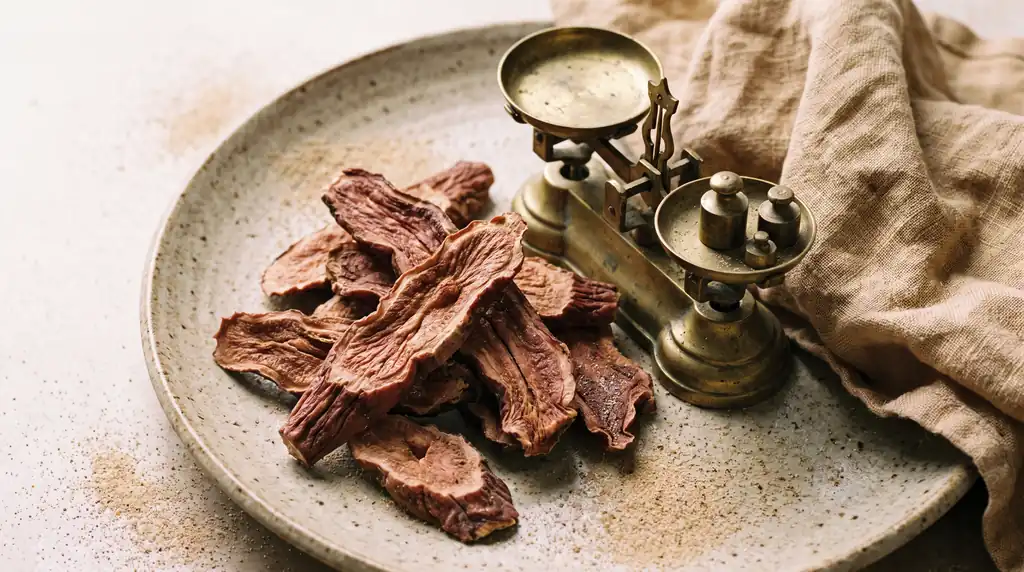
C. songaricum grows mainly in Inner Mongolia, Gansu, Xinjiang, Qinghai and Ningxia, at altitudes up to about 2,000 m[1]. The Hong Kong Chinese Materia Medica Standards define the medicinal material, Cynomorii Herba, as the dried fleshy stem: it is dug up in spring, the flower spike is removed, and the stem is cut into segments and sun dried[5].
Sustainability
Demand is a real problem for this plant. A 2024 review in Molecules estimates that about 1,500 tons are harvested each year, that wild plants need 4 to 5 years to reach harvest size (3 to 4 years when cultivated), and that the wild range is shrinking. The review reports that the species is listed as vulnerable[1]. The Parasitic Plant Connection at Southern Illinois University also warns that suo yang is extensively harvested from the wild and needs conservation[6]. If you buy it, look for cultivated material from a supplier that discloses its source.
Suo Yang in Traditional Chinese Medicine
The name suo yang roughly means "locking yang." In classical texts the herb is said to tonify kidney yang, benefit essence and blood, and moisten the intestines to relieve constipation[1]. "Kidney yang" is a traditional Chinese medicine concept, not the kidney organ as Western medicine defines it. It covers warmth, energy, sexual function and fertility.
Traditional uses listed by researchers include impotence, premature ejaculation, spermatorrhea and support for sperm production, as well as diarrhea, gum bleeding, colic and stomach ulcers[1][3]. The 2024 review lists 12 classical or pharmacopoeia formulas that contain it, such as Huqian wan and Suoyang gujing wan[1]. Ethnomedical use has also been recorded in Saudi Arabia, Afghanistan, Mongolia and Iran, and the plant appears in health foods, teas and cosmetics[3]. In China it is also eaten in rice dishes, soups and wines[1].
Many of these traditional uses overlap with other men's herbs such as horny goat weed (epimedium), which is also classed as a yang tonic.
Cynomorium Songaricum Benefits: What the Research Shows
This is the most important point of the article: almost everything known about suo yang's effects comes from test tubes and lab animals. The 2024 Molecules review, which pulled together the research on traditional uses, chemistry, pharmacology and safety, describes in vitro and animal work and calls for clinical trials to confirm efficacy and safety in humans[1]. A 2017 overview in the Tropical Journal of Pharmaceutical Research, which searched English and Chinese literature, reached a similar conclusion: many bioactivities, unknown mechanisms, and more safety work needed before clinical use[4]. We did not find a single randomized controlled trial in people.
Male reproductive function (animal studies)
The animal data are interesting but inconsistent. In Wistar rats, a water extract reportedly lowered serum testosterone and FSH while raising another pituitary hormone, yet the same review describes enhanced sperm production and motility, and other rat strains showing increased testosterone secretion[1].
The best designed recent study is a 2024 paper in Frontiers in Pharmacology. Researchers damaged the reproductive system of male mice with the chemotherapy drug cyclophosphamide (60 mg/kg for 5 days), then gave Cynomorium flavonoids at 45, 90 or 180 mg/kg for 28 days, with ten mice per group. Compared with untreated damaged mice, the flavonoid groups had higher testosterone, higher sperm counts, heavier testes and higher activity of the enzymes that make testosterone (StAR, CYP11A1, CYP17A1 and 3β-HSD)[2]. The study shows recovery from chemical injury in mice. It does not show that the herb raises testosterone in healthy men.
Prostate (lab and animal studies)
An ethanol extract at 2.5 mg/mL inhibited 5α-reductase, the enzyme that converts testosterone to DHT, in lab tests, and a water extract reduced prostate weight in rats given testosterone to enlarge the prostate[1]. No human prostate studies exist.
Antioxidant, anti-fatigue and aging (lab and animal studies)
Extracts improved antioxidant capacity in mice, extended lifespan in fruit flies and in C. elegans worms, and showed anti-fatigue and anti-hypoxia effects in animal models[1][3]. Immune, blood sugar, bone, liver, nerve and antiviral effects have also been reported in cell or animal models[1][3], none tested in human trials.
Claims vs Evidence at a Glance
| Claim | Type of evidence | Evidence level in humans |
|---|---|---|
| Supports male vigor ("kidney yang") | Traditional texts since 1347 | Traditional use only |
| Raises testosterone | Mixed animal results: lower in one rat study, restored after chemical damage in mice | None (no human trials) |
| Improves sperm count | Rat and mouse studies | None |
| Supports prostate health | Enzyme test and rat model | None |
| Antioxidant and anti-aging | Cell, mouse, fly and worm studies | None |
| Anti-fatigue | Animal models | None |
| Blood sugar support | Cell and diabetic rat studies | None |
| Safe at normal amounts | Acute, genetic and 90-day animal toxicity tests | Long traditional and food use, but no formal human safety trials |
Proposed Active Compounds
The 2024 review counted 98 compounds isolated from C. songaricum[1]:
- Flavonoids (27): including epicatechin, procyanidins, naringenin, rutin and isoquercetin. These are the compounds tested in the 2024 mouse fertility study[2].
- Terpenoids (12): such as ursolic acid, oleanolic acid and betulinic acid.
- Steroids (10): plant sterols such as β-sitosterol, daucosterol and campesterol. These are not hormones and are not testosterone.
- Polysaccharides and glycosides: water soluble sugars tested for blood sugar, liver and ulcer effects in rats.
- Organic acids and phloroglucinol adducts: including gallic, protocatechuic and ferulic acids, plus tannin related compounds with antibacterial activity in the lab.
Researchers generally credit the flavonoids, triterpenes and polysaccharides for most of the activity, but the exact mechanism is still unknown[4].
Safety and Who Should Avoid It
What animal toxicity tests found
The 2024 review summarizes the safety data, all from animals[1]:
- Heavy metals (copper, lead, cadmium, chromium, arsenic, mercury) in tested samples were far below Chinese limits.
- The oral LD50 of the water extract was above 21.5 g/kg, and the maximum tolerated dose in mice was above 15 g/kg, which means very low acute toxicity.
- Standard genetic toxicity tests (Ames, micronucleus and sperm abnormality tests) found no mutagenic effect.
- A 90-day rat study at up to 4.16 g/kg found no significant blood or tissue changes.
- However, a Wistar rat study at 2.83, 5.66 and 8.49 g/kg found that the medium and high doses significantly increased prothrombin time (blood took longer to clot) and changed testis and epididymis weight ratios. The no observed adverse effect level was set at 2.83 g/kg.
The review itself advises caution and avoiding overdose[1]. These rat doses are very large, but the clotting finding has not been studied in people.
Who should talk to a doctor first
- People taking blood thinners (such as warfarin) or antiplatelet drugs, or anyone with a bleeding disorder or upcoming surgery, because of the prothrombin time finding in rats.
- Men taking prostate or hormone medicines, or being treated for a hormone sensitive condition, because of the mixed hormone and 5α-reductase findings.
- Men trying to conceive with a fertility specialist, since animal results on testosterone point in different directions.
- Pregnant or breastfeeding women and children, because there is no safety data for these groups.
- People prone to loose stools, since the herb is traditionally used to moisten the intestines and relieve constipation.
How Suo Yang Is Sold and Dosed
You will find Cynomorium songaricum as dried stem slices (the traditional form used in decoctions and herbal wines), powders, concentrated extracts, teas and capsules, often combined with other yang tonics. Quality varies, so look for the Latin name Cynomorium songaricum on the label, a stated amount per serving, the part used (the fleshy stem) and third party testing for heavy metals.
There is no research based dose for people. Studies dose animals in mg or g per kg of body weight, and those numbers do not translate directly to a human serving. In practice, amounts are set by traditional Chinese medicine practitioners or by the product label. If you want to try it, use a labeled product, stay at the stated serving, and stop if you notice bruising, bleeding or digestive upset.
If you are comparing traditional men's herbs, it helps to know which ones have human trials. Our guides to Panax ginseng benefits for men and Butea superba review the research on those plants the same way.
Cynomorium Songaricum in Ultra Bann
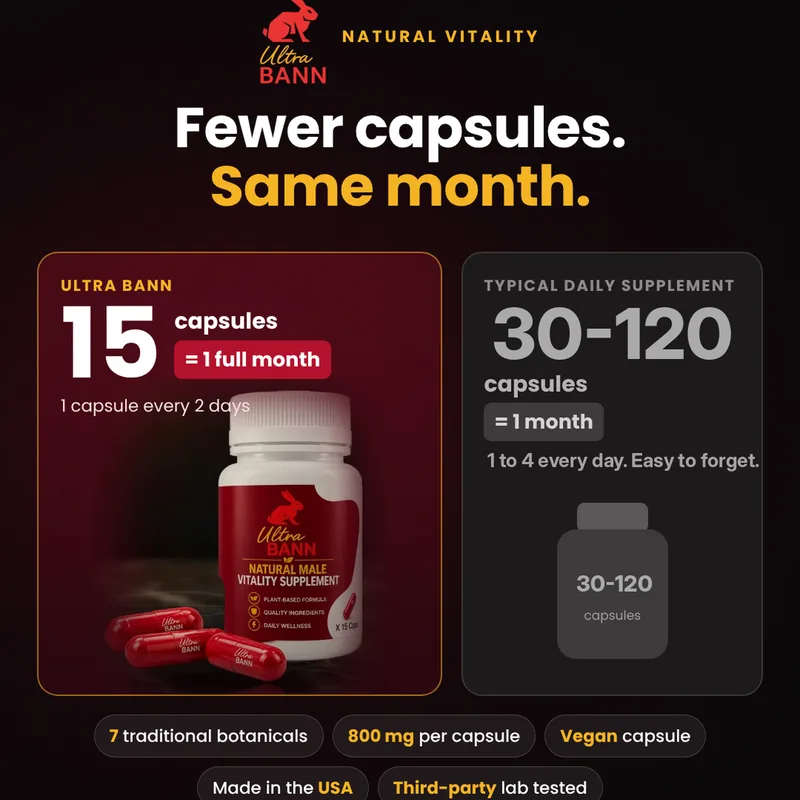
Ultra Bann, a natural male vitality supplement by DL Bioproducts, contains 85 mg of Cynomorium songaricum per capsule as one of seven botanicals, alongside Thai Butea superba 345 mg, Panax ginseng 110 mg, black ginger 85 mg, tongkat ali 85 mg, epimedium 45 mg and reishi 45 mg, for 800 mg in total. The Cynomorium songaricum in Ultra Bann comes from cultivated plants, not from wild harvesting. Every amount is on the label and there is no proprietary blend. You take one capsule every 2 days. As explained above, suo yang is included for its traditional role, and its effects have not been confirmed in human trials. See the full Ultra Bann ingredient list, or try Ultra Bann with free US shipping and a 60-day money-back guarantee on your first order. If you take a blood thinner, check with your doctor first.
Frequently Asked Questions
Is Cynomorium songaricum the same as suo yang?
Yes. Suo yang is the Chinese name for the dried stem of Cynomorium songaricum, listed in herbal standards as Cynomorii Herba[5]. It is sometimes confused with Cynomorium coccineum, the related Mediterranean species known as the Maltese mushroom.
Does Cynomorium songaricum increase testosterone?
Not in any proven way. One rat study found lower testosterone with a water extract, while a 2024 mouse study found its flavonoids restored testosterone after chemotherapy damage[1][2]. There are no human studies.
Is Cynomorium songaricum safe?
Animal tests show very low acute toxicity and no genetic toxicity, and the plant is eaten as food in parts of China. One rat study found slower blood clotting at high doses, so people on blood thinners should ask a doctor first[1].
How much Cynomorium songaricum should I take?
No dose has been tested in human trials. Follow the label of a reputable product or the advice of a qualified practitioner, and do not exceed the stated serving.
Is suo yang endangered?
Wild populations are declining because of heavy harvesting, and the species is reported as vulnerable[1][6]. Choose cultivated, traceable sources when possible.
References
- Zhang J, Chen X, Han L, Ma B, Tian M, Bai C, Zhang Y. Research Progress in Traditional Applications, Phytochemistry, Pharmacology, and Safety Evaluation of Cynomorium songaricum. Molecules. 2024;29(5):941. mdpi.com/1420-3049/29/5/941
- Chen J, Yang X, He Z, Chen W, Zhao Y, Li J, Zong Y, Du R. Cynomorium songaricum Rupr. flavonoids improve cyclophosphamide-induced reproductive function damage by regulating the testosterone synthesis pathway. Frontiers in Pharmacology. 2024;15:1457780. frontiersin.org
- Cui Z, Guo Z, Miao J, Wang Z, Li Q, Chai X, Li M. The genus Cynomorium in China: An ethnopharmacological and phytochemical review. Journal of Ethnopharmacology. 2013;147(1):1 to 15. agris.fao.org
- Cheng D, Zheng J, Ma S, et al. Chemical constituents, and pharmacological and toxicological effects of Cynomorium songaricum: An overview. Tropical Journal of Pharmaceutical Research. 2017;16(11):2689 to 2696. tjpr.org
- Chinese Medicine Regulatory Office, Hong Kong. Hong Kong Chinese Materia Medica Standards, Volume 6: Cynomorii Herba. cmro.gov.hk
- The Parasitic Plant Connection. Cynomoriaceae. Southern Illinois University. parasiticplants.siu.edu/Cynomoriaceae
These statements have not been evaluated by the Food and Drug Administration. This product is not intended to diagnose, treat, cure or prevent any disease. This article is for information only and is not medical advice.
Ultra Bann natural male vitality support
1 capsule every 2 days. Free US shipping and a 60-day money-back guarantee on your first order.
See Ultra BannThese statements have not been evaluated by the Food and Drug Administration. This product is not intended to diagnose, treat, cure, or prevent any disease.