Short answer: For most men, cycling is good for long-term health, including sexual health. In a survey of nearly 4,000 men, cyclists had erectile function scores as good as or slightly better than swimmers and runners.[1] The real issue is pressure: a traditional saddle presses on the perineum, the area between the scrotum and the anus where key nerves and blood vessels run, and long, unbroken pressure can cause numbness and, in some riders, erection problems.[2][3] Handlebar height, standing regularly, saddle choice and short breaks all reduce that pressure. Numbness that lingers after a ride is a signal to change your setup and talk to a doctor.
Key Takeaways
- Cycling is a heart-health win: in a UK study of 264,337 adults, cycle commuting was linked to a 46% lower risk of cardiovascular disease and a 41% lower risk of premature death.[4]
- Riders did not have worse erections: the largest survey to date found no worse sexual or urinary function in cyclists than in swimmers or runners.[1]
- Pressure is the risk factor: saddle contact can compress soft tissue and impair blood flow to the groin.[2]
- Standing helps: riders who stood more than 20% of the time had lower odds of genital numbness.[1]
- Saddle design matters: no-nose saddles reduce groin pressure, while the evidence on cutout saddles is mixed.[2][3]
- Numbness is a warning, not a badge: numbness that lasts after rides, pelvic pain or new erection problems deserve a bike fit check and a medical visit.[3]
Why Cycling Is Worth Protecting
Before talking about saddles, it helps to keep the big picture in view. A University of Glasgow team followed 264,337 UK Biobank participants for about five years. Compared with people who commuted by car or public transport, those who cycled to work had a 41% lower risk of dying from any cause, a 46% lower risk of developing cardiovascular disease and a 45% lower risk of developing cancer.[4] This was an observational study, so it shows a strong association rather than proof, but the size of the effect is hard to ignore.
Cycling also fits the US activity guidelines well. The CDC recommends 150 minutes a week of moderate activity or 75 minutes of vigorous activity, plus muscle strengthening on at least two days.[5] It lists riding a bike on level ground or with few hills as moderate activity, and riding fast or on hills as vigorous.[5]
The arteries that supply the genitals are small blood vessels that respond to the same things as the heart's arteries: blood pressure, blood sugar, cholesterol, smoking and fitness. Regular aerobic exercise supports all of them. Our guide to improving vascular health explains that connection in more detail. The goal is not to give up the bike. It is to ride in a way that protects the pelvis.
What Happens Between You and the Saddle
When you sit on a bike, your weight should rest mainly on your sit bones, the two bony points at the bottom of the pelvis. On a narrow or nose-heavy saddle, or in a low, stretched-out position, more weight shifts forward onto the perineum. That soft area carries the pudendal nerve, which provides sensation to the genitals, and the small arteries that supply blood to the genitals.
NIOSH, the CDC's workplace safety institute, studied this in police officers and other workers who ride bikes on the job. It describes saddle contact as "contact stress": pressure that can compress soft tissue and impair blood flow. NIOSH reports that prolonged pressure from a traditional saddle may be associated with a higher risk of erectile dysfunction in men.[2]
A 2021 systematic review of pudendal nerve problems in cyclists found the core symptoms were genital numbness, erection problems and sharp pelvic pain.[3] In one older study of riders on a 540 km tour, 22% reported numbness and 13% reported erection problems; for most the numbness was temporary, but it lasted more than a week in 11 riders and more than a month in 3.[3] The review notes that short nerve compression is usually quickly reversible, while longer periods of reduced blood flow can take weeks to recover.[3] The review also rated most of the included studies as low to moderate quality, which is why advice in this area relies partly on expert judgment.
One more finding from the large survey: cyclists had higher odds of urethral stricture (a narrowing of the tube that carries urine) than swimmers and runners, although their urinary symptom scores were not different.[1]
Your Bike Setup Checklist
Use this checklist on your own bike, or bring it to a professional bike fit. Small changes often make a big difference in comfort.
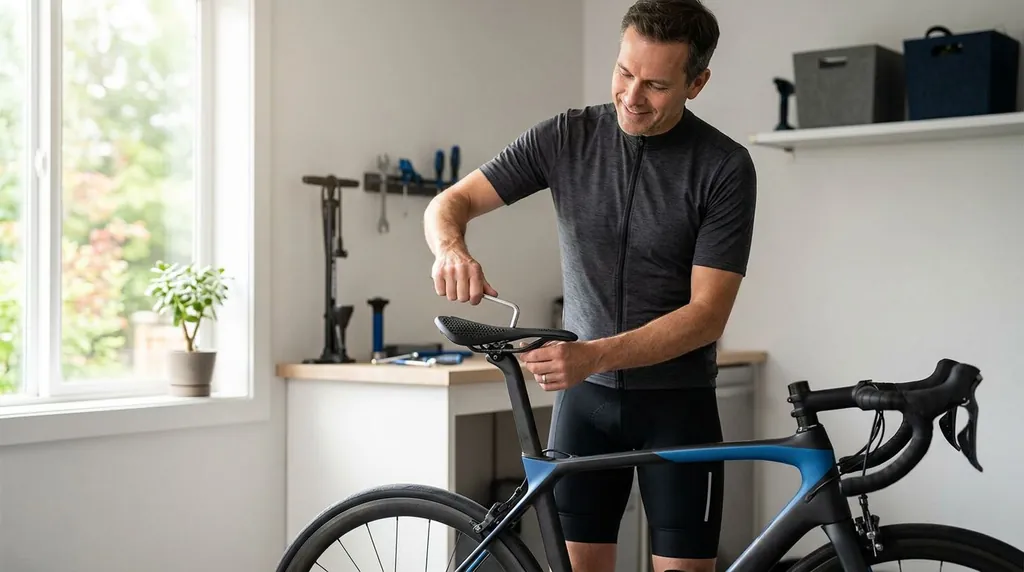
- ☐ Handlebars not too low. In the large survey, setting the handlebar level with or higher than the saddle was linked to lower odds of genital numbness and of saddle sores.[1] An older race study pointed the other way, so treat this as a comfort setting to test, not a fixed rule.[3] Avoid long periods on aero or triathlon bars, which push you forward onto the perineum.[3]
- ☐ Stand up regularly. Riders who spent more than 20% of their time standing had lower odds of numbness.[1] The review cites a pattern of a 20 to 30 second break from the saddle every 20 minutes.[3]
- ☐ Choose a saddle that supports your sit bones. The review recommends a wide, horizontal saddle with a flexible or absent nose.[3] NIOSH found that no-nose saddles reduce groin pressure in workers who ride.[2]
- ☐ Be careful with assumptions about cutouts. Cutout saddles are marketed for pressure relief, but one study linked cutouts to a higher risk of erection problems in riders who already had numbness.[3] Comfort and the absence of numbness are your best guide.
- ☐ Check saddle tilt. A level saddle, or the nose tilted very slightly down, reduces pressure at the front.[3]
- ☐ Set saddle height correctly. Your knee should keep a slight bend at the bottom of the pedal stroke.[3] A saddle that is too high makes you rock side to side and grind on the perineum.
- ☐ Wear padded cycling shorts. Padding protects soft tissue on longer rides.[3]
- ☐ Shift and move. The review suggests shifting to a higher gear and standing on the pedals from time to time.[3] Changing hand positions on the bars also moves your weight around.
- ☐ Build volume gradually. Long rides after months off are when problems usually start. Increase distance in steps.
Off the bike, core and hip strength help you hold a stable, more upright posture. The review also mentions stretching and, for men carrying extra weight, weight loss to reduce pressure on the saddle.[3] Pelvic floor training is another good habit for riders; see our guide to Kegel exercises for men.
Numbness: What Is Normal and What Is Not
| What you notice | What it may mean | What to do |
|---|---|---|
| Brief tingling that goes away within minutes of standing | Short pressure on nerves or vessels | Stand more often and review saddle and bar height |
| Numbness after most rides, lasting hours | Setup is putting too much weight on the perineum[2][3] | Get a bike fit, consider a wider or no-nose saddle |
| Numbness lasting days, or burning pelvic pain | Possible pudendal nerve irritation[3] | Stop riding and see a doctor; rest often helps |
| New or worsening erection problems | Pressure related, or a sign of a separate vascular problem | See a doctor; do not assume the bike is the only cause |
| Weak or split urine stream, straining to urinate | Possible urethral narrowing[1] | See a doctor or urologist |
When to See a Doctor
See a doctor if numbness persists after you have changed your setup, if you have pelvic pain, if erections have changed, or if you notice changes in how you urinate. In the review, rest of 3 to 10 days often helped riders recover from pudendal nerve symptoms, along with posture changes and saddle adjustments.[3] A doctor can also check for other causes, including nerve problems that have nothing to do with the bike.
Keep in mind that erection problems in men over 40 are often linked to blood vessel health in general: high blood pressure, diabetes, high cholesterol and smoking. If you have new erection problems, ask for a checkup that includes these, and see our men's sexual health checklist for what to review with your doctor. If you take medicine for any of these conditions, never stop or change it without talking to the doctor who prescribed it.
Frequently Asked Questions
Does cycling cause erectile dysfunction?
Not for most riders. The largest survey found cyclists did not have worse erectile function than swimmers or runners.[1] Prolonged saddle pressure may raise the risk, which is why fit, standing and breaks matter.[2]
Are no-nose saddles worth trying?
If you get numbness, they are a reasonable option. NIOSH found they reduce groin pressure in workers who ride.[2] They can feel different for steering and climbing, so try one before committing.
How often should I get off the saddle?
One pattern cited in the research is a 20 to 30 second break every 20 minutes.[3] Standing more than 20% of the time was linked to lower odds of numbness.[1]
Is numbness after a long ride normal?
Brief tingling that clears quickly is common, but it is still a sign of pressure. Numbness that lasts hours or days is not something to ride through.[3]
References
- Awad MA, Gaither TW, Murphy GP, et al. Cycling, and male sexual and urinary function: results from a large, multinational, cross-sectional study. Journal of Urology (2018). escholarship.org/uc/item/1jw5b72p
- National Institute for Occupational Safety and Health (NIOSH). About Contact Stress and Reproductive Health (bicycle saddles). CDC (2024). cdc.gov/niosh/topics/repro/bike
- Chiaramonte R, Pavone P, Vecchio M. Diagnosis, rehabilitation and preventive strategies for pudendal neuropathy in cyclists: a systematic review. Journal of Functional Morphology and Kinesiology (2021). doi.org/10.3390/jfmk6020042
- University of Glasgow. Cycling to work may cut your risk of premature death by 40% (reporting Celis-Morales CA et al., BMJ, 2017). gla.ac.uk/news/headline_522765_en
- Centers for Disease Control and Prevention. Adult Activity: An Overview, and What Counts as Physical Activity for Adults. CDC. cdc.gov/physical-activity-basics/guidelines/adults
These statements have not been evaluated by the Food and Drug Administration. This product is not intended to diagnose, treat, cure or prevent any disease. This article is for information only and is not medical advice.
Ultra Bann natural male vitality support
1 capsule every 2 days. Free US shipping and a 60-day money-back guarantee on your first order.
See Ultra BannThese statements have not been evaluated by the Food and Drug Administration. This product is not intended to diagnose, treat, cure, or prevent any disease.