Short answer: The best supplements for men over 50 are the ones that match what actually changes at this age: vitamin B12 (absorption from food falls), protein and creatine paired with strength training (muscle loss speeds up), calcium from food first with enough vitamin D (bone), and omega-3s only if you rarely eat fish. Saw palmetto did not beat placebo for prostate symptoms in large NIH trials. Just as important is what to drop: extra iron, high-dose vitamin E, and beta-carotene if you smoke or used to.
Key Takeaways
- After 50, the Food and Nutrition Board advises getting vitamin B12 mainly from fortified foods or supplements[2].
- Men 51 to 70 need 1,000 mg of calcium a day (1,200 mg after 70), mostly from food[3].
- In the VITAL trial of 25,871 adults, 1 gram of fish oil a day did not lower major cardiovascular events overall, though heart attacks fell 28 percent[4].
- NCCIH concludes saw palmetto is "probably not helpful" for symptoms of an enlarged prostate[5].
- In the SELECT trial of 35,533 men aged 50 and older, 400 IU of vitamin E a day was followed by a 17 percent higher risk of prostate cancer[6].
Why 50 Is a Different Starting Point
Around 50, changes that were slow in your 40s start to show up in blood tests and on the scale, and many men begin taking daily prescriptions. The question shifts from "what can I add?" to "what fits my body and my medicines now?"
If you want the general evidence for each core nutrient, our guide to the best supplements for men over 40 covers it, and our daily supplements for men guide explains timing. This article starts with five changes that matter after 50, matches a supplement to each, and is honest about where the big trials came up short.
Change 1: Your Body Absorbs Less B12 From Food
Vitamin B12 in meat, fish, eggs and dairy is bound to protein. Your stomach needs acid and a protein called intrinsic factor to release and absorb it. Atrophic gastritis, a condition that lowers both, affects about 2 percent of the general population but 8 to 9 percent of adults 65 and older[1]. Depending on how deficiency is defined, between 3 and 43 percent of older adults living in the community have low B12[1].
That is why the Food and Nutrition Board advises people older than 50 to get their B12 mainly from fortified foods or dietary supplements[2]. The B12 in supplements and fortified foods is not bound to food protein, so it does not need to be released first. The daily need stays at 2.4 mcg for men[1], and B12 has no upper limit because it is considered safe even at high doses[1].
Two medicines that make this more urgent
Metformin might reduce B12 absorption and lower blood levels, and proton pump inhibitors such as omeprazole interfere with B12 absorption from food[1]. If you take either one, ask for a B12 test. Our article on B12 deficiency symptoms explains what to watch for.
Change 2: Muscle Loss Speeds Up
Age-related muscle loss, called sarcopenia, affects strength, balance and blood sugar control, not just appearance. No pill stops it on its own. The foundation is regular resistance training, and supplements only help if that foundation is in place.
Protein
Many men eat most of their protein at dinner. Spreading it across meals is the more useful pattern, and a protein powder is simply a convenient way to close the gap when food falls short. Use our guide to daily protein intake for men to find your number.
Creatine
Creatine monohydrate is the most studied muscle supplement in older adults, and its benefit shows up when it is combined with strength training rather than taken alone. It draws water into muscle, so a small gain on the scale early on is normal. Men with kidney disease or on medicines that affect the kidneys should talk to their doctor first. Doses and the research are in our guide to creatine for men over 50.
Change 3: Bone Needs a Steady Supply of Calcium and Vitamin D
Men lose bone with age too. Calcium needs rise in stages: 1,000 mg a day for men 51 to 70 and 1,200 mg a day for men over 70, with an upper limit of 2,000 mg from food and supplements combined[3]. Vitamin D matters because it is required for calcium to be absorbed in the gut[3].
Why food comes first for calcium
The NIH says nutritional needs should be met primarily through diet, including fortified foods[3]. For men there is another reason to go easy on pills. In the Cancer Prevention Study II Nutrition Cohort, which followed 132,823 adults for about 17.5 years, men who took 1,000 mg or more of supplemental calcium a day had a 22 percent higher risk of death from cardiovascular disease than men who took none[3]. An expert panel later concluded that calcium, with or without vitamin D, neither raises nor lowers cardiovascular risk, so this is a reason for moderation, not panic.
A practical approach: add up the dairy, fortified foods and greens you eat, then supplement only the difference. If you do take calcium, absorption is highest at 500 mg or less per dose[3], so split larger amounts. For vitamin D amounts, see vitamin D benefits for men.
Change 4: Heart Risk Climbs, and Fish Oil Is Not a Shield
Fish oil is the supplement most men over 50 already take "for the heart." The large trials give a more mixed picture than the label suggests[4]:
- VITAL (25,871 men 50 and older and women 55 and older, 1 gram a day for a median of 5.3 years): no significant drop in major cardiovascular events, stroke or cardiovascular death. Heart attacks fell 28 percent, with a 40 percent reduction in people who ate less than 1.5 servings of fish a week.
- ASCEND (15,480 adults with diabetes, 1 gram a day for 7.4 years): no significant effect on serious vascular events, although cardiovascular death was 19 percent lower.
- REDUCE-IT (8,179 people, 4 grams a day of the prescription drug icosapent ethyl): cardiovascular events fell 25 percent, but the mineral oil placebo may have inflated the apparent benefit.
The takeaway: if you rarely eat fatty fish, 1 gram a day is a reasonable choice. Very high doses are a prescription decision, because two large trials found that 4 grams a day slightly increased atrial fibrillation risk in people with, or at high risk of, heart disease[4]. The FDA considers up to 5 grams a day of EPA and DHA from supplements safe[4]. More in our guide to fish oil benefits for men.
Change 5: The Prostate Grows, and Saw Palmetto Disappoints
An enlarging prostate is common after 50 and can mean more trips to the bathroom at night. Saw palmetto is the best known supplement for it. A 2023 review of 27 studies in men with an enlarged prostate found that saw palmetto alone provides little or no benefit for symptoms, and two NIH-funded trials, one at a standard dose and one at up to three times the usual dose, found no improvement over placebo[5]. NCCIH's conclusion is that saw palmetto is "probably not helpful for this purpose"[5].
On the safety side, it is well tolerated in studies lasting up to 3 years, side effects such as digestive upset, dizziness and headache are mild and infrequent, and it does not appear to affect PSA readings[5]. New or worsening urinary symptoms deserve a medical visit, not a supplement trial. Our article on enlarged prostate symptoms covers when to see a doctor.
Supplements for Men Over 50: Quick Comparison
| Change after 50 | Supplement | Evidence | Typical amount | Caution |
|---|---|---|---|---|
| Less B12 absorbed from food | Vitamin B12 (fortified foods or supplement) | Strong: official advice for adults over 50 | Need is 2.4 mcg a day; no upper limit | Get tested if you take metformin or a PPI |
| Faster muscle loss | Protein; creatine monohydrate | Good when combined with strength training | Enough protein to reach your daily target; creatine as labeled | Creatine: ask your doctor if you have kidney disease |
| Bone loss | Calcium (food first) and vitamin D | Good for meeting needs; vitamin D is needed to absorb calcium | Calcium 1,000 mg (51 to 70) or 1,200 mg (71+) total | Upper limit 2,000 mg; 500 mg or less per dose |
| Rising heart risk | Omega-3 (EPA and DHA) | Mixed: no overall drop in major events in VITAL | 1 g a day in VITAL and ASCEND | 4 g a day linked to atrial fibrillation; check INR on warfarin |
| Prostate growth | Saw palmetto | Weak: no benefit over placebo in NIH trials | Standard dose and up to 3 times it showed no benefit | See a doctor for urinary symptoms first |
What Men Over 50 Should Avoid
Iron in multivitamins
Most men get enough iron from food, and multivitamins designed for adults over 50 often contain little or no iron and more calcium, vitamin D and B12[2]. In one cohort of adults 45 and older, 10 to 15 percent of multivitamin users had excessive intakes of vitamin A, iron and zinc[2]. Unless a blood test shows you are low, skip the iron. Our article on whether men should take a multivitamin explains the trade-offs.
High-dose vitamin E
In SELECT, 35,533 healthy men aged 50 and older took 400 IU (180 mg) of synthetic vitamin E a day, and after follow-up the vitamin E group had a 17 percent higher risk of prostate cancer[6]. In the Physicians' Health Study II, 400 IU every other day in nearly 15,000 male doctors aged 50 and older had no effect on heart attacks, stroke or cardiovascular death, and a higher risk of hemorrhagic stroke[6]. Men need 15 mg a day, which food and a standard multivitamin easily cover[6].
Beta-carotene if you smoke or smoked
In a Finnish trial of 29,133 male smokers, 20 mg of beta-carotene a day was followed by an 18 percent higher incidence of lung cancer. A second trial in 18,314 people that combined beta-carotene with vitamin A found a 28 percent higher lung cancer risk than placebo[2]. Current and former smokers should avoid high-dose beta-carotene products.
Hidden interactions with blood thinners and statins
- Warfarin and vitamin K: anyone on warfarin or similar blood thinners should talk to their provider before taking any multivitamin or supplement containing vitamin K[2].
- Blood thinners and vitamin E: large doses can increase bleeding risk, especially with low vitamin K intake[6].
- Warfarin and fish oil: high doses may prolong clotting time, so prescription omega-3 labels advise periodic INR checks[4].
- Statins with niacin and antioxidants: in people taking simvastatin and niacin, a mix of vitamin E, vitamin C, selenium and beta-carotene blunted the expected rise in HDL ("good") cholesterol[6].
For more pairs to keep apart, see vitamins that should not be taken together.
Where Ultra Bann Fits
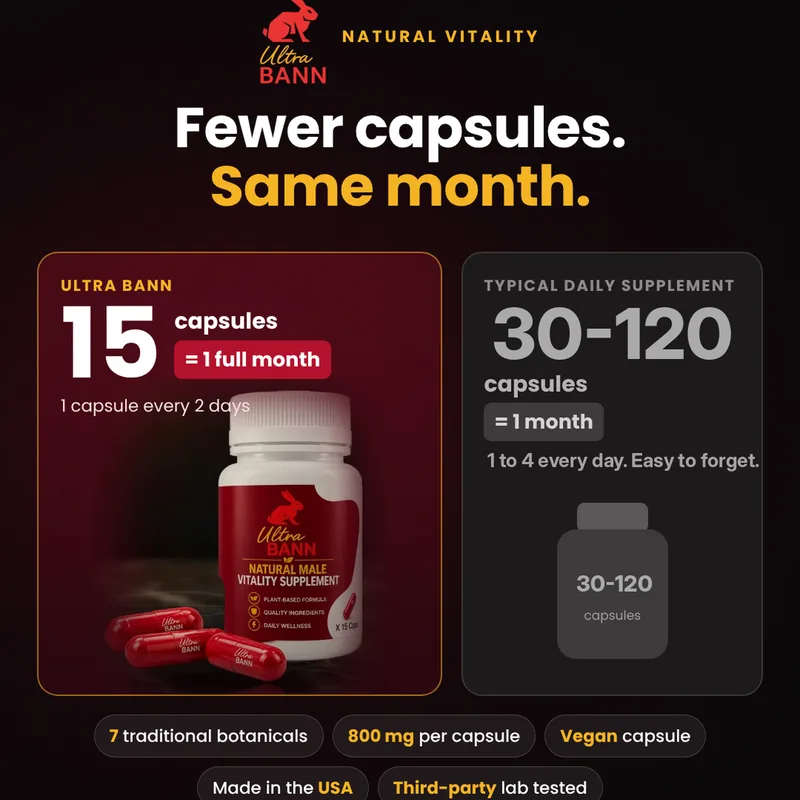
Ultra Bann is not a multivitamin or a prostate formula, so it does not replace B12, calcium or the other basics above. It is a natural male vitality supplement by DL Bioproducts for men who want an herbal formula with a simple routine: one capsule every 2 days. Each serving lists seven botanicals with exact amounts and no proprietary blend: Thai Butea superba 345 mg, Panax ginseng 110 mg, Cynomorium songaricum 85 mg, black ginger 85 mg, tongkat ali 85 mg, epimedium (horny goat weed) 45 mg and reishi 45 mg, 800 mg in total. If you take daily medicines, show the label to your doctor or pharmacist first. You can try Ultra Bann with free US shipping and a 60-day money-back guarantee on your first order.
Frequently Asked Questions
What vitamins should a 50 year old man take?
Start with the gaps common at this age: vitamin B12 from fortified foods or a supplement, calcium mostly from food with enough vitamin D, and fish oil if you rarely eat fish. Choose a 50+ multivitamin with little or no iron. A blood test is the best guide.
Does saw palmetto work for an enlarged prostate?
The best evidence says probably not. A 2023 review of 27 studies and two NIH-funded trials, including one at three times the usual dose, found little or no benefit over placebo for urinary symptoms. It is not a substitute for a medical evaluation.
Should men over 50 take vitamin E?
Not as a high-dose supplement. In the SELECT trial, 400 IU a day was followed by a 17 percent higher prostate cancer risk, and in the Physicians' Health Study II it did not prevent heart disease. Food and a standard multivitamin cover the 15 mg daily need.
Can I take fish oil with a blood thinner or a statin?
Only with your doctor's knowledge. High doses may prolong clotting time with warfarin, and prescription omega-3 labels call for periodic INR checks.
References
- NIH Office of Dietary Supplements. Vitamin B12: Fact Sheet for Health Professionals. ods.od.nih.gov/factsheets/VitaminB12-HealthProfessional
- NIH Office of Dietary Supplements. Multivitamin/mineral Supplements: Fact Sheet for Health Professionals. ods.od.nih.gov/factsheets/MVMS-HealthProfessional
- NIH Office of Dietary Supplements. Calcium: Fact Sheet for Health Professionals. ods.od.nih.gov/factsheets/Calcium-HealthProfessional
- NIH Office of Dietary Supplements. Omega-3 Fatty Acids: Fact Sheet for Health Professionals. ods.od.nih.gov/factsheets/Omega3FattyAcids-HealthProfessional
- National Center for Complementary and Integrative Health. Saw Palmetto. Updated April 2025. nccih.nih.gov/health/saw-palmetto
- NIH Office of Dietary Supplements. Vitamin E: Fact Sheet for Health Professionals. ods.od.nih.gov/factsheets/VitaminE-HealthProfessional
These statements have not been evaluated by the Food and Drug Administration. This product is not intended to diagnose, treat, cure or prevent any disease. This article is for information only and is not medical advice.
Ultra Bann natural male vitality support
1 capsule every 2 days. Free US shipping and a 60-day money-back guarantee on your first order.
See Ultra BannCes déclarations n’ont pas été évaluées par la Food and Drug Administration (FDA). Ce produit n’est pas destiné à diagnostiquer, traiter, guérir ou prévenir une maladie.