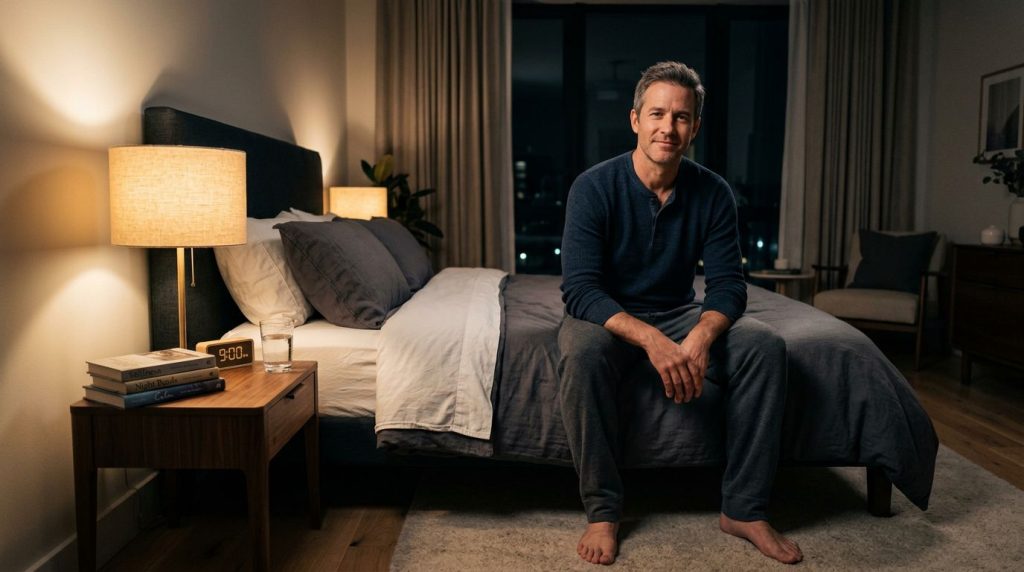
Short answer: You get more deep sleep mostly by protecting the first half of the night, because that is when the body packs in most of its slow-wave sleep. The evening levers with the best support are a fixed sleep schedule, no caffeine in the 6 hours before bed, little or no alcohol at night, dim and screen-free light for the last 2 to 3 hours, a warm shower or bath 1 to 2 hours before bed, and a cool, dark bedroom. None of these force deep sleep on demand, but together they remove the things that block it.
Key Takeaways
- Deep sleep is stage 3 of non-REM sleep (N3). Estimates of its share range from about 10% to 20% of the night (Sleep Foundation) to about 25% (Cleveland Clinic), and it shrinks with age.[1][2]
- The body tries to fit most deep sleep into the early part of the night, so whatever you do in the 3 to 6 hours before bed matters more than anything you do at 3 a.m.[1][2]
- In a 2013 lab study, 400 mg of caffeine taken 6 hours before bed cut total sleep by more than an hour, and the sleepers did not notice.[3]
- Alcohol makes you fall asleep faster and adds deep sleep early, then fragments the second half of the night, which cancels the early benefit.[4]
- A 10 minute warm shower or bath at 40 to 42.5 °C, taken 1 to 2 hours before bed, was linked to falling asleep faster in a 2019 meta-analysis.[5]
- A bedroom around 65 to 68 °F (about 18 to 20 °C), dark and quiet, supports the natural drop in core temperature that comes with sleep.[7]
What Deep Sleep Is and Why It Matters
Every night you cycle through light sleep (stages 1 and 2), deep sleep (stage 3) and REM sleep. A full cycle takes about 90 to 120 minutes, and most adults go through four or five of them.[2] During deep sleep, heart rate, breathing and brain waves reach their slowest point and the muscles are very relaxed.[1] Brain waves become slow but strong, which is why this stage is also called slow-wave sleep.
Cleveland Clinic describes deep sleep as the stage the body uses to repair injuries and strengthen the immune system, and notes that without enough of it you can feel drained even after a long night.[2] The Sleep Foundation lists possible roles in hormone regulation (including growth hormone), immune support, learning and memory, and clearing waste products from the fluid around the brain, while stressing that research on these roles is still ongoing.[1]
How much deep sleep do you need?
There is no official target. The Sleep Foundation states plainly that no guideline exists for how much deep sleep a person needs.[1] What is clear is the pattern: children get the most, the amount falls as people get older, and older adults usually get less deep sleep than middle-aged adults.[1][2] Fixing the habits known to interfere with it is more useful than chasing a wearable’s deep sleep score.
Why the evening is the key window
Deep sleep is front-loaded. Cleveland Clinic explains that the body tries to fit as much stage 3 sleep as possible into the early part of the sleep period, and the Sleep Foundation says most deep sleep happens in the first half of the night.[1][2] Caffeine still active, alcohol on board or a high core temperature at lights out all hit that first half, so the goal is to arrive at bedtime with nothing in the way.
The Evening Timeline for More Deep Sleep
Here is a timeline built from the sources below. Count backward from your target bedtime and keep the same bedtime every night, weekends included, which both Cleveland Clinic and the Sleep Foundation list as a core habit.[1][2]
| Time before bed | What to do | Why it helps | Source |
|---|---|---|---|
| 6 hours or more | Last caffeine (coffee, energy drinks, pre-workout, strong tea) | 400 mg of caffeine 6 hours before bed reduced total sleep by more than 1 hour in a lab study | [3] |
| 3 hours or more | Finish dinner; keep it moderate in size. Skip alcohol or keep it small and early | Large meals and alcohol close to bedtime are on the “avoid” list; alcohol disrupts the second half of the night | [2] [4] |
| 2 to 3 hours | Turn off bright screens; switch to warm, dim lamps (dim red for night lights) | Blue light suppressed melatonin about twice as long as green light and shifted circadian rhythm by about 3 hours | [6] |
| 1 to 2 hours | Warm shower or bath, at least 10 minutes, water at 40 to 42.5 °C (about 104 to 109 °F) | Linked to faster sleep onset and better self-rated sleep quality | [5] |
| 1 hour | Quiet routine: reading, slow breathing, light stretching; limit drinks to reduce night bathroom trips | Lowers stress, which is linked to lighter sleep; fewer wake-ups | [1] [2] |
| Lights out | Bedroom at about 65 to 68 °F (18 to 20 °C), dark and quiet | Supports the natural drop in core temperature; higher core temperature is associated with less slow-wave sleep | [1] [7] |
If your bedtime is 10:30 p.m., that means coffee stops by about 4:30 p.m., dinner ends by 7:30 p.m., screens go off between 7:30 and 8:30 p.m., and the shower lands between 8:30 and 9:30 p.m. Adjust the clock, not the gaps.
What the Evidence Shows for Each Step
Caffeine: the 6 hour rule
In the 2013 study published in the Journal of Clinical Sleep Medicine, researchers from Henry Ford Hospital and Wayne State University gave 12 healthy sleepers 400 mg of caffeine (roughly 2 to 3 cups of coffee) at bedtime, 3 hours before bed, or 6 hours before bed. Even at 6 hours, measured sleep time dropped by more than one hour, and participants did not report the disruption themselves.[3] The researchers suggested avoiding caffeine after 5 p.m. It was a small study, so treat 6 hours as a minimum. Pre-workout powders and energy drinks count too. For how caffeine affects energy and drive more broadly, see our guide on how much caffeine is too much.
Alcohol: deeper early, worse later
Alcohol is the most misunderstood item on the list. A 2013 review in Alcoholism: Clinical & Experimental Research screened 153 studies and kept 20 that met its quality criteria and studied healthy sleepers. At all doses, alcohol shortened the time to fall asleep, and most studies found it increased slow-wave sleep in the first half of the night. But in the second half it increased sleep disruption, which offsets the early benefit, and at moderate and high doses total REM sleep fell.[4] In plain terms: a nightcap may feel like it deepens sleep, but the full night is worse. If you drink, keep it small and finish it well before bed. Our article on how much alcohol is too much covers the bigger picture. If you drink heavily, talk to a doctor before cutting back, since alcohol withdrawal can be dangerous.[1]
Dinner timing
Cleveland Clinic advises avoiding large meals close to bedtime and choosing a light snack if you are hungry.[2] There is no proven cutoff, but finishing dinner about 3 hours before bed is a simple rule. Limiting fluids in the final hour also reduces bathroom trips that break up sleep.[2]
Light and screens
Light is the main signal your internal clock uses. In a Harvard experiment, 6.5 hours of blue light suppressed melatonin about twice as long as green light of similar brightness and shifted circadian rhythm by about 3 hours, compared with 1.5 hours for green.[6] Harvard Health recommends stopping bright screens 2 to 3 hours before bed, using dim red night lights, and getting plenty of bright light during the day.[6]
The warm shower paradox
Heating your body to cool it down sounds backward, but it fits the physiology. Core temperature starts falling about two hours before bedtime as melatonin rises, and the body sheds heat by widening blood vessels in the hands and feet.[7] A warm shower or bath pulls blood to the skin and speeds that heat loss after you step out. A 2019 systematic review and meta-analysis in Sleep Medicine Reviews (17 studies included, 13 pooled) found that bathing at 40 to 42.5 °C, scheduled 1 to 2 hours before bed and lasting as little as 10 minutes, was associated with falling asleep faster and better self-rated sleep quality.[5] The authors noted the evidence base is small and that the ideal timing and duration are still unclear.
Bedroom temperature
The Sleep Foundation suggests 65 to 68 °F, with about 65 °F (18.3 °C) as a good starting point.[7] It also notes that a higher core body temperature is associated with less restorative slow-wave sleep.[7] Use breathable bedding, blackout curtains and earplugs or a sound machine if your room is bright or noisy.[1]
Stress and the last hour
Stress is tied to lighter sleep. The Sleep Foundation cites research showing that stress reduces sleep depth and recommends relaxation exercises, deep breathing, yoga or meditation, plus avoiding stressful topics right before bed.[1] Try writing down tomorrow’s top three tasks, then 5 minutes of slow breathing. Cleveland Clinic adds that if you are not sleepy at bedtime, a calm activity like reading beats lying in bed forcing it.[2]
Daytime Habits That Set Up the Night
The evening routine works best on top of a few daytime basics:
- Same wake time every day. A fixed wake time is what makes a fixed bedtime possible.[1][2]
- Daytime activity. Cleveland Clinic notes that physical activity during the day, even a walk, can improve sleep quality.[2]
- Bright light early. Daytime light improves nighttime sleep, alertness and mood.[6]
- Bedroom for sleep and intimacy only. Keep work, news and email out.[2]
- Healthy weight. Excess weight raises the risk of obstructive sleep apnea, which breaks up deep sleep.[2]
For a broader bedtime plan, our guide on how to sleep better covers schedules, naps and bedroom setup in more detail.
When Poor Deep Sleep Needs a Doctor
A good routine cannot fix a sleep disorder. See a clinician if you snore loudly, someone notices pauses in your breathing, you wake up gasping, you feel sleepy while driving, or you still feel unrested after several weeks of solid habits. These can point to obstructive sleep apnea, insomnia or another condition that needs testing. Our article on sleep apnea and testosterone explains warning signs. The Sleep Foundation links long-term sleep loss to heart conditions, high blood pressure, stroke, obesity and type 2 diabetes, so persistent problems are worth taking seriously.[1] Cleveland Clinic also advises against relying on sleep medications long term, including over-the-counter ones.[2]
Where Supplements Fit (and Where Ultra Bann Does Not)
No supplement replaces the timeline above. If you take any supplement, check whether its ingredients are stimulating and think about timing. Ultra Bann, a natural male vitality supplement by DL Bioproducts, is not a sleep product and should not be used as one. It contains seven botanicals per capsule with amounts listed on the label (Thai Butea superba, Panax ginseng, Cynomorium songaricum, black ginger, tongkat ali, epimedium and reishi), and it is taken as one capsule every 2 days. One of those ingredients, Panax (Asian) ginseng, deserves a sleep note: the NIH National Center for Complementary and Integrative Health lists insomnia as its most common side effect.[8] If you take Ultra Bann and notice lighter or broken sleep, take it in the morning rather than the evening, and talk to your doctor if sleep problems continue. You can review the full label on our ingredients page or see the product on the shop page.
Frequently Asked Questions
What is the fastest way to get more deep sleep?
Remove the blockers first: no caffeine within 6 hours of bed, little or no alcohol in the evening, screens off 2 to 3 hours before bed, and a cool, dark room. A warm shower 1 to 2 hours before bed is a simple addition with meta-analysis support for falling asleep faster.[3][4][5][6]
How much deep sleep is normal?
There is no official target. Estimates range from about 10% to 20% of the night to about 25%, depending on the source, and the share declines with age.[1][2] Consumer wearables estimate sleep stages and can be off, so judge by how rested you feel.
Does alcohol help you get deep sleep?
It adds slow-wave sleep early in the night but increases disruption in the second half and lowers REM sleep at moderate and high doses, so overall sleep gets worse.[4]
What time should you stop drinking coffee?
At least 6 hours before bed. In the 2013 study, caffeine taken 6 hours before bedtime still cut total sleep by more than an hour.[3] For a 10:30 p.m. bedtime, that means no caffeine after about 4:30 p.m.
Why do I get less deep sleep as I get older?
The amount of deep sleep naturally falls with age, and older adults usually get less than middle-aged adults.[1][2] You cannot fully reverse that, but you can avoid the habits that cut it further and rule out sleep disorders with a doctor.
References
- Rausch-Phung E, reviewed by Singh A. How to Get More Deep Sleep. Sleep Foundation. Updated July 29, 2025.
- Cleveland Clinic. Sleep: What It Is, Why It’s Important, Stages, REM and NREM. Updated June 19, 2023.
- American Academy of Sleep Medicine. Late afternoon and early evening caffeine can disrupt sleep. SleepEducation.org, summarizing Drake C, et al. Journal of Clinical Sleep Medicine, 2013.
- ScienceDaily. Reviewing alcohol’s effects on normal sleep. January 2013, summarizing Ebrahim I, Shapiro CM, Williams AJ, Fenwick PB, Idzikowski C. Alcohol and Sleep I: Effects on Normal Sleep. Alcoholism: Clinical & Experimental Research, 2013.
- Haghayegh S, Khoshnevis S, Smolensky MH, Diller KR, Castriotta RJ. Before-bedtime passive body heating by warm shower or bath to improve sleep: A systematic review and meta-analysis. Sleep Medicine Reviews. 2019;46:124-135.
- Harvard Health Publishing. Blue light has a dark side. Updated July 24, 2024.
- Pacheco D, reviewed by Rosen D. Best Temperature for Sleep. Sleep Foundation. Updated July 11, 2025.
- National Center for Complementary and Integrative Health. Asian Ginseng. NIH.
These statements have not been evaluated by the Food and Drug Administration. This product is not intended to diagnose, treat, cure or prevent any disease. This article is for information only and is not medical advice.
Ultra Bann natural male vitality support
1 capsule every 2 days. Free US shipping and a 60-day money-back guarantee on your first order.
See Ultra BannThese statements have not been evaluated by the Food and Drug Administration. This product is not intended to diagnose, treat, cure, or prevent any disease.